
Podhoc
Podhoc turns PDFs, videos, articles, URLs and text into podcast-style audio episodes.
What Podhoc is
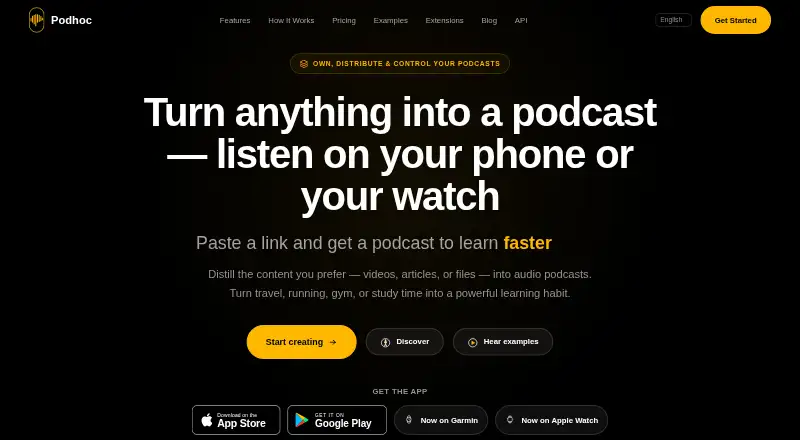
Podhoc turns PDFs, videos, articles, URLs and text into podcast-style audio episodes. Users can choose among nine audio styles, including Deep Dive, Critique, Didactic, Debate and Feynman Technique, and configure episodes from five minutes to hour-long deep dives. Creator and Pro plans support 73 output languages. Inputs include YouTube URLs, web articles, Wikipedia, pasted text and, on Creator or Pro, PDF, DOCX, DOC and TXT files. The service extracts YouTube transcripts, offers a Telegram bot and Pro REST API, and lists Chrome and Firefox extensions for saving webpage links. Native Android and iOS apps are available, and episodes can sync to Garmin and Apple Watch for listening away from a phone. Uploaded source files remain private, but generated episodes are public in Discover by default unless Creator or Pro users disable auto-publishing. The free plan includes 50 welcome credits, one source per podcast and two supported languages. Creator costs €20.99 a month, while a 2,000-credit pack costs 44.99 EUR once.
Good
- Offers nine built-in audio styles.
- Creator and Pro support 73 output languages.
- Accepts YouTube, web, Wikipedia and text sources.
- Native Android and iOS apps are available.
- Credit packs never expire.
Watch out
- Free plan supports only two languages.
- Free episodes are public by default.
- REST API does not accept file uploads or raw text.
- Chrome extension is desktop-only.
Who it suits
It suits students, researchers and knowledge workers who want written or video sources converted into audio. Developers can also use the Pro REST API, which accepts publicly accessible URLs.
Verdict
Podhoc offers multiple source types, audio formats and language options, with mobile apps and integrations for saving or listening to episodes. Review the publication defaults and plan limits if privacy or broader source capacity is important.
Plans and prices
From Podhoc's own pricing page, checked 15 Oct 2026.
| Plan | Price | What it gives you |
|---|---|---|
| Free | Free | 50 welcome credits · 1 source · 2 languages · pasted text · no API · public Discover publishing |
| 100-credit pack | €2.29, paid once | 100 credits · credits never expire · €2.29 one-time |
| 200-credit pack | €4.49, paid once | 200 credits · credits never expire · €4.49 one-time |
| 500-credit pack | €11.49, paid once | 500 credits · credits never expire · €11.49 one-time |
| Creator | €20.99 a month | 1,000 credits/month · 2 sources · 73 languages · PDF/DOCX/DOC/TXT uploads · 2 voices · read-along · no API · €20.99 /month |
| Creator monthly | €20.99 a month | 1,000 credits/month · up to 2 sources per podcast · 73 languages · file uploads · 2 voices · read-along · €20.99 / month |
| 1,000-credit pack | €22.99, paid once | 1,000 credits · about ten 30-minute podcasts · best-rate anchor · €22.99 one-time |
| Credit pack | €44.99, paid once | 2,000 credits · 20 listed 30-minute podcasts · credits never expire · €44.99 |
| Pro | €72.99 a month | 3,500 credits/month · up to 50 sources · 73 languages · 3 voices · source weighting · priority processing · API access · read-along · €72.99 /month |
| Pro monthly | €72.99 a month | 3,500 credits/month · up to 50 sources per podcast · 73 languages · 3 voices · source weighting · priority processing · credit rollover · REST API · €72.99 / month |
| Creator yearly | €230.99 a year | 12,000 credits/year · monthly credit refills · Creator features · about one month discount · €230.99 /year |
| Pro yearly | €802.99 a year | 42,000 credits/year · monthly credit refills · Pro features · about one month discount · €802.99 /year |
The facts
Each one read from Podhoc's own pages, with the date it was checked.
What it does
- AI data use
- Podhoc says submitted content is sent to AI processing providers for generation and is not used to train external models.checked 15 Oct 2026
- API authentication
- API calls use an X-Api-Key token against https://api-ext.podhoc.com/v1, with separate test and production tokens.checked 15 Oct 2026
- API availability
- A REST API is available only to Pro users for creating, monitoring and downloading podcasts.checked 15 Oct 2026
- API limitation
- The REST API accepts publicly accessible URLs and does not currently support file uploads or raw text input.checked 30 Sep 2026
- API limits
- The API accepts publicly accessible URLs but does not currently accept file uploads or raw text.checked 15 Oct 2026
- API SDKs
- The API documentation provides HTTP examples and endpoint details but does not identify an official SDK package.checked 15 Oct 2026
- Audience
- The maker describes use by researchers, students, knowledge workers, and developers integrating the REST API into learning and content systems.checked 30 Sep 2026
- Audio styles
- The service offers nine built-in styles, with five available on Free and all nine on paid plans.checked 15 Oct 2026
- Content sources
- Supported inputs include YouTube URLs, web articles, Wikipedia, pasted text, and Creator or Pro file uploads such as PDF, DOCX, DOC, and TXT.checked 30 Sep 2026
- Custom duration
- Users can target episodes from roughly five minutes up to two hours.checked 15 Oct 2026
- Data handling
- The maker says user data is hosted in the EU (Frankfurt), is not used to train external AI models, and the operator works under EU privacy regulations.checked 30 Sep 2026
- Documentation
- Public documentation covers authentication, endpoints, parameters, styles, errors, examples and rate limiting.checked 15 Oct 2026
- Duration and languages
- Episodes can be configured from 5 minutes to hour-long deep dives, and Creator and Pro support 73 output languages.checked 30 Sep 2026
- Firefox extension licence
- The Firefox listing marks the extension licence as All Rights Reserved.checked 15 Oct 2026
- Firefox extension permissions
- The extension requests tab access and access to Podhoc, its app/API domains and Google Analytics, while the developer says it collects no required data.checked 15 Oct 2026
Money
- Apple in-app prices
- The US App Store lists Pro at $79.99 monthly or $999 yearly, Creator at $24.99 monthly or $249.99 yearly, and credit packs from $2.99.checked 15 Oct 2026
- Billing
- Credit packs are one-time purchases whose credits never expire, and the maker says subscriptions can be upgraded, downgraded, or canceled anytime.checked 30 Sep 2026
Where it runs
- Apple system requirements
- The iOS app requires iOS 15.1 or later; Mac use requires macOS 12 and an Apple M1-or-newer Mac.checked 15 Oct 2026
- Browser extensions
- Chrome and Firefox extensions save webpage URLs to a Podhoc wishlist for later generation.checked 15 Oct 2026
- Browser support
- The Chrome extension is desktop-only and the Firefox listing supports desktop Firefox 142 or later; Safari extension support is marked coming soon.checked 30 Sep 2026
The company
- Company founded
- Nexo Apex SL was founded in 2024 by David Pelayo.checked 15 Oct 2026
- Company headquarters
- The operator’s registered address is in El Vendrell, Tarragona, Spain.checked 15 Oct 2026
- Company legal name
- Podhoc is operated by Nexo Apex SL, a Spanish company.checked 15 Oct 2026
- Company size
- The App Store description characterizes Podhoc as made by a small team in Spain.checked 15 Oct 2026
The full review of Podhoc
Podhoc turns PDFs, videos, articles, URLs and text into podcast-style episodes, with controls for format, length and language. It suits people who want to listen to source material rather than read it, especially learners and researchers working across different kinds of content. Its broad input options and mobile apps are appealing, but the free plan is narrow and paid plans become costly if you need larger source bundles or API access.
Overview
Podhoc converts source material into audio using nine built-in styles, including Deep Dive, Critique, Debate and the Feynman Technique. Episodes can run from five minutes to as long as 120 minutes, so it can serve both quick recaps and longer explorations. The central trade-off is that listening is flexible, while meaningful control over language, uploads and the number of sources depends on a paid plan.
Key features
Turn varied sources into audio
You can start with YouTube URLs, web articles, Wikipedia pages or pasted text. Creator and Pro add PDF, DOCX, DOC and TXT uploads. That range makes Podhoc more useful for turning existing reading or video material into listening than for someone seeking a general-purpose podcast player.
Control the episode
Nine styles provide different ways to approach material, from a deep dive to a debate or critique. Creator and Pro support 73 output languages, compared with two on Free. Paid plans also raise the per-podcast source limit from one to two on Creator or as many as 50 on Pro. That makes Creator a reasonable step for multilingual listening and small source combinations; Pro is the tier for bringing together substantially more material.
Save and listen across devices
Podhoc extracts YouTube transcripts and offers a Telegram bot, Chrome and Firefox extensions for saving webpage links, and a REST API on Pro. The API accepts publicly accessible URLs, not file uploads or raw text, so developers who need those inputs will have to use another route. Native iOS and Android apps are available, and Podhoc says episodes can sync to Garmin and Apple Watch for phone-free listening. The Chrome extension is desktop-only; Firefox requires desktop Firefox 142 or later, while Safari support is coming soon.
Privacy choices
Uploaded files remain private, but generated episodes are public in Discover by default. Creator and Pro can disable automatic publishing, a meaningful distinction for anyone converting material they do not want shared. The maker says data is hosted in Frankfurt, is not used to train external AI models, and is handled under EU privacy regulations.
Pricing
Podhoc is freemium. Free includes 50 welcome credits, one source per podcast, two supported languages, and pasted text or supported URLs; episodes are public by default. It is a useful way to try the workflow, but it does not include file uploads or the language breadth of the paid plans.
| Plan | Price | What it includes |
|---|---|---|
| Creator monthly | €20.99 per month | 1,000 credits per month, up to two sources per podcast, 73 languages, file uploads, two voices and read-along. |
| Creator yearly | €230.99 per year | 12,000 credits per year, with the same two-source limit, 73 languages, file uploads, two voices and read-along. |
| Credit pack | €44.99 once | 2,000 credits, described as 20 listed 30-minute podcasts; credits never expire. |
| Pro monthly | €72.99 per month | 3,500 credits per month, up to 50 sources per podcast, 73 languages, three voices, source weighting, priority processing, credit rollover and REST API. |
| Pro yearly | €802.99 per year | 42,000 credits per year, with the same 50-source limit, three voices, source weighting, priority processing, credit rollover and REST API. |
Creator suits regular listeners who need uploads, read-along or more languages without Pro’s larger source capacity. Pro is aimed at heavy or technical use: its 50-source ceiling, weighting and API are substantial extras, but its price is a steep jump. The one-time credit pack fits occasional use better than a subscription, though it does not add the Creator or Pro features. Subscriptions can be upgraded, downgraded or canceled anytime; credit packs never expire.
Platforms
Podhoc is available on the web, Android and iOS, with browser extensions for desktop Chrome and Firefox. Its watch syncing is aimed at listening away from a phone. Safari extension support is coming soon rather than currently available.
Who it's for
Researchers, students and knowledge workers can use Podhoc to turn source material into listenable episodes, with Creator suited to varied inputs and languages. Developers may value the Pro REST API for learning or content systems, provided public URLs are enough for their workflow. It is a weaker fit for users who need private-by-default episodes on Free, broad source capacity without a high monthly cost, or API ingestion of files and raw text.
Pros and cons
Pros
- Accepts video, articles, Wikipedia, text and, on paid plans, several document formats, making it practical for converting existing material.
- Style, length and language options support different listening goals, with episodes up to 120 minutes and 73 languages on Creator and Pro.
- Native mobile apps and stated Garmin and Apple Watch syncing support listening away from a computer or phone.
- One-time credits do not expire, giving occasional users an option without an ongoing subscription.
Cons
- Free limits podcasts to one source and two languages, and publishes generated episodes publicly by default.
- Creator remains capped at two sources per podcast; combining many sources requires the much pricier Pro tier.
- The Pro API only accepts publicly accessible URLs, excluding file uploads and raw text.
- Browser support is limited to desktop Chrome and Firefox for now, with Safari still forthcoming.
Alternatives
AI Podcast Generators is the broader category to compare before choosing a tool. Choose 302 AI Podcast Generator if you want a free basic tool across Linux, macOS, Windows and web. AnyPod is the better fit for free podcast listening, with a full catalog, offline listening and speed control across Android, iOS and web.
ListenHub may suit a web or API workflow centered on generating podcasts, videos and images; its Starter plan is $8.34 per year, billed $100/year, with 1,200 credits per month. VocalVia is a web alternative with a free workflow preview and paid plans from $12.00 per month. Wondercraft offers web and API access, with a free plan and a $25.00-per-month Creator plan. Jellypod is a web option if free hosting and a dedicated podcast website matter; its Starter plan is $25.00 per month, billed yearly. Podycy is another freemium option for web, iOS and Android. Tider is a freemium alternative for macOS, Linux and iOS.
Verdict
Podhoc is a strong choice for people who want to turn varied source material into configurable audio and listen on mobile or a watch. Creator is the sensible tier for uploads and multilingual use; choose Pro only if its broad source bundles, API and advanced controls justify the higher price. Look elsewhere if you need a generous free plan, private-by-default publishing without a paid upgrade, or API support for files and raw text.
Getting started
- Visit https://podhoc.com/.
- Use the Free plan's 50 welcome credits to start with pasted text or a supported URL.
- Choose an audio style and configure episode duration.
- Use the Android or iOS app, web service, or supported browser extension.
- Choose Creator or Pro for file uploads and 73 output languages.
Limits worth knowing
The Free plan includes 50 welcome credits, one source per podcast, and two supported languages; episodes are public by default. The listed Creator monthly plan is €20.99 per month and supports up to two sources per podcast, while Pro monthly is €72.99 per month and supports up to 50.
Questions
Is Podhoc free?
Yes. The Free plan costs nothing and includes 50 welcome credits.
What does the free plan allow?
It supports one source per podcast, two languages, and pasted text or supported URLs. Episodes are public by default.
Which platforms are available?
Podhoc has web, Android, and iOS access, plus Chrome and Firefox extensions. Chrome is desktop-only, and the Firefox listing supports desktop Firefox 142 or later.
How much do paid plans cost?
Creator monthly costs €20.99 per month, Pro monthly costs €72.99 per month, and a credit pack costs €44.99 once. Creator and Pro yearly plans are also available at €230.99 and €802.99 per year, respectively.
Does Podhoc offer an API?
The Pro REST API accepts publicly accessible URLs. It does not support file uploads or raw text input.
Who makes Podhoc?
The listed headquarters are in El Vendrell, Tarragona, Spain; a maker name is not provided.