Podframes
Podframes is an open-source tool that turns a topic into a two-host video podcast with AI avatars.
What Podframes is
Podframes is an open-source tool that turns a topic into a two-host video podcast with AI avatars. It generates a script, produces and mixes speech, animates the hosts, adds B-roll and captions, and renders an MP4. You can run it from a command-line interface or use its local web studio. Each host can have a separate text-to-speech provider, with Speechbase mixing audio and aligning it to word-level timestamps.
P-Video Avatar through Replicate is the default lip-sync video provider; LTX-2.3 through fal.ai is another option. The studio offers eight caption styles and can export word-timed SRT and VTT captions. It also supports Minimal, Editorial, and Cinematic visual treatments, and can regenerate selected lines or clips while showing an estimated cost before animation. Podframes runs locally, reads service API keys from a local environment file, and stores project files on disk. Setup requires Node.js 22 or later, pnpm, ffmpeg, and keys for the services used. The local web app has no authentication layer, and its README warns against public deployment as-is. It is licensed under Apache-2.0 and credited to Jellypod, Inc.
Good
- Creates two-host video podcasts from a topic.
- Includes command-line and local web interfaces.
- Offers eight caption styles and timed caption exports.
- Shows estimated cost before animation.
- Can regenerate selected lines or clips.
Watch out
- Requires Node.js 22 or later, pnpm, and ffmpeg.
- Requires API keys for services used.
- Local web app has no authentication layer.
- README warns against public deployment as-is.
Who it suits
Podframes may suit users who want to generate avatar-hosted video podcasts and are comfortable setting up local software and service API keys. It is not suited to public deployment as-is because the local web app has no authentication layer.
Verdict
Podframes provides a local workflow for scripting, voicing, animating, and captioning a two-host video podcast. Plan for the listed setup requirements and do not expose its unauthenticated web studio publicly as-is.
The facts
Each one read from Podframes's own pages, with the date it was checked.
What it does
- Captions
- The studio offers eight caption styles and can export word-timed SRT and VTT captions.checked 4 Oct 2026
- Deployment limitation
- The web studio proxies API keys from a local .env.local file and reads and writes project files on disk; the README says it has no authentication layer and should not be deployed publicly as-is.checked 9 Oct 2026
- Editing
- The studio can regenerate selected lines or clips and displays a cost estimate before animation runs.checked 4 Oct 2026
- Editing and captions
- The studio offers eight caption styles and lets users choose an avatar image for each host independently of the voice.checked 9 Oct 2026
- Interfaces
- The project includes a command-line runner and a local web studio.checked 4 Oct 2026
- License
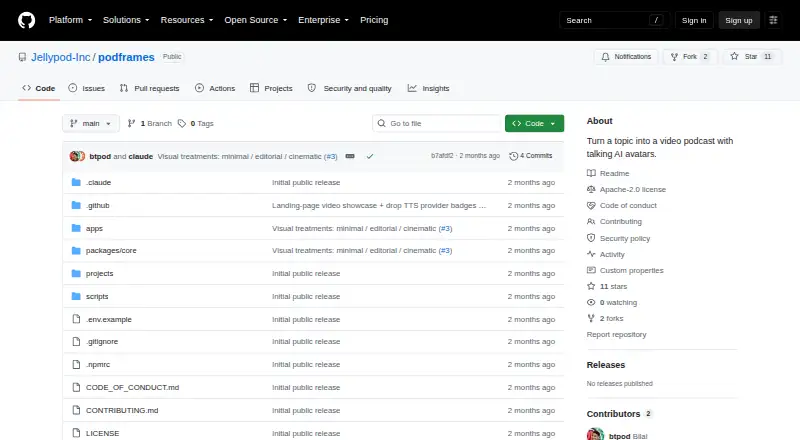
- The public repository is licensed under Apache-2.0.checked 9 Oct 2026
- Local operation
- The README describes Podframes as a local tool that uses API keys supplied in a local environment file and stores project files on disk.checked 4 Oct 2026
- Local setup
- Running from source requires Node.js 22 or newer, pnpm, ffmpeg, and API keys for the services used.checked 9 Oct 2026
- Purpose
- Podframes turns a topic into a two-host video podcast with AI avatars, mixed voices, lip-synced clips, and timed captions.checked 9 Oct 2026
- Requirements
- The quickstart lists Node.js 22 or later, pnpm, ffmpeg, and API keys for the services used.checked 4 Oct 2026
- Security limitation
- The local web app has no authentication layer, and the README warns against deploying it publicly as-is.checked 4 Oct 2026
- Security reporting
- The security policy asks users to report vulnerabilities by email and not through a public GitHub issue.checked 9 Oct 2026
- Speech providers
- Each host can use a different text-to-speech provider, including Google, ElevenLabs, OpenAI, and Cartesia, routed through Speechbase.checked 9 Oct 2026
- Video providers
- The default video provider is P-Video Avatar through Replicate, with LTX-2.3 through fal.ai as an alternative.checked 9 Oct 2026
- Visual treatments
- The composition offers Minimal, Editorial, and Cinematic treatments.checked 4 Oct 2026
- Voice providers
- Each host can use a different text-to-speech provider, with the audio mixed and aligned to word-level timestamps through Speechbase.checked 4 Oct 2026
- Ways to use it
- Podframes can be run through a command-line interface or a local web studio.checked 9 Oct 2026
- Workflow
- Its pipeline writes a script with Gemini, creates speech through Speechbase, animates host avatars, adds optional B-roll, and renders a captioned MP4.checked 9 Oct 2026
Money
- Costs
- The README says Speechbase's free tier covers demos and gives approximate image and video API costs; it does not list Podframes subscription plans.checked 4 Oct 2026
- Cost visibility
- The studio displays an estimated cost before video generation and can regenerate only the edited lines or selected clips.checked 9 Oct 2026
The company
- Maker
- The repository credits Jellypod, Inc. as the maker; the Podframes pages opened did not state its headquarters or founding year.checked 9 Oct 2026