PassWeb
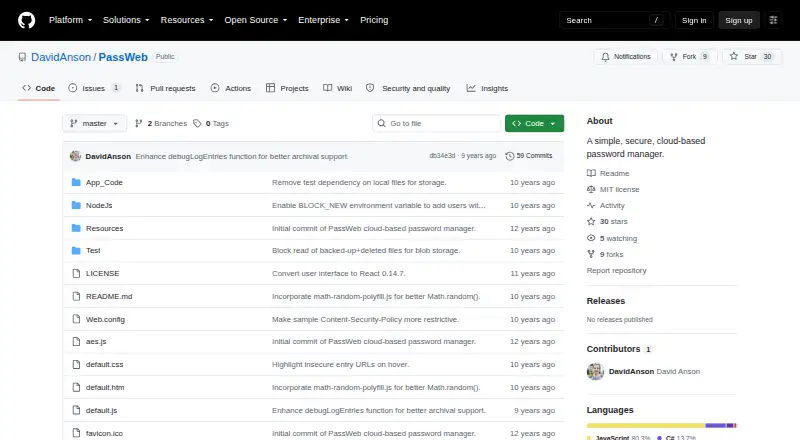
The facts below are what the maker publishes about PassWeb, checked and dated. Our editors have not written about it yet.
The facts
Each one read from PassWeb's own pages, with the date it was checked.
What it does
- Account recovery limit
- The README says forgetting the master password means the encrypted data is irretrievably lost because there are no backdoors or secondary passwords.checked 8 Oct 2026
- Account setup
- The README says users must contact the administrator to request an account, which is created with a temporary password.checked 8 Oct 2026
- Client-side privacy
- The README says data is decrypted only on the client and unencrypted data never leaves the machine.checked 8 Oct 2026
- Encryption
- The account data file is encrypted with 256-bit AES in CBC mode, and the README says the encryption key uses PBKDF2 with SHA-512 and 1,000 iterations.checked 8 Oct 2026
- Hosting
- The client can be hosted on any web server or file server, and the storage API has ASP.NET and Node.js implementations.checked 8 Oct 2026
- Intended use
- The author says PassWeb was intended to be safe for normal use in low-risk environments and advises users to evaluate it for their own needs and risks.checked 8 Oct 2026
- Local encryption
- Account data is decrypted only on the client; the server does not see the username, password, or unencrypted data.checked 8 Oct 2026
- Offline use
- Users can cache encrypted passwords for offline access, and changes synchronize with the server when PassWeb is used online.checked 8 Oct 2026
- Password tools
- Users can generate random complex passwords, copy or select stored names and passwords, and keep additional information in notes.checked 8 Oct 2026
- Purpose
- PassWeb is an online/offline web application for securely managing passwords.checked 8 Oct 2026
- Recovery limit
- The README says forgotten master-password data is irretrievably lost because there are no backdoors or secondary passwords.checked 8 Oct 2026
- Security guidance
- The author recommends HTTPS for both the storage API and client files, and warns users to avoid entering their master password on untrusted devices.checked 8 Oct 2026
- Server implementations
- The storage REST API implementations are provided for ASP.NET and Node.js.checked 8 Oct 2026
- Session protection
- PassWeb logs users out after three minutes of inactivity and re-masks revealed names and passwords after ten seconds.checked 8 Oct 2026
- Storage
- It stores encrypted password data in the cloud so it can be accessed from anywhere.checked 8 Oct 2026
- Storage options
- The Node.js implementation supports storing data as blobs in Microsoft Azure.checked 8 Oct 2026
- Support
- The author asks users to report problems and says browser issues should be emailed with detailed reproduction steps.checked 8 Oct 2026
Where it runs
- Browser support
- The README says PassWeb works on modern browsers, including recent Internet Explorer, Chrome, Firefox, and Safari releases.checked 8 Oct 2026
- Supported platforms
- webchecked 20 Sep 2026
Alternatives to PassWeb
- 1

Proton Pass
Free planOpen sourceAndroidiOSWebAPI9.4From $35.88 a year - 2

Padloc
Free planOpen sourceAndroidiOSWebExtension9.1From $3.49 a month - 3

NordPass
Free planAndroidiOSWebAPI9.0Free plan - 4

Zoho Vault
Free planAndroidiOSWebAPI8.9Free plan - 5
LogMeOnce
Free planAndroidiOSWebAPI8.8From $2.50 a month - 6

1Password
AndroidiOSWebAPI8.7From $2.99 a month