partycls
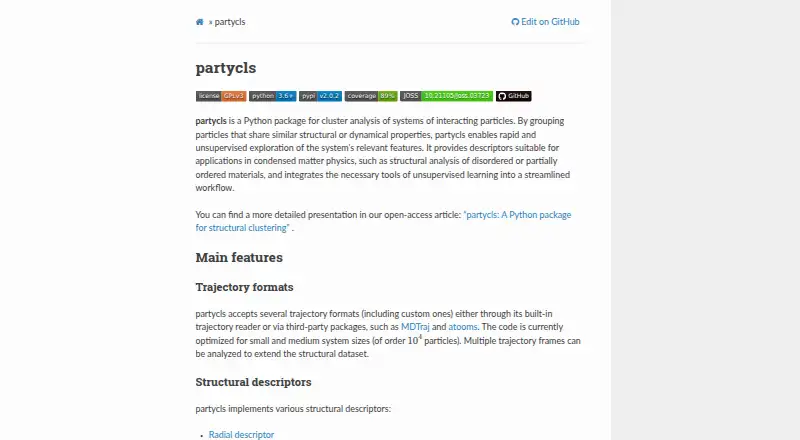
The facts below are what the maker publishes about partycls, checked and dated. Our editors have not written about it yet.
The facts
Each one read from partycls's own pages, with the date it was checked.
What it does
- Additional descriptors
- partycls supports additional structural descriptors through DScribe.checked 12 Oct 2026
- Data import formats
- XYZ, LAMMPS dumpchecked 23 Sep 2026
- Dependencies
- The required dependencies listed are a Fortran compiler, NumPy, and scikit-learn.checked 12 Oct 2026
- Deployment
- desktopchecked 23 Sep 2026
- Descriptors
- Built-in structural descriptors include radial, tetrahedral, bond-angle, bond-orientational, compactness, and coordination descriptors.checked 12 Oct 2026
- Documentation
- The project provides tutorials, detailed examples, and API documentation.checked 12 Oct 2026
- Documentation and support
- The documentation provides Jupyter notebook tutorials, detailed examples, and an API reference.checked 12 Oct 2026
- Installation
- The latest stable release can be installed from PyPI with pip install partycls.checked 12 Oct 2026
- Integrations
- The documentation names MDTraj and atooms as third-party packages for reading additional trajectory formats.checked 12 Oct 2026
- License
- The project repository identifies its license as GPL-3.0.checked 12 Oct 2026
- Operating systems
- The installation documentation says partycls currently supports Unix-based systems.checked 12 Oct 2026
- Purpose
- partycls is a Python package for clustering systems of interacting particles by similar structural or dynamical properties.checked 12 Oct 2026
- Python versions
- The installation documentation says the package is compatible with Python 3.6 and higher and lists testing on versions 3.6 through 3.9.checked 12 Oct 2026
- Scale limit
- The code is optimized for small and medium systems of around 10⁴ particles.checked 12 Oct 2026
- Scientific citation
- The project asks users citing partycls in scientific publications to consider citing its 2021 Journal of Open Source Software article.checked 12 Oct 2026
- Scripting support
- Yeschecked 23 Sep 2026
- Structural features
- Built-in descriptors include radial, tetrahedral, bond-angle, bond-orientational, compactness, and coordination descriptors.checked 12 Oct 2026
- Support
- The project invites users to report issues by email or through its repository issue tracker.checked 12 Oct 2026
- System size
- The package is currently optimized for small and medium systems of about 10^4 particles.checked 12 Oct 2026
- Trajectory formats
- It reads several trajectory formats, including custom formats, through its built-in reader or third-party packages.checked 12 Oct 2026
- Trajectory input
- It reads several trajectory formats, including custom formats, through its built-in reader or packages such as MDTraj and atooms.checked 12 Oct 2026
Money
- Free plan
- Yeschecked 23 Sep 2026
Where it runs
- Machine learning
- It performs feature scaling, dimensionality reduction, and cluster analysis using scikit-learn and additional built-in algorithms.checked 12 Oct 2026
The company
- Maker
- The documentation copyright credits Joris Paret.checked 12 Oct 2026