partition
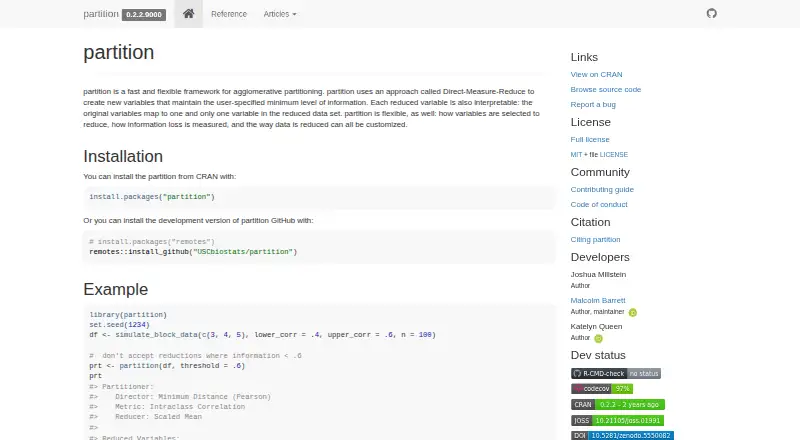
The facts below are what the maker publishes about partition, checked and dated. Our editors have not written about it yet.
The facts
Each one read from partition's own pages, with the date it was checked.
What it does
- Authors
- The site lists Joshua Millstein, Malcolm Barrett, and Katelyn Queen as developers, with Malcolm Barrett identified as maintainer.checked 12 Oct 2026
- Built-in methods
- Built-in partitioners include ICC, K-means, minimum R-squared, principal component 1, and standardized mutual information options.checked 12 Oct 2026
- Citation
- The site cites a 2020 Bioinformatics paper titled “Partition: A Surjective Mapping Approach for Dimensionality Reduction.”checked 11 Oct 2026
- Customizable
- Users can customize which variables are selected, how information loss is measured, and how data is reduced.checked 12 Oct 2026
- Customization
- Users can customize variable selection, how information loss is measured, and how data is reduced.checked 11 Oct 2026
- Custom partitioners
- Users can create custom partitioners from functions that select variables, measure information loss, and reduce data.checked 12 Oct 2026
- Data import formats
- R data frames/tibbleschecked 23 Sep 2026
- Deployment
- desktopchecked 23 Sep 2026
- Developers
- The site lists Joshua Millstein, Malcolm Barrett, and Katelyn Queen as developers and identifies Malcolm Barrett as maintainer.checked 11 Oct 2026
- Information threshold
- The partition() function reduces a data frame to as few variables as possible while meeting a user-specified information threshold.checked 12 Oct 2026
- Installation
- The package can be installed from CRAN or from the USCbiostats GitHub repository.checked 12 Oct 2026
- Interpretability
- Each original variable maps to exactly one variable in the reduced data set.checked 12 Oct 2026
- Large feature sets
- super_partition() handles data with many features by first dividing it into smaller clusters, with a default maximum cluster size of 4000.checked 12 Oct 2026
- License
- partition is released under the MIT license.checked 12 Oct 2026
- Methods
- Built-in partitioners include methods based on intraclass correlation, K-means, minimum R-squared, principal component 1, and standardized mutual information.checked 11 Oct 2026
- Performance
- The documentation reports benchmarking on a data frame with one million rows using a 2017 MacBook Pro with 16 GB RAM.checked 12 Oct 2026
- Permutation testing
- test_permutation() compares observed partition statistics with summaries from permuted data sets and defaults to 100 permutations.checked 12 Oct 2026
- Purpose
- partition is an R framework for agglomerative data reduction using a Direct-Measure-Reduce approach.checked 12 Oct 2026
- Scaling
- The site says the default ICC method scales more linearly than K-means methods as the number of columns exceeds the number of rows, while K-means is often faster at lower dimensions.checked 11 Oct 2026
- Scripting support
- Yeschecked 23 Sep 2026
- Statistical tests
- Yeschecked 23 Sep 2026
- Support
- The project directs users to GitHub to report bugs and provides contributor guidelines and a code of conduct.checked 12 Oct 2026
- Use case
- The package is particularly useful for highly correlated data, including genomic data with redundant features.checked 12 Oct 2026
Money
- Free plan
- Yeschecked 23 Sep 2026