
Parse Platform
Parse Platform is an open-source backend for mobile and web applications that can run on infrastructure supporting Node.js, including your own infrastructure.
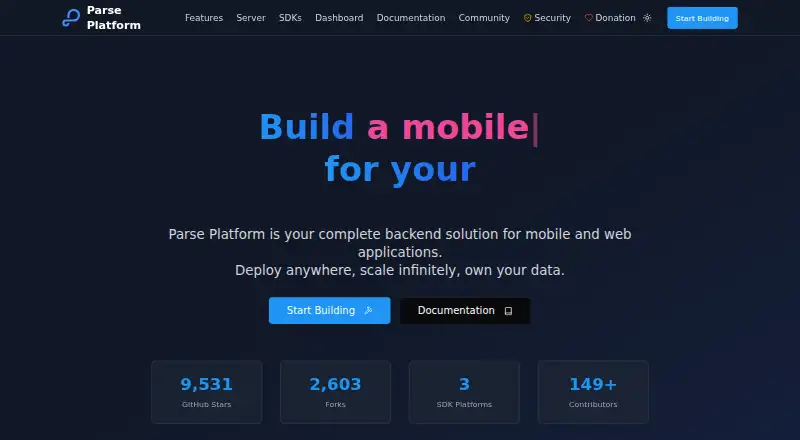
What Parse Platform is
Parse Platform is an open-source backend for mobile and web applications that can run on infrastructure supporting Node.js, including your own infrastructure. Parse Server works with MongoDB and PostgreSQL, and its REST API lets applications written in any programming language use server data. A GraphQL API supports custom schemas and Cloud Code resolvers. Cloud Code runs server-side JavaScript functions, jobs, and data triggers, while access control lists help restrict access to objects. The platform also offers user management, authentication integrations, real-time updates, push notifications, and several file-storage options, including local storage and cloud providers. Parse Dashboard provides tools to browse and edit data, manage users and permissions, test queries, and configure app settings. SDKs cover a range of languages and platforms, including iOS, Android, Flutter, and JavaScript. The project is free and open source, but users need to manage database indexes themselves. Its guide also warns that a poorly configured public deployment may lead to intrusions, data leaks, or unexpected costs.
Good
- Open-source backend can run on your infrastructure.
- Supports MongoDB and PostgreSQL.
- Provides REST and GraphQL APIs.
- Includes access controls and real-time features.
Watch out
- Users must manage database indexes.
- Cloud Jobs are not supported on a schedule.
- Poorly configured public deployments carry security and cost risks.
Who it suits
Parse Platform suits developers building mobile or web applications who want an open-source backend they can deploy on their own infrastructure or elsewhere. It requires attention to deployment security and database index management.
Verdict
Parse Platform offers a broad backend toolkit with database, API, authentication, and file-storage options. It is a fit for teams prepared to manage their deployment, indexes, and scheduling needs.
The facts
Each one read from Parse Platform's own pages, with the date it was checked.
What it does
- APIs
- The REST API lets applications written in any programming language interact with Parse Server data.checked 4 Oct 2026
- Authentication
- The site lists user management, OAuth integration, email verification, and custom authentication.checked 4 Oct 2026
- Cloud Code
- Cloud Code runs server-side JavaScript functions and jobs, and supports data triggers.checked 4 Oct 2026
- Dashboard
- Parse Dashboard includes tools to browse and edit data, manage users and permissions, test queries, and configure app settings.checked 4 Oct 2026
- Database consideration
- The server guide says users of MongoDB or PostgreSQL need to manage their indexes themselves.checked 4 Oct 2026
- Databases
- Parse Server supports MongoDB and PostgreSQL as databases.checked 4 Oct 2026
- Databases and files
- It supports MongoDB and PostgreSQL, with file storage options including Amazon S3, Google Cloud Storage, and local storage.checked 4 Oct 2026
- Deployment
- Parse Server can run on infrastructure that supports Node.js, including users’ own infrastructure.checked 4 Oct 2026
- File storage
- Parse Server’s guide describes MongoDB-backed GridFS, Amazon S3, Google Cloud Storage, and local file storage options.checked 4 Oct 2026
- GraphQL
- Parse provides a GraphQL API that supports custom user-defined schemas and Cloud Code resolvers.checked 4 Oct 2026
- Integrations
- Parse Server supports authentication adapters for third-party authentication providers.checked 4 Oct 2026
- Intended users
- The site presents Parse Platform for building mobile and web applications, and its guide includes local development and cloud deployment instructions.checked 4 Oct 2026
- Notable limit
- The Cloud Code guide says Parse does not support scheduling Cloud Jobs and recommends using a third-party scheduling system.checked 4 Oct 2026
- Open source
- The site describes Parse Platform as an open-source backend that can be deployed anywhere and gives users control of their data.checked 4 Oct 2026
- Product
- Parse Platform describes itself as a complete backend solution for mobile and web applications.checked 4 Oct 2026
- Real-time features
- The site lists Live Queries, real-time data updates, and push notifications.checked 4 Oct 2026
- SDKs
- The site lists SDKs for Apple platforms, Android, JavaScript, PHP, Flutter, Dart, .NET, Swift, and Arduino.checked 4 Oct 2026
- Security
- Parse supports access control lists for restricting access to objects.checked 4 Oct 2026
- Security guidance
- The Parse Server guide warns that an improperly configured public deployment may be vulnerable to intrusions, data leaks, and unexpected cost increases.checked 4 Oct 2026
- Server-side code
- Cloud Code supports custom JavaScript functions, database triggers, and background jobs.checked 4 Oct 2026
- Support
- The site directs users to the community forum, Slack, Discord, GitHub, and Stack Overflow for help and discussion.checked 4 Oct 2026
- What it does
- Parse Platform is an open-source backend for mobile and web applications.checked 4 Oct 2026
- Who it is for
- The Parse documentation describes Parse Server as a backend for mobile applications and also documents its use with web applications.checked 4 Oct 2026
Alternatives to Parse Platform
- 1
Oracle WebCenter Content
AndroidiOSWebAPI7.7$3,450 one-time - 2
Phusion Passenger
Free planLinuxmacOSSelf-hosted6.8From $23.52 a year - 3
Azul Payara Server
Free planWebLinuxmacOSSelf-hosted6.5Free plan - 4
SAP Extended Enterprise Content Management by OpenText
AndroidiOSWebLinux6.4 - 5
Lucee Server
Free planWebExtensionLinuxmacOS6.3Free plan - 6
MAMP
Free planmacOSWindows6.3Free plan