
ParadeDB
ParadeDB adds full-text and vector search, filters, facets, and joins directly to PostgreSQL through the pg_search extension.
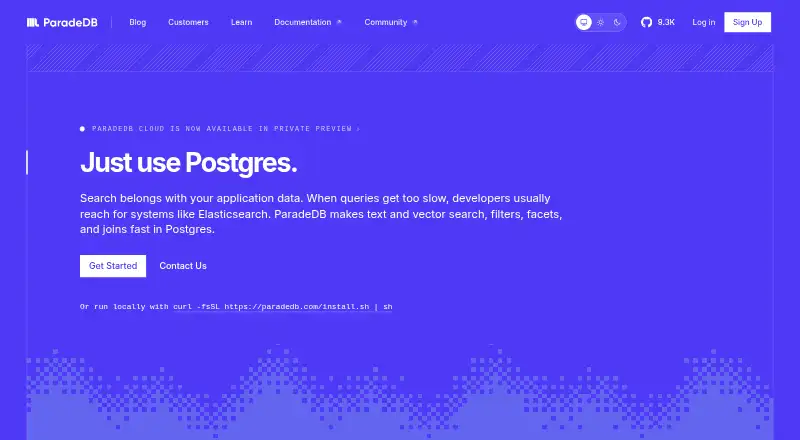
What ParadeDB is
ParadeDB adds full-text and vector search, filters, facets, and joins directly to PostgreSQL through the pg_search extension. It runs inside standard Postgres without a fork or sidecar process. Documented queries include BM25 full-text, vector and hybrid search, fuzzy, phrase, proximity, and regex searches, with filtering, sorting, and highlighting. Indexing supports columnar, vector, JSON, array, and composite data, alongside aggregates, facets, and joins. ParadeDB documents ACID transactions and consistent reads, with index updates applied when application data is written. Deployment choices include ParadeDB Cloud, BYOC, Kubernetes with CloudNativePG, self-hosted PostgreSQL, and listed PaaS providers. Local installation options are a curl installer, Docker, and Postgres.app; the documented Postgres.app procedure assumes PostgreSQL 18. Community is open source under AGPL-3.0 and supports single-node deployments. Read replicas and high availability are Enterprise features. Community costs nothing, fully free forever. Cloud is in private preview with pricing not stated, while Enterprise uses custom pricing.
Good
- Full-text, vector, and hybrid search in PostgreSQL
- Filters, facets, joins, and highlighting
- ACID transactions with consistent reads
- Open-source AGPL-3.0 Community edition
- Self-hosted, cloud, BYOC, and Kubernetes options
Watch out
- Community supports single-node deployments only
- Read replicas and high availability require Enterprise
- Postgres.app instructions assume PostgreSQL 18
Who it suits
It suits teams outgrowing PostgreSQL full-text search or pgvector, building transactional applications with search, or syncing Postgres to another search engine. SQL is the query interface, with self-hosted and managed deployment paths.
Verdict
ParadeDB keeps advanced search capabilities inside standard PostgreSQL while retaining transactional behavior and SQL access. The free Community edition is suitable for single-node use; larger availability features require Enterprise.
Plans and prices
From ParadeDB's own pricing page, checked 7 Oct 2026.
| Plan | Price | What it gives you |
|---|---|---|
| Community | Free | Single node · No read replicas · Community support · Fully free forever |
| Cloud | Priced on request | Fully managed · One-click deployments · Everything in Enterprise · Private preview; pricing not stated |
| Enterprise | Priced on request | Read replicas · High availability · Dedicated support and SLA · Custom pricing |
The facts
Each one read from ParadeDB's own pages, with the date it was checked.
What it does
- Architecture
- It is delivered as the pg_search PostgreSQL extension and runs inside standard Postgres without a fork or sidecar process.checked 7 Oct 2026
- Community limits
- Community supports single-node deployments; ParadeDB index high availability and read replicas are Enterprise features.checked 7 Oct 2026
- Data consistency
- ParadeDB documents ACID transactions and consistent reads, and says index updates happen with writes to the application data.checked 7 Oct 2026
- Deployment options
- Deployment choices include ParadeDB Cloud, BYOC, Kubernetes with CloudNativePG, self-hosted PostgreSQL, and listed PaaS providers.checked 7 Oct 2026
- Ecosystem
- The product page lists pg_dump, logical replication, pgBackRest, pg_partman, pg_cron, PostGIS, and other PostgreSQL extensions and tools.checked 7 Oct 2026
- Indexing and analytics
- The reference describes columnar, vector, JSON, array, and composite indexing, along with aggregates, facets, and joins.checked 7 Oct 2026
- Intended users
- The documentation identifies teams outgrowing PostgreSQL full-text search or pgvector, building transactional applications that need search, or syncing Postgres to an external search engine as likely fits.checked 7 Oct 2026
- Licensing
- ParadeDB Community is described as open source under the AGPL-3.0 license.checked 7 Oct 2026
- Local installation
- The maker documents a curl installer, Docker, and Postgres.app for local installation, with the Postgres.app steps assuming PostgreSQL 18.checked 7 Oct 2026
- Product
- ParadeDB adds full-text and vector search, filters, facets, and joins to PostgreSQL.checked 7 Oct 2026
- Search features
- Its documented query capabilities include BM25 full-text search, vector and hybrid search, fuzzy, phrase, proximity and regex queries, filtering, sorting, and highlighting.checked 7 Oct 2026
- Security reports
- The contact page asks people to report suspected vulnerabilities privately to [email protected] with reproduction steps and the affected version or service.checked 7 Oct 2026
- Support
- The company lists community support for Community and dedicated support with an SLA for Enterprise, and provides product support by email.checked 7 Oct 2026
The company
- Company identity
- The site identifies the company as ParadeDB, Inc.checked 7 Oct 2026
- Headquarters
- New York, New York, United Stateschecked 28 Sep 2026
Alternatives to ParadeDB
- 1

Chroma
Free planOpen sourceAndroidiOSWebAPI8.6From $250 a month - 2

Vespa
Open sourceWebAPILinuxmacOS8.4 - 3

Algolia
Free planAndroidiOSWebAPI8.2From $0.50 a month - 4

Pinecone
Free planWebAPILinuxmacOS7.8From $20 a month - 5

Apache Solr
Free planOpen sourceWebAPILinuxmacOS7.7Free plan - 6

Meilisearch
Free planWebAPILinuxmacOS7.2From $20 a month