papaw
papaw is a free, MIT-licensed packer for Linux executables that include statically linked third-party components.
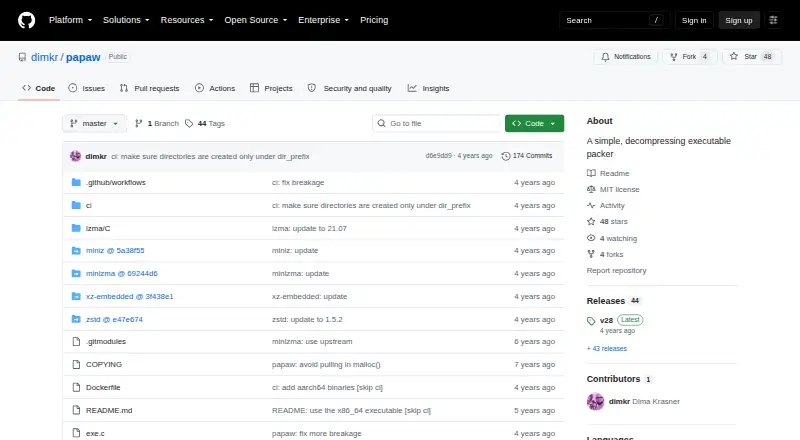
What papaw is
papaw is a free, MIT-licensed packer for Linux executables that include statically linked third-party components. It is intended for devices with limited disk space: it compresses executables and packages them with a small decompressor, about 15–40 KB. Supported algorithms are LZMA2, LZMA1, Zstandard, and Deflate, and a packed executable can replace itself on disk when run. The project aims for portability across devices by avoiding machine-specific assembly and newer system calls such as fexecve(). It uses Meson and can be included as a Meson subproject; the README recommends using custom_target() to run papawify. Prebuilt static binaries are available through GitHub releases, with example assets for aarch64, arm, armeb, i386, mips, mipsel, and x86_64. papaw can optionally provide very basic anti-debugging protection intended to discourage trivial reverse-engineering techniques. Its payload is extracted to a temporary file; when run as root, it mounts a tmpfs filesystem and lazily unmounts it before extraction.
Good
- Free and unencumbered under the MIT license
- Supports four compression algorithms
- Can replace packed executables on disk
- Prebuilt static binaries are available
Watch out
- Linux only
- Anti-debugging protection is described as very basic
- Payload extraction uses a temporary file
Who it suits
papaw suits developers packaging Linux executables for devices with limited disk space. Its Meson integration and multi-architecture release assets may be useful to developers building for different devices.
Verdict
papaw focuses on compressing Linux executables while keeping its decompressor small. Its Meson integration and release assets support varied development setups, but users should account for the temporary-file extraction behavior.
Plans and prices
From papaw's own pricing page, checked 8 Oct 2026.
| Plan | Price | What it gives you |
|---|---|---|
| papaw | Free | Free and unencumbered software under the MIT license |
The facts
Each one read from papaw's own pages, with the date it was checked.
What it does
- Anti-debugging
- It can optionally provide very basic anti-debugging protection intended to discourage trivial reverse-engineering techniques.checked 8 Oct 2026
- Architecture coverage
- The v28 release lists example executable assets for aarch64, arm, armeb, i386, mips, mipsel, and x86_64.checked 8 Oct 2026
- Build
- papaw uses Meson as its build system and can be used as a Meson subproject.checked 8 Oct 2026
- Build integration
- papaw uses Meson and can be included as a Meson subproject, with custom_target() recommended for running papawify.checked 8 Oct 2026
- Compression
- Supported algorithms are LZMA2, LZMA1, Zstandard, and Deflate.checked 8 Oct 2026
- Download
- The README says prebuilt static binaries are available from the project's GitHub releases.checked 8 Oct 2026
- Downloads
- The README says prebuilt static binaries are available through GitHub releases.checked 8 Oct 2026
- Intended use
- The README describes papaw as designed for portability across devices and says it avoids machine-specific assembly and newer system calls such as fexecve().checked 8 Oct 2026
- License
- The project is released as free and unencumbered software under the MIT license.checked 8 Oct 2026
- Maintainer
- The GitHub profile identifies the repository owner as Dima Krasner and describes his work as low-level development specializing in C, Go, porting, *nix, and distro development.checked 8 Oct 2026
- Portability
- The project avoids machine-specific assembly and newer system calls such as fexecve() to support portability across devices.checked 8 Oct 2026
- Purpose
- papaw is a permissively licensed packer for executables with statically linked third-party components, intended for devices with limited disk space.checked 8 Oct 2026
- Release assets
- The v28 release lists example binaries for architectures including aarch64, ARM, i386, MIPS, and x86_64.checked 8 Oct 2026
- Replacement
- Packed executables can replace themselves on disk when run.checked 8 Oct 2026
- Security
- papaw can optionally provide very basic anti-debugging protection intended to discourage trivial reverse-engineering techniques.checked 8 Oct 2026
- Self replacement
- Packed executables can replace themselves on disk when run.checked 8 Oct 2026
- Size reduction
- papaw compresses executables and packages them with a small decompressor executable of about 15–40 KB.checked 8 Oct 2026
- Temporary files
- The payload is extracted to a temporary file; when run as root, papaw mounts a tmpfs filesystem and lazily unmounts it before extraction.checked 8 Oct 2026
Alternatives to papaw
- 1
Obsidian
Free planOpen sourceAndroidiOSExtensionLinux8.4From $48 a year - 2
Enigma Protector
WebAPILinuxSelf-hosted7.4 - 3

Virbox Protector
AndroidiOSLinuxmacOS7.1CN¥2,499 one-time - 4
VMProtect
LinuxmacOSWindows6.6 - 5
Crinkler
Free planWindows6.3Free plan - 6

Themida
Windows6.3From €79 a year