Packistry
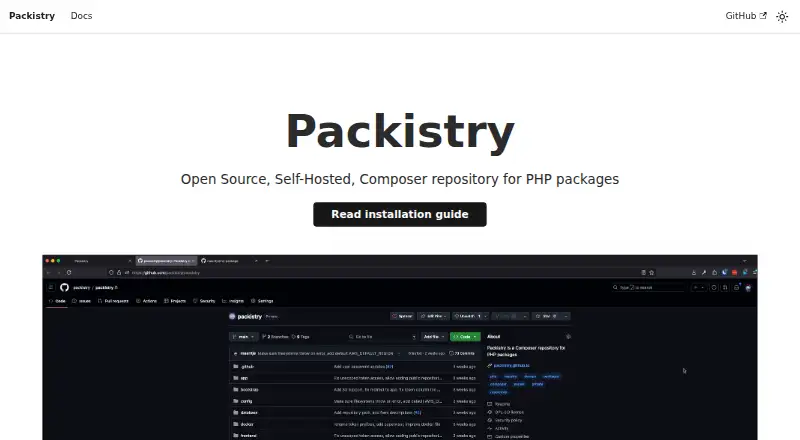
The facts below are what the maker publishes about Packistry, checked and dated. Our editors have not written about it yet.
The facts
Each one read from Packistry's own pages, with the date it was checked.
What it does
- Access control
- User accounts can be assigned roles and repository access, while deploy tokens grant machines access to selected private repositories.checked 5 Oct 2026
- Archive storage
- The documentation provides a guide for storing package archives in S3-compatible storage, using MinIO and MySQL in its example.checked 5 Oct 2026
- Automatic updates
- When a package is added from a connected source, Packistry automatically configures webhooks to update it with the latest tags and branches.checked 11 Oct 2026
- Composer
- Packistry can be added to Composer configuration as a Composer repository and packages can be installed with Composer.checked 5 Oct 2026
- Composer setup
- Repositories are added to Composer configuration through composer.json or the Composer CLI.checked 11 Oct 2026
- Database
- The default installation uses SQLite, and the documentation also provides a MySQL setup guide.checked 5 Oct 2026
- Data storage
- The default setup stores data and package archive ZIP files under /data in the container; the guides also describe MySQL and S3-compatible storage configurations.checked 11 Oct 2026
- Deployment
- Packistry can run locally or on a cloud platform using Docker or Docker Compose.checked 11 Oct 2026
- Deployment option
- The Kamal deployment guide describes obtaining a free TLS certificate through Let's Encrypt.checked 11 Oct 2026
- Intended users
- The introduction describes Packistry for private projects, developer teams, and open-source initiatives.checked 5 Oct 2026
- Package sources
- Packistry supports importing packages from GitHub, GitLab, Gitea, and Bitbucket.checked 5 Oct 2026
- Private repositories
- It supports hosting sensitive or proprietary packages in private repositories.checked 11 Oct 2026
- Product
- Packistry is an open-source, self-hosted Composer repository for PHP packages.checked 11 Oct 2026
- Repositories
- Repositories can be public or private; private repositories require deploy tokens or specific user permissions.checked 5 Oct 2026
- Security
- The installation guide strongly recommends HTTPS for production environments.checked 5 Oct 2026
- Setup requirement
- The Kamal guide lists root server access, an SSH key, a DNS A record, and container registry credentials as prerequisites.checked 11 Oct 2026
- Single sign-on
- Authentication sources support OAuth 2.0 and OpenID Connect, including GitHub, GitLab, Bitbucket, Google, Okta, Keycloak, and Microsoft Entra ID.checked 5 Oct 2026
- Source integrations
- It can manage and synchronize Composer packages from GitHub, GitLab, Gitea, and Bitbucket.checked 11 Oct 2026
- Synchronization
- Packistry uses webhooks to pull the latest changes from source repositories.checked 5 Oct 2026
- Transport security
- The installation guide recommends HTTPS for production and documents configuring trusted proxies behind a reverse proxy.checked 11 Oct 2026
- User access
- It supports user accounts and personal access tokens for controlling access to private repositories.checked 11 Oct 2026
Where it runs
- Machine access
- Deploy tokens can grant CI systems and other machines access to assigned repositories.checked 11 Oct 2026
Alternatives to Packistry
- 1

Azure Test Plans
Free planWebAPIExtensionLinux8.1From $6 a month - 2

Nexspence
Free planOpen sourceWebAPILinuxmacOS8.1From $25 a month - 3
Oracle WebCenter Content
AndroidiOSWebAPI7.7$3,450 one-time - 4

Packagecloud
Free planWebAPILinuxmacOS7.7From $89 a month - 5

Sonatype Nexus Repository
Free planWebAPILinuxmacOS7.5From $1,950 a year - 6

Inedo ProGet
Free planWebAPILinuxSelf-hosted7.4From $2,395 a year