
Packagecloud
Packagecloud stores and distributes software packages through an automated service available in the cloud and on-premises.
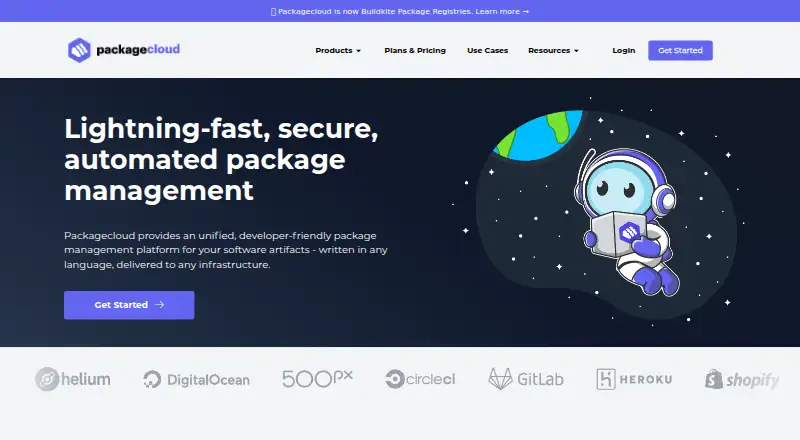
What Packagecloud is
Packagecloud stores and distributes software packages through an automated service available in the cloud and on-premises. Supported formats include npm, APT/Debian, Maven, Yum/RPM, RubyGems and Python packages; Alpine, Helm and Docker repositories are also listed. Users can work through a graphical interface, command-line tools or an API, with access control and collaboration features. Listed CI integrations include CircleCI, Travis CI, Jenkins, Buildkite and GitHub Actions, while build tool integrations include Maven, Leiningen, Gradle and SBT. The free plan includes 10 GB bandwidth and 2 GB storage. The pricing FAQ notes that paid plans can incur bandwidth and storage overage charges; account holders can set a maximum overage amount before account disablement. Packagecloud says its websites and microservices use SSL/TLS encryption, that it is SOC 2 compliant and that it complies with HIPAA standards. Audit and penetration test reports are shared on request under a signed NDA.
Good
- Free plan includes 10 GB bandwidth and 2 GB storage.
- Supports multiple package formats and repositories.
- Offers graphical, command-line and API access.
- Available in cloud and on-premises.
Watch out
- Paid plans can have bandwidth and storage overages.
- Enterprise+ pricing is custom and not listed.
Who it suits
It suits teams that need to store and distribute software packages across several package formats. Cloud and on-premises options support different deployment environments.
Verdict
Packagecloud combines package distribution with access controls, integrations and cloud or on-premises deployment. Review storage, bandwidth and potential overage charges when selecting a plan.
Plans and prices
From Packagecloud's own pricing page, checked 15 Oct 2026.
| Plan | Price | What it gives you |
|---|---|---|
| Free | Free | 10 GB bandwidth · 2 GB storage · unlimited CI/CD minutes |
| Starter | $89 a month | 20 GB bandwidth · 5 GB storage · unlimited CI/CD minutes · Billed at the start of each month |
| Pro | $150 a month | 50 GB bandwidth · 15 GB storage · unlimited CI/CD minutes · Billed at the start of each month |
| Enterprise | $699 a month | 250 GB bandwidth · 150 GB storage · unlimited CI/CD minutes · Billed at the start of each month |
| Enterprise+ | Priced on request | Custom bandwidth · custom storage · unlimited CI/CD minutes |
The facts
Each one read from Packagecloud's own pages, with the date it was checked.
What it does
- Access and tooling
- The service provides a graphical interface, command line tools, access control, collaboration features, and an API.checked 2 Oct 2026
- Access controls
- The home page says access-control and collaboration features are built in for individuals and teams.checked 15 Oct 2026
- API
- The public REST API is version 1, uses HTTPS, and authenticates most requests with an API token supplied as the basic-auth username.checked 15 Oct 2026
- API scope
- The API documentation covers automation for Debian, RPM, RubyGems and Python packages.checked 15 Oct 2026
- Availability claim
- Packagecloud claims 99.99% availability since its 2014 inception.checked 15 Oct 2026
- Build-tool integrations
- Listed build-tool integrations are Maven, Leiningen, Gradle and SBT.checked 15 Oct 2026
- CI integrations
- Listed CI integrations are CircleCI, Travis CI, Jenkins, Buildkite and GitHub Actions.checked 15 Oct 2026
- CLI
- The official package_cloud Ruby gem uploads Node.js, Debian, RPM, RubyGem, Python and Java packages and version 0.3.12 is documented.checked 15 Oct 2026
- CLI licence
- The package_cloud CLI gem is released under the MIT license.checked 15 Oct 2026
- Compliance
- The security page says Packagecloud is SOC 2 compliant and undergoes an annual third-party penetration test.checked 15 Oct 2026
- Deployment
- The About page says Packagecloud is available in the cloud and on-premises, including behind a corporate firewall or inside a perimeter network.checked 2 Oct 2026
- Documentation depth
- The documentation includes package-format procedures, repository installation, distribution/version tables, CI examples, API reference and troubleshooting guidance.checked 15 Oct 2026
- HIPAA
- Packagecloud says it complies with HIPAA standards for protecting personal health information and can sign a Business Associate Agreement.checked 2 Oct 2026
- Infrastructure security
- Infrastructure runs in AWS data centers and uses firewalls, role-based access control and key-based SSH authentication.checked 15 Oct 2026
- Installation methods
- Repository installation can use generated Bash scripts, a Chef cookbook, a Puppet module, manual instructions or the package_cloud client.checked 15 Oct 2026
- Integrations
- Listed CI integrations include CircleCI, Travis CI, Jenkins, Buildkite, and GitHub Actions; build tool integrations include Maven, Leiningen, Gradle, and SBT.checked 2 Oct 2026
- Limit: authentication
- A G2 reviewer complained that two-factor authentication was unavailable for their account.checked 15 Oct 2026
- Limit: missing build templates
- Capterra reviewers requested starter templates for compiling RPM and DEB packages.checked 15 Oct 2026
- Limit: pricing fit
- A Capterra reviewer described the newer pricing tiers as not fitting their needs perfectly.checked 15 Oct 2026
- Limit: repository refresh
- A G2 reviewer reported that repositories can sometimes take time to refresh.checked 15 Oct 2026
The company
- Company headquarters
- LinkedIn lists headquarters in San Francisco, California.checked 15 Oct 2026
- Company size
- LinkedIn lists Packagecloud as a privately held software-development company with 2–10 employees.checked 15 Oct 2026
- Company status
- The homepage identifies Packagecloud as a Buildkite company.checked 2 Oct 2026
- Founded
- LinkedIn lists the company as founded in 2014.checked 15 Oct 2026
The full review of Packagecloud
Packagecloud is a package registry and distribution service for software teams managing releases across several ecosystems. It suits organizations that need CI-connected publishing or on-premises deployment. Its flexible tooling is a strong fit, provided your storage and bandwidth needs fit the quotas and overage terms.
Overview
Packagecloud combines package storage and distribution with fine-grained access controls, collaboration features, and an API. It supports npm, APT/Debian, Maven, Yum/RPM, RubyGems, Python, Alpine, Helm, and Docker repositories, making it useful for teams publishing different artifact types through one service. Container artifacts and upstream proxy support broaden its role beyond hosting packages for direct downloads.
Teams can use a graphical interface, command-line tools, or the API. CI integrations include CircleCI, Travis CI, Jenkins, Buildkite, and GitHub Actions; build-tool integrations include Maven, Leiningen, Gradle, and SBT. That range can fit into varied release workflows, while unlimited CI/CD minutes on every plan removes one usage constraint. It does not remove the bandwidth and storage caps.
Cloud and on-premises deployment are both supported, including installation behind a corporate firewall or inside a perimeter network. This is a meaningful advantage for organizations with infrastructure constraints. Packagecloud states it has maintained 99.99% availability since its 2014 launch. Its security claims include SSL/TLS encryption for websites and microservices and SOC 2 compliance; audit and penetration-test reports are shared on request under a signed NDA. It also says it complies with HIPAA standards and can sign a Business Associate Agreement.
Key features
Fine-grained access control is useful when different teams or collaborators need distinct package permissions. Collaboration features support shared work, while retention rules are not included, so teams that rely on automated cleanup should account for managing stored packages another way. Support is by email; Enterprise+ customers are directed to [email protected].
Pricing
| Plan | Price | Bandwidth | Storage | CI/CD minutes |
|---|---|---|---|---|
| Free | free | 10 GB | 2 GB | Unlimited |
| Starter | $89 a month | 20 GB | 5 GB | Unlimited |
| Pro | $150 a month | 50 GB | 15 GB | Unlimited |
| Enterprise | $699 a month | 250 GB | 150 GB | Unlimited |
| Enterprise+ | Custom pricing | Custom | Custom | Unlimited |
The Free plan is a sensible way to try package distribution or support a small project, but its 10 GB of bandwidth and 2 GB of storage leave little room for growing repositories. Starter raises those caps to 20 GB and 5 GB for teams with modest usage. Pro is a better fit when package delivery or storage is growing, while Enterprise provides substantially more capacity at a steeply higher monthly price. Enterprise+ is for organizations needing custom capacity and terms.
Paid plans include a 14-day trial. Paid-plan bandwidth and storage overages can incur charges, but account holders can set a maximum overage amount that disables the account when reached. That safeguard helps control unexpected spend, though teams still need to estimate usage and monitor the cap. All paid plans are billed monthly.
Platforms
Packagecloud supports API, Linux, macOS, self-hosted, web, and Windows environments. The cloud and on-premises options make it applicable both to distributed teams and organizations that need repositories inside their own network perimeter.
Who it's for
Packagecloud is best for development teams publishing packages across multiple formats, especially when CI integration, access control, or on-premises deployment is important. Its broad ecosystem coverage and unlimited CI/CD minutes are useful for established release pipelines. It is less suited to teams that need high delivery or storage volumes at a predictable low cost, or automated retention rules, because quotas and paid-plan overages require active capacity management.
Pros and cons
- Pros: Broad package-format support, including container repositories, lets teams consolidate distribution across ecosystems.
- Pros: Fine-grained access controls, collaboration features, and numerous CI and build-tool integrations support shared publishing workflows.
- Pros: Cloud and on-premises deployment accommodate teams with different infrastructure requirements.
- Cons: Storage and bandwidth are capped even with unlimited CI/CD minutes, so pipeline activity does not guarantee affordable package delivery.
- Cons: Paid-plan overages can add charges, making usage estimates and account caps important.
- Cons: Retention rules are not included, which leaves package cleanup to other processes.
Alternatives
Browse artifact repository software for more options. Cloudsmith is worth comparing for a freemium alternative with a free open-source plan that includes 50 GB of artifact data and 200 GB of package delivery. Choose Sonatype Nexus Repository if its free Community Edition's full ecosystem support, CI/CD integration, and external PostgreSQL option better fit your needs. Inedo ProGet offers a free edition with unlimited feeds for private packages and Docker, making it a candidate for teams focused on those feeds. Ravenstash has a free plan with 1 GB of storage, unlimited data transfer, one repository, and one user, which may suit an individual with modest storage needs. Nexspence is a free option with no license fees. Buildkite is an alternative to consider when the need is a CI/CD platform rather than a package repository. RepoFlow offers a cloud-free plan with 10 GB of storage, 10 GB of monthly bandwidth, and 100 published packages. Anaconda Notebooks is an alternative to consider for notebook-focused workflows.
Verdict
Choose Packagecloud if your team needs package distribution across varied formats, integrated build workflows, and the option to deploy on-premises. Its access controls and deployment flexibility are compelling; look elsewhere if your usage is likely to exceed storage or bandwidth quotas or you need built-in retention rules.
Alternatives to Packagecloud
- 1

Azure Test Plans
Free planWebAPIExtensionLinux8.1From $6 a month - 2

Nexspence
Free planOpen sourceWebAPILinuxmacOS8.1From $25 a month - 3
Oracle WebCenter Content
AndroidiOSWebAPI7.7$3,450 one-time - 4

Sonatype Nexus Repository
Free planWebAPILinuxmacOS7.5From $1,950 a year - 5

Inedo ProGet
Free planWebAPILinuxSelf-hosted7.4From $2,395 a year - 6
Omni Line Multipurpose Artifact Registry
Free planWebAPILinuxSelf-hosted7.4From $2,499 a year