
PacketFence
PacketFence is an enterprise network access control platform for organizations that need to manage and secure wired, wireless, or VPN access.
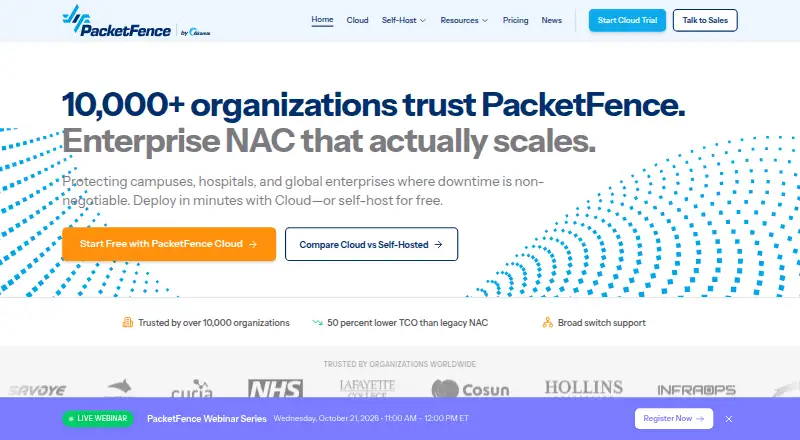
What PacketFence is
PacketFence is an enterprise network access control platform for organizations that need to manage and secure wired, wireless, or VPN access. It can apply access policies through SNMP or RADIUS, inline Layer 2 or Layer 3 deployment, VLAN assignment, and quarantine. Authentication options include 802.1X/EAP, directory services, external RADIUS, social login, SAML, and certificates. Guest access workflows include self-registration and sponsored access, while self-service onboarding can configure 802.1X profiles on supported devices. The platform checks antivirus, patch, and security-agent status, and can isolate devices that fail policy. Administrators can use its web interface, command-line tools, REST API, captive portals, and Perl extension points. The self-hosted Community Edition is GPL v2+ and includes unlimited devices and source code; listed minimum requirements include four CPU cores and 16 GB RAM. PacketFence Cloud is also offered as a managed service with usage-based pricing.
Good
- Supports wired, wireless, and VPN access control.
- Offers multiple authentication and guest-access workflows.
- Can quarantine devices that fail compliance checks.
- Community Edition includes unlimited devices and full source code.
Watch out
- Self-hosted minimum is four CPU cores and 16 GB RAM.
- Starter plan costs $5,000/yr.
- Listed device limit is 250 devices.
Who it suits
PacketFence suits organizations that need centralized network access controls, device onboarding, guest access, and compliance checks. Its self-hosted edition may appeal to teams prepared to meet its listed server requirements.
Verdict
PacketFence combines access enforcement, authentication, onboarding, and compliance controls in one platform. The free self-hosted edition has unlimited devices, while paid plans and cloud service provide other options.
Plans and prices
From PacketFence's own pricing page, checked 14 Oct 2026.
| Plan | Price | What it gives you |
|---|---|---|
| Community Edition | Free | unlimited devices · full source code · community forum support · core NAC features · self-hosted · free forever |
| Starter | $5,000 a year | up to 250 registered devices · 2,500 guest devices/year · business-hours support · self-service onboarding · annual |
| Premium Support | $5,000 a year | 24/7 unlimited support · one-hour urgent-response SLA · yearly upgrades · performance tuning · per server/year |
| Professional | $15,000 a year | up to 1,000 registered devices · 10,000 guest devices/year · 24/7 premium support · guided onboarding · annual |
| Professional Deployment | $20,000, paid once | architecture planning · production rollout assistance · legacy NAC migration · knowledge transfer · starting price |
| Enterprise | Priced on request | 10,000+ registered devices · unlimited guest devices · 24/7 elite support · white-glove onboarding · custom pricing |
| Training Services | — | Basic $8,000 · Standard $18,000 · Advanced $30,000 · Remote delivery included · Starting prices |
The facts
Each one read from PacketFence's own pages, with the date it was checked.
What it does
- 802.1X and EAP
- The product includes FreeRADIUS-based 802.1X support with PEAP-TLS, EAP-TLS, EAP-PEAP and EAP-TTLS methods.checked 14 Oct 2026
- Administration
- The platform provides a web administration interface, command-line tools, a REST API, customizable captive portals, and Perl extension points.checked 1 Oct 2026
- API and extensibility
- PacketFence offers a REST API, command-line tools, customizable Template Toolkit portals and Perl extension points for authentication, VLAN logic and workflows.checked 14 Oct 2026
- Authentication
- Authentication includes 802.1X/EAP through FreeRADIUS, LDAP and Active Directory, external RADIUS, OAuth2 social login, SAML 2.0, and PKI certificates.checked 1 Oct 2026
- Captive portal
- It provides customizable captive portals for guest registration, remediation and sponsored access.checked 14 Oct 2026
- Cloud architecture
- PacketFence Cloud uses an on-premises connector with a secure tunnel and local RADIUS caching to continue serving cached decisions during internet loss.checked 14 Oct 2026
- Cloud service
- PacketFence Cloud is managed without customer infrastructure, offers a 99.99% uptime SLA, local RADIUS caching for internet outages, and usage-based pricing.checked 1 Oct 2026
- Cloud SLA
- The cloud offering advertises a 99.99% uptime SLA for Cloud RADIUS.checked 14 Oct 2026
- Compliance controls
- PacketFence checks antivirus status, OS patch level, and security-agent presence, and can quarantine devices that fail policy.checked 1 Oct 2026
- Deployment formats
- Downloads include RHEL RPM packages, Debian packages and a bootable Debian-based ISO, while a ZEN virtual appliance is documented for VMware and Hyper-V.checked 14 Oct 2026
- Deployment requirements
- Self-hosted PacketFence lists Debian 12.x or RHEL 8.x, four CPU cores, 16 GB RAM minimum, 200 GB disk, and at least one network interface.checked 1 Oct 2026
- Documentation
- Official documentation includes installation, upgrade, network-device configuration, clustering, developer and stable or development OpenAPI specifications.checked 14 Oct 2026
- Enforcement
- It supports out-of-band SNMP or RADIUS enforcement, inline Layer 2 or Layer 3 deployment, VLAN assignment, and quarantine isolation.checked 1 Oct 2026
- Enterprise integrations
- Listed integrations include Palo Alto, FortiGate, Check Point, Microsoft Intune, JAMF, Kandji, MobileIron, VMware Workspace ONE, Cisco, Aruba, Juniper, Meraki and Ruckus.checked 14 Oct 2026
- Guest and BYOD
- Guest workflows include self-registration, sponsored access, email or SMS confirmation, password-of-the-day, payment integrations, and CSV bulk import.checked 1 Oct 2026
- High availability
- High availability uses active/active clustering, automatic failover, Galera synchronous multi-master replication, geographic distribution, and automatic recovery.checked 1 Oct 2026
Where it runs
- Android app purpose
- The PacketFence Agent configures Android Wi-Fi profiles, including SSID, authentication method and trusted certificates, when the NAC PKI workflow is configured.checked 14 Oct 2026
- Device onboarding
- Self-service device provisioning supports iOS, Android, Windows, macOS, and ChromeOS with automatic 802.1X profile configuration.checked 1 Oct 2026
- Device profiling
- Fingerbank profiling classifies endpoints using DHCP fingerprints, user-agent data and network behavior.checked 14 Oct 2026
The company
- Company facts
- LinkedIn lists Inverse as a privately held Montreal company with 11–50 employees and a 1998 founding year.checked 14 Oct 2026
- Company legal history
- Akamai announced acquisition of Inverse, the PacketFence developer, on February 1, 2021.checked 14 Oct 2026
- Current owner facts
- LinkedIn lists Akamai Technologies as a public company headquartered in Cambridge, Massachusetts with 5,001–10,000 employees.checked 14 Oct 2026
- Founded
- 2005checked 28 Sep 2026
- Headquarters
- Cambridge, Massachusetts, United Stateschecked 28 Sep 2026
The full review of PacketFence
PacketFence is an enterprise network access control platform for organizations that need policy-based control over wired, wireless, or VPN connections. It suits IT and security teams managing varied devices, guest access, and compliance requirements. Its breadth is compelling, but the self-hosted route demands substantial infrastructure and network expertise.
Overview
PacketFence brings authentication, access enforcement, device onboarding, and compliance checks together. Organizations can run the GPL v2+ self-hosted edition or use PacketFence Cloud, a managed service that requires no customer infrastructure. The self-hosted Community Edition has unlimited devices and full source code; paid plans add device and guest quotas, support, or deployment services.
Self-hosting calls for Debian 12.x or RHEL 8.x, at least four CPU cores, 16 GB of RAM, 200 GB of disk, and one network interface. That is a meaningful operational commitment, particularly for smaller teams without network administration capacity.
Key features
Access control and authentication
Enforcement can run out of band through SNMP or RADIUS, or inline at Layer 2 or Layer 3. Administrators can assign VLANs or quarantine devices. Authentication supports 802.1X/EAP through FreeRADIUS, LDAP and Active Directory, external RADIUS, OAuth2 social login, SAML 2.0, and PKI certificates. This range makes PacketFence a strong fit for organizations combining different network types and identity sources, though configuring that breadth is likely to demand specialist ownership.
Guest access and device onboarding
Guest workflows include self-registration, sponsored access, email or SMS confirmation, password-of-the-day, payment integrations, and CSV bulk import. Self-service provisioning supports iOS, Android, Windows, macOS, and ChromeOS, with automatic 802.1X profile configuration. Together these capabilities reduce the need to handle guest and device setup entirely by hand.
Compliance and security integrations
PacketFence checks antivirus status, operating-system patch level, and security-agent presence, and can quarantine devices that fail policy. It can use compliance signals from FleetDM, osquery, SentinelOne, CrowdStrike, and Microsoft Defender, react to Snort and Suricata alerts, and use Nessus, OpenVAS, and Rapid7 scan results to trigger violations and isolation. It also lists integrations with major firewall, endpoint-management, and network vendors. That makes it more than a connection gate: organizations can tie access decisions to device posture and security signals.
Administration and resilience
A web administration interface, command-line tools, REST API, customizable captive portals, and Perl extension points give teams several ways to manage and extend the platform. High availability includes active/active clustering, automatic failover, Galera synchronous multi-master replication, geographic distribution, and automatic recovery. These are substantial capabilities for large or distributed environments, but they come with infrastructure and administration complexity.
Cloud service
PacketFence Cloud removes the need to maintain customer infrastructure, offers a 99.99% uptime SLA, and provides local RADIUS caching during internet outages. Its usage-based pricing may suit organizations that prefer managed operations, though costs will depend on usage.
Pricing
PacketFence uses a freemium model, with a 30-day trial and paid plans starting at $5,000 /year. The free Community Edition is billed Free forever and is GPL licensed; it includes unlimited devices, full source code, community forum support, and self-hosted deployment. It is the most flexible choice on device count, but organizations must operate the infrastructure themselves and do not get paid-plan support.
- Starter — $5,000 /year: Up to 250 registered devices, 2,500 guest devices/year, business-hours support, and self-service onboarding. It suits smaller deployments that can work within firm device and guest quotas.
- Premium Support — $5,000 /year per server: 24/7 unlimited support, a 1-hour urgent response SLA, yearly version upgrades, and performance tuning. This adds support and maintenance rather than a stated device allowance; the per-server billing matters when budgeting for multiple servers.
- Professional — $15,000 /year: Up to 1,000 registered devices, 10,000 guest devices/year, 24/7 Premium support, and guided onboarding. It is the clearer fit for organizations beyond Starter's limits that want support and implementation guidance.
- Professional Deployment — starting at $20,000 once: Architecture design and planning, production rollout assistance, legacy NAC migration, and knowledge transfer. This is a one-time services option for teams that need help implementing or replacing a system, not a recurring subscription.
- Training Services — custom pricing: Starting prices are Basic $8,000, Standard $18,000, and Advanced $30,000; remote delivery is included. The tiered starting costs make this a substantial separate budget item.
- Enterprise — custom pricing: For 10,000+ registered devices, it includes unlimited guest devices, 24/7 Elite support with a 1-hour response, and white-glove onboarding. It targets large deployments beyond the stated Professional allowance.
The device limit shown for the product is 250 devices, matching Starter's registered-device cap; the Community Edition is explicitly unlimited, while higher paid tiers state their own allowances. PacketFence Cloud uses usage-based pricing.
Platforms
PacketFence supports Android, iOS, Linux, macOS, Windows, web, API, and self-hosted environments. Its hybrid deployment model offers a choice between operating the platform yourself and using the managed cloud service.
Who it's for
PacketFence is best suited to organizations that need granular control across wired, wireless, and VPN access, and want to connect authentication, guest onboarding, compliance, and security signals. The unlimited-device open-source edition is particularly relevant where source access and control matter and a team can manage the infrastructure. Organizations wanting a managed service can consider PacketFence Cloud; teams with limited network expertise or modest needs may find the self-hosted requirements and configuration scope excessive.
Pros and cons
- Pros: The GPL v2+ Community Edition has unlimited devices and full source code, avoiding a device cap for teams able to self-host.
- Pros: Broad authentication, guest access, and onboarding options cover varied identities and common device platforms.
- Pros: Compliance checks, scanner integrations, and alert-driven quarantine connect network access to security posture.
- Pros: Cloud service includes a 99.99% uptime SLA and local RADIUS caching for internet outages.
- Cons: Self-hosting requires at least 16 GB RAM, four CPU cores, and 200 GB disk, before accounting for the effort of operating NAC.
- Cons: Starter limits registered devices to 250 and guest devices to 2,500 per year; growing deployments need a higher tier.
- Cons: The listed support plan is $5,000 /year per server, so support costs can rise with server count.
Alternatives
Consider SecureW2 Cloud NAC if you want to compare another paid NAC option with Android, iOS, Linux, macOS, web, and Windows platforms; its pricing is requested through a quote form.
Ivanti Neurons for Zero Trust Access is worth considering if you prefer paid named-user licensing and a SaaS option alongside self-hosted deployment.
Portnox NAC is another option if you want to assess a paid NAC product with a free trial and continuous risk assessment and remediation.
Genian NAC offers both cloud-managed and on-premises NAC options for organizations comparing deployment approaches.
Arista NG Firewall may suit readers seeking a freemium security and connectivity product rather than PacketFence's broad NAC platform.
Arbiter and NACVIEW are other freemium options to compare.
HPE Aruba Networking Fabric Composer is a paid option for readers focused on network fabric and device management.
Browse Network Access Control Software or Network Provisioning Software for more options.
Verdict
Choose PacketFence if your organization needs a highly configurable NAC platform that ties network access to identity, device posture, guest workflows, and security alerts—and has the team to run it or the budget for managed service. Its unlimited-device, full-source Community Edition is a standout for capable self-hosting teams. Look elsewhere if you need a low-maintenance setup or cannot work within the paid tiers' device and guest quotas.
Getting started
- Choose self-hosted PacketFence or PacketFence Cloud.
- For self-hosted deployment, prepare Debian 12.x or RHEL 8.x, four CPU cores, at least 16 GB RAM, 200 GB disk, and a network interface.
- Choose the Community Edition, Starter, Professional, or another listed service plan.
- Use the web administration interface, command-line tools, or REST API to administer the platform.
- Configure network enforcement and authentication for the access workflows you need.
- Set up guest access and device onboarding for the supported platforms.
Limits worth knowing
The free Community Edition is listed with unlimited devices and full source code. Starter is limited to 250 registered devices and 2,500 guest devices per year; Professional lists up to 1,000 registered devices and 10,000 guest devices per year. Enterprise lists 10,000+ registered devices and unlimited guest devices, with custom pricing.
Questions
Is PacketFence free?
Yes. The Community Edition is free forever, GPL licensed, self-hosted, and includes unlimited devices and full source code.
What does the Starter plan cost?
Starter is listed at $5,000/year. It includes up to 250 registered devices, 2,500 guest devices per year, business-hours support, and self-service onboarding.
Which platforms does PacketFence support?
The listed platforms are Android, iOS, Linux, macOS, Windows, web, API, and self-hosted deployment. Self-service device provisioning also lists ChromeOS.
Is PacketFence open source?
The self-hosted Community Edition is GPL v2+ and includes full source code. It is developed and maintained by Akamai with community contributions.
Does PacketFence have a cloud option?
PacketFence Cloud is managed without customer infrastructure, offers a 99.99% uptime SLA, local RADIUS caching for internet outages, and usage-based pricing.
What are the self-hosted requirements?
The listed minimums are Debian 12.x or RHEL 8.x, four CPU cores, 16 GB RAM, 200 GB disk, and at least one network interface.
Alternatives to PacketFence
- 1

UniFi Network
Free planAndroidiOSWebAPI8.1From $29 a month - 2

TP-Link Omada SDN
Free planAndroidiOSWebLinux6.9Free plan - 3

Portnox NAC
AndroidiOSWebAPI6.5 - 4
Cisco Meraki Dashboard
AndroidiOSWebAPI6.4 - 5
Cradlepoint NetCloud Manager
AndroidiOSWebAPI6.4 - 6
Cambium cnMaestro
Free planWebAPISelf-hosted6.2Free plan