Orpheus TTS
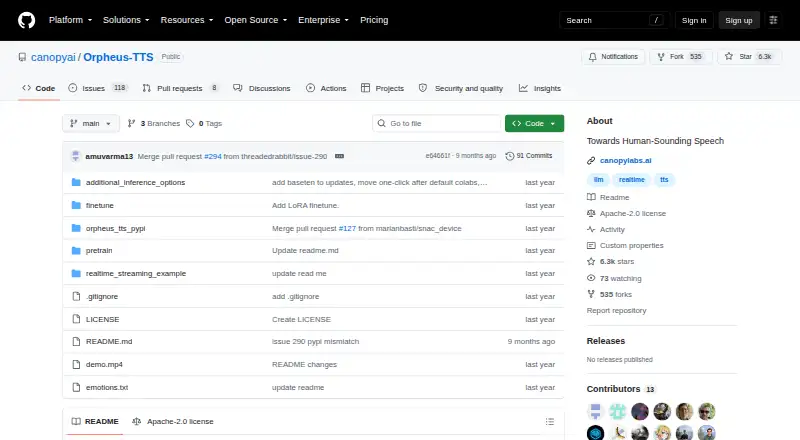
The facts below are what the maker publishes about Orpheus TTS, checked and dated. Our editors have not written about it yet.
The facts
Each one read from Orpheus TTS's own pages, with the date it was checked.
What it does
- API access
- Yeschecked 20 Sep 2026
- Baseten deployment
- The Baseten model page lists text input, audio output, Apache 2.0 licensing, and H100 MIG 40GB hardware.checked 12 Oct 2026
- Baseten throughput
- The Baseten model page says its implementation supports 16 concurrent real-time streams with variable traffic, 24 with consistent traffic, or 128 concurrent non-real-time generations.checked 12 Oct 2026
- Commercial use
- Yeschecked 20 Sep 2026
- Current hosted offering
- The maker’s Orpheus page describes enterprise deployments on customer infrastructure, including on-premise or private cloud, with priority support and SLA guarantees.checked 13 Oct 2026
- Customization
- The README provides data-processing scripts and sample datasets for creating finetunes, with training instructions for user datasets.checked 12 Oct 2026
- Deployment
- The repository documents local inference and one-click deployment through Baseten, which it calls its preferred inference partner.checked 13 Oct 2026
- Emotion controls
- Speech characteristics can be guided with tags, including tags for laughter, sighs, coughing, and gasping.checked 13 Oct 2026
- Export formats
- WAVchecked 20 Sep 2026
- Known limitations
- The repository checklist mentions an unresolved streaming issue that occasionally skips frames and a voice-cloning notebook implementation to fix.checked 13 Oct 2026
- License
- The GitHub repository identifies its license as Apache-2.0.checked 13 Oct 2026
- Limitations
- The README notes that the real-time streaming package may occasionally skip frames and lists fixing this as an open checklist item.checked 12 Oct 2026
- Models
- The repository offers an English finetuned production model, a pretrained model trained on more than 100,000 hours of English speech, and a multilingual research release.checked 13 Oct 2026
- Purpose
- Orpheus TTS is an open-source text-to-speech system built on a Llama 3B backbone.checked 13 Oct 2026
- Speech capabilities
- The project describes natural intonation, emotion, and rhythm, plus voice cloning without prior fine-tuning.checked 13 Oct 2026
- Speech controls
- Simple tags can guide speech and emotion characteristics, and the README lists tags such as <laugh>, <sigh>, and <gasp>.checked 12 Oct 2026
- Speech quality
- The project describes its speech as having natural intonation, emotion, and rhythm.checked 12 Oct 2026
- Streaming
- The repository reports about 200 ms streaming latency, reducible to about 100 ms with input streaming.checked 13 Oct 2026
- Training
- The repository provides data processing scripts and sample datasets for fine-tuning, and describes fine-tuning on text and speech.checked 13 Oct 2026
- Voice cloning
- The project lists zero-shot voice cloning without prior fine-tuning as an ability.checked 12 Oct 2026
- Watermarking
- The repository points to an implementation for watermarking generated audio with Silent Cipher.checked 13 Oct 2026
The company
- Company focus
- Canopy Labs describes itself as building realtime interactive models for avatars.checked 13 Oct 2026
- Headquarters
- San Francisco, California, United Stateschecked 28 Sep 2026
Where it runs
- Platforms
- api,self_hostedchecked 20 Sep 2026
Alternatives to Orpheus TTS
- 1
iSpeech
Free planOpen sourceAndroidiOSWebAPI8.5Free plan - 2

Voicebox
Free planOpen sourceAndroidiOSWebAPI8.5From $12 a year - 3

Resemble AI
Free planAndroidiOSWebAPI8.3From $280 a month - 4

Speechify
Free planAndroidiOSWebAPI8.3From $10 a month - 5
Voice.ai
Free planAndroidiOSWebAPI8.3From $5 a month - 6

Fliki
Free planAndroidiOSWebAPI8.2From $28 a month