OPUS-MT
The facts below are what the maker publishes about OPUS-MT, checked and dated. Our editors have not written about it yet.
Plans and prices
From OPUS-MT's own pricing page, checked 12 Oct 2026.
| Plan | Price | What it gives you |
|---|---|---|
| OPUS-MT models and services | Free | pretrained models are downloadable under CC-BY 4.0 · no commercial pricing listed |
The facts
Each one read from OPUS-MT's own pages, with the date it was checked.
What it does
- API access
- Yeschecked 22 Sep 2026
- API behavior
- The WebSocket client sends JSON with source text and source and target language IDs, and can request language detection by setting the source to detect or DL.checked 12 Oct 2026
- Deployment
- The web application can be installed manually or with Docker, with a separate Dockerfile for CUDA GPU use.checked 12 Oct 2026
- Integrations
- The project links to OPUS-CAT, which provides a local offline engine and plugins for SDL Trados Studio and memoQ, plus custom-provider use in Wordfast CAT.checked 12 Oct 2026
- Known quality limits
- The project warns that many automatic evaluation scores come from simple, short Tatoeba sentences and may overstate performance on more realistic data.checked 12 Oct 2026
- Language pair configuration
- The web server uses a JSON configuration to specify translation language pairs and model decoder configurations or remote hosts.checked 5 Oct 2026
- License
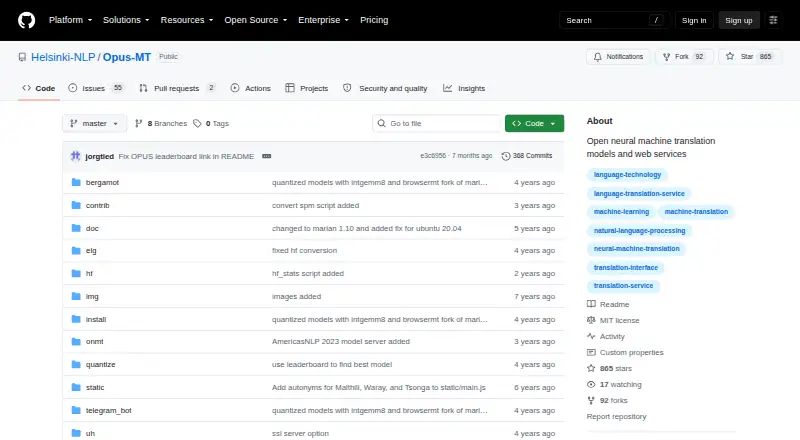
- The OPUS-MT software repository lists the MIT license, while its downloadable pretrained translation models are listed under CC-BY 4.0.checked 12 Oct 2026
- Maintainer
- The repository belongs to the Language Technology Research Group at the University of Helsinki, whose GitHub organization lists Helsinki, Finland.checked 12 Oct 2026
- Model foundation
- The models are based on Marian-NMT and trained on OPUS data using OPUS-MT-train.checked 5 Oct 2026
- Model framework
- The models and services are based on Marian-NMT and are mainly segmented with SentencePiece.checked 12 Oct 2026
- Model license
- The repository says its downloadable pre-trained translation models are licensed CC-BY 4.0.checked 5 Oct 2026
- Model limitations
- The maintainers state that current models lack filtering, data augmentation, domain adaptation, and quality control beyond automatic evaluation on selected test sets.checked 5 Oct 2026
- Privacy deployment
- The related OPUS-CAT engine is described as local and offline, intended to provide confidential machine translation on local computers.checked 12 Oct 2026
- Purpose
- OPUS-MT provides open neural machine translation models and web services.checked 12 Oct 2026
- Quality limitation
- The maintainers caution that many automatic evaluation scores use simple, short Tatoeba sentences and may be too optimistic for realistic data.checked 5 Oct 2026
- Training environment
- The project says its model-training scripts are currently tailored to the University of Helsinki and CSC computing environment.checked 12 Oct 2026
- Training limitation
- The maintainers say the model training scripts are heavily customized for the University of Helsinki and CSC computing environment.checked 5 Oct 2026
- Training limits
- The project says current models lack filtering, data augmentation and domain adaptation, and that there is no quality control beyond automatic evaluation on automatically selected test sets.checked 12 Oct 2026
- Translation models
- The project provides downloadable pretrained models trained on OPUS data, and the listed models use a CC-BY 4.0 license.checked 12 Oct 2026
- Translation output
- The WebSocket example returns translated text along with alignment and source and target segments.checked 5 Oct 2026
- Translation workflow integration
- The project points to OPUS-CAT as an NMT plugin for Trados Studio that can run OPUS-MT models.checked 5 Oct 2026
- Web interface and API
- One included setup is a Tornado-based web application with a web UI and API for multiple language pairs.checked 5 Oct 2026
Where it runs
- Linux service
- The project documents installing a WebSocket translation service on Ubuntu.checked 5 Oct 2026
- Web application
- One setup is a Tornado-based web application with a web interface and API for multiple language pairs.checked 12 Oct 2026
Alternatives to OPUS-MT
- 1
QuillBot
Free planAndroidiOSWebExtension8.3Free plan - 2

iTranslate
Free planAndroidiOSWebAPI8.2Free plan - 3

locize
Free planAndroidiOSWebAPI8.2From $7 a month - 4
SimpleLocalize
Free planAndroidiOSWebAPI8.2Free plan - 5

Lara Translate
Free planAndroidiOSWebAPI7.9From $9.99 a month - 6
Localizely
Free planWebAPILinuxmacOS7.9From $16 a month