OpenUBA
OpenUBA is an open-source framework for user and entity behavior analytics in security analytics.
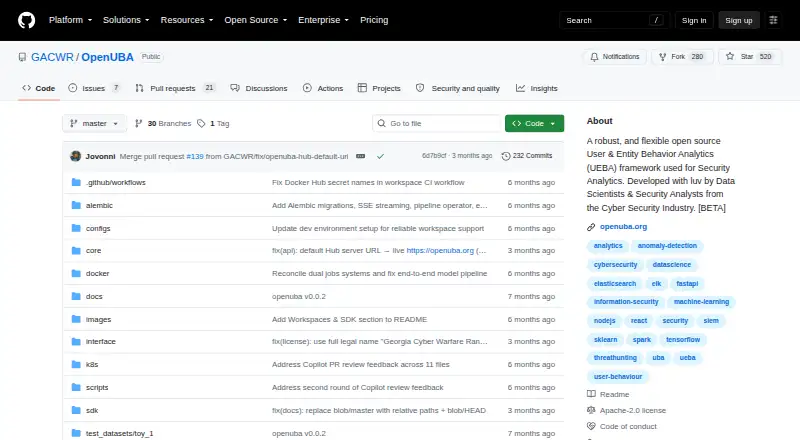
What OpenUBA is
OpenUBA is an open-source framework for user and entity behavior analytics in security analytics. It lets users install, train, and run models, track versions and artifacts, and use feedback and shadow modes. The listed frameworks include scikit-learn, PyTorch, TensorFlow, Keras, NetworkX, and Spark MLlib. A visual rule builder combines model outputs with logical conditions, and alerts can link to anomalies and cases. Data loaders include local CSV, Elasticsearch, Spark, and aggregated sources. The project describes a Kubernetes-native deployment, with containerized components for development Kind clusters or production Kubernetes clusters. It provides REST endpoints, GraphQL, and a Python SDK. Listed controls include JWT authentication, four roles, per-page permissions, audit logging, and cryptographic model hash verification. Training and inference use isolated Docker containers or ephemeral Kubernetes Jobs with resource limits. The assistant supports local Ollama and cloud APIs from OpenAI, Claude, and Gemini. The README labels the project beta, and its v0.0.2 release is listed as a pre-release.
Good
- Supports several machine-learning frameworks
- Combines model outputs and conditions in visual rules
- Provides REST, GraphQL, and Python SDK interfaces
- Lists role-based permissions and audit logging
- Offers local and cloud assistant providers
Watch out
- README labels the project beta
- v0.0.2 is listed as a pre-release
- HuggingFace integration is marked planned
Who it suits
OpenUBA is aimed at security analytics teams working with user and entity behavior models. The project says its inspectable, auditable model approach is designed for security analysts who want to understand how models work.
Verdict
OpenUBA brings model lifecycle tools, detection rules, and deployment controls into one security analytics framework. Its beta and pre-release status are worth considering before relying on it for operational use.
The facts
Each one read from OpenUBA's own pages, with the date it was checked.
What it does
- Access control
- The README lists JWT authentication, four roles, configurable per-page read/write permissions, and audit logging.checked 4 Oct 2026
- API and SDK
- The project documents a REST API, GraphQL API, and Python SDK installable with pip for model registration, job submission, and visualization.checked 8 Oct 2026
- Current maturity
- The repository README labels the project beta and identifies the release as v0.0.2.checked 4 Oct 2026
- Data integrations
- Built-in data loaders support local CSV files, Elasticsearch, Spark, and aggregated source groups.checked 8 Oct 2026
- Data sources
- Listed data loaders include local CSV, Elasticsearch, Spark, and aggregated multi-source loading.checked 4 Oct 2026
- Deployment
- OpenUBA is Kubernetes-native, with Docker containers and ephemeral Kubernetes jobs for model training and inference.checked 8 Oct 2026
- Deployment security guidance
- The security policy recommends TLS behind a reverse proxy, Kubernetes RBAC, Kubernetes Secrets for database credentials, network policies, and regular container image updates.checked 8 Oct 2026
- Detection and response
- A visual flow-based rule builder combines model outputs and logical conditions to generate alerts that can be linked to anomalies and cases.checked 8 Oct 2026
- Detection rules
- A visual flow-based rule builder composes model outputs and logical conditions, with triggered alerts linked to anomalies and cases.checked 4 Oct 2026
- Execution isolation
- Model training and inference run in isolated Docker containers or ephemeral Kubernetes Jobs, with resource limits described as a way to contain misbehaving models.checked 4 Oct 2026
- Intended users
- OpenUBA is designed for security analysts interested in understanding how detection models work under the hood.checked 8 Oct 2026
- LLM integrations
- The built-in assistant supports Ollama locally and cloud API providers OpenAI, Claude, and Gemini.checked 8 Oct 2026
- LLM providers
- The built-in assistant supports local Ollama and cloud APIs from OpenAI, Claude, and Gemini.checked 4 Oct 2026
- Model frameworks
- Documented model frameworks include scikit-learn, PyTorch, TensorFlow, Keras, NetworkX, and Spark MLlib.checked 8 Oct 2026
- Model lifecycle
- The platform supports installing, training, and running inference with models, and tracks model versions and artifacts.checked 8 Oct 2026
- Model registries
- The README lists GitHub, OpenUBA Hub, HuggingFace, Kubeflow, and local filesystem as model registry options, while noting HuggingFace integration as planned in its adapter table.checked 8 Oct 2026
- Model transparency
- The project describes its models as inspectable and auditable, with model source code available for inspection.checked 8 Oct 2026
- Product
- OpenUBA is an open-source User and Entity Behavior Analytics framework for security analytics.checked 8 Oct 2026
- Release status
- The GitHub releases page lists OpenUBA v0.0.2 as a pre-release.checked 8 Oct 2026
- Security controls
- The README describes JWT authentication, role-based access control, per-page permissions, audit logging, and cryptographic model hash verification.checked 8 Oct 2026
- Support
- The security policy asks vulnerability reporters to email [email protected] and states an acknowledgment target of 48 hours and an initial assessment target of 7 days.checked 8 Oct 2026
Where it runs
- Approach
- It uses inspectable, auditable models and says model transparency supports compliance, investigations, and decision making.checked 4 Oct 2026
The full review of OpenUBA
OpenUBA is a free, open-source framework for user and entity behavior analytics that combines model operations with security detection workflows. It suits security analysts and engineering teams who want inspectable models, custom rules, and control over deployment. The broad toolkit is compelling for teams prepared to run Kubernetes infrastructure, while its beta, pre-release maturity calls for caution in production-critical operations.
Overview
OpenUBA brings model installation, training, execution, and detection response into one security analytics framework. Teams can track model versions and artifacts, incorporate feedback, and use shadow modes before putting changes into active use. Model outputs can feed visual rules that combine logical conditions, generate alerts, and link those alerts to anomalies and cases.
The project focuses on users and other entities and uses hybrid anomaly methods. Its emphasis on inspectable, auditable models is valuable when analysts must explain behavior during investigations, compliance work, or operational decisions. Source-level visibility is a stronger fit for teams that need to understand and modify detection logic than for buyers seeking a finished, opaque appliance.
The repository identifies the software as beta, and GitHub lists v0.0.2 as a pre-release. That early status limits confidence for organizations that require a mature release process, although it leaves technically capable teams room to shape their own implementation.
Key features
Model lifecycle and frameworks
OpenUBA supports installing, training, and running models while recording versions and artifacts. Feedback and shadow modes help teams compare or observe models before relying on their decisions. Listed integrations cover scikit-learn, PyTorch, TensorFlow, Keras, NetworkX, and Spark MLlib, giving data-science teams a wide choice of existing tooling rather than forcing one modeling stack.
Rules, alerts, and data
The visual, flow-based rule builder combines model results with logical conditions. Alerts can be connected to anomalies and cases, making the system more useful for investigation workflows than a score-only pipeline. Data loaders cover local CSV files, Elasticsearch, Spark, and aggregated multi-source loading, which suits deployments that need to combine activity from different systems.
Deployment and interfaces
The architecture is Kubernetes-native. Components run in containers for a development Kind cluster or a production Kubernetes cluster, so teams gain a path from local evaluation to cluster deployment but must be comfortable operating that environment. REST endpoints, a GraphQL API, and a Python SDK support model registration, job submission, and visualization.
Security and assistance
JWT authentication, four roles, configurable per-page read and write permissions, audit logging, and cryptographic model hash verification provide useful governance controls. Training and inference run in isolated Docker containers or ephemeral Kubernetes Jobs with resource limits, reducing the blast radius of a misbehaving model. The built-in assistant supports local Ollama as well as OpenAI, Claude, and Gemini cloud APIs, giving teams a choice between local and hosted processing.
Pricing
OpenUBA is free and open source, with a free plan and no stated seat, usage, or trial limits. That removes subscription cost and permits teams to align spending with their own infrastructure and operating effort. The trade-off is that running Kubernetes, data pipelines, model workloads, and security controls remains the buyer's responsibility; the project does not provide a paid tier that packages those obligations into a managed service.
Platforms
OpenUBA is offered as an API, web application, Linux software, and self-hosted deployment. Its container and Kubernetes model makes self-hosting central rather than incidental, while the API and SDK support integration into existing security tooling.
Who it's for
Security analysts who want to inspect how models work are the clearest audience. It also fits data-science and platform teams that already use the listed ML frameworks and can operate Kind or Kubernetes clusters. Organizations needing transparent, auditable detection logic may value the model source visibility, version tracking, and audit controls.
It is a weaker choice for teams seeking a turnkey, vendor-operated UEBA product, a mature release with established operational assurances, or a deployment that avoids Kubernetes and container administration.
Pros and cons
Pros
- Inspectable model design: Auditable source and transparent behavior support investigations and compliance decisions.
- Broad ML coverage: Support for six named frameworks lets teams reuse varied modeling expertise.
- Complete workflow: Lifecycle tracking, visual rules, alerts, anomalies, and cases connect modeling to response.
- Flexible integration: CSV, Elasticsearch, Spark, aggregated sources, REST, GraphQL, and Python interfaces cover common integration patterns.
- Useful isolation controls: Containerized jobs and resource limits help contain faulty or abusive workloads.
Cons
- Early maturity: Beta labeling and pre-release v0.0.2 make it a cautious choice for critical production operations.
- Operational burden: Kubernetes-native deployment and self-hosting require platform expertise and ongoing administration.
- Open-source responsibility: The free price does not remove the work of securing clusters, managing data, and maintaining model pipelines.
- Uneven registry status: The project lists several registry options, while its adapter table marks HuggingFace integration as planned.
Alternatives
Choose Netskope One Behavior Analytics instead when you want a paid platform with cloud-application anomaly rules covering uploads, downloads, deletes, failed logins, rare events, risky countries, and data movement.
Proofpoint Email DLP and Encryption is a paid option for teams that specifically need email-focused data loss prevention and encryption across Android, iOS, web, and Windows.
Pick Security Vision TIP when a paid, self-hosted or Linux/API/web deployment with individually calculated modules, connectors, event volume, nodes, and support better matches procurement needs.
DTEX Insider Risk Management is a paid alternative centered on insider-risk management with demo-led purchasing.
Consider Teramind Insider Risk Management when you want a paid product with a free trial and an enterprise plan offering tailored deployment assistance, custom behavior-rule reporting, premium support, and an SLA.
Security Vision UEBA provides a paid API, Linux, self-hosted, web, and Windows option priced individually by modules, connectors or event volume, nodes, support, license type, and multi-tenancy.
Choose Securonix UEBA when you prefer a paid web platform with tiered storage and search-capacity plans.
VbtEngine UEBA is another paid self-hosted and web alternative.
Verdict
OpenUBA is best for technically capable security teams that want a free, transparent UEBA foundation they can adapt, inspect, and deploy on their own Kubernetes infrastructure. Its strongest reason to choose it is the combination of open model visibility, broad framework support, and connected detection workflows. Look elsewhere if operational maturity, managed delivery, or minimal platform administration matters more than control and extensibility.
Alternatives to OpenUBA
- 1
Microsoft Defender for Business
AndroidiOSAPImacOS7.5 - 2

NetWitness Platform
WebAPILinuxmacOS6.5 - 3
Teramind Insider Risk Management
WebAPILinuxmacOS6.4 - 4
Security Vision UEBA
WebAPILinuxSelf-hosted6.3 - 5

Netskope One Behavior Analytics
AndroidiOSWebAPI6.1 - 6

Veriato Insider Risk Management
AndroidAPImacOSSelf-hosted6.1