OpenStitch
OpenStitch is a free, open-source tool for turning text prompts, screenshots, or sketches into rendered, interactive frontend code.
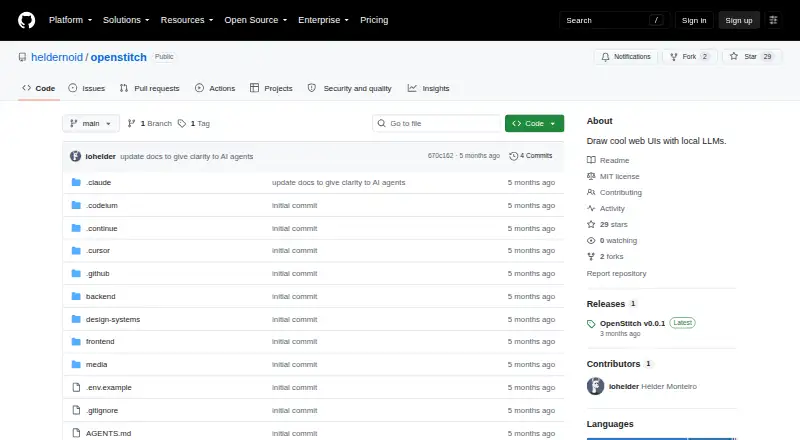
What OpenStitch is
OpenStitch is a free, open-source tool for turning text prompts, screenshots, or sketches into rendered, interactive frontend code. It is designed to run locally, with Docker, Docker Compose, and Ollama required for the documented quick start. Users can describe a screen in natural language to generate HTML, or use a vision model to create code from a screenshot or rough wireframe. More than 50 brand design systems are available, and users can also ask AI to create one from a description. Its infinite canvas lets users arrange screens, connect them into flows, and preview them in Play Mode with simulated click navigation. Screens can be downloaded as a ZIP containing DESIGN.md and individual HTML files. The project supports HTML and Tailwind CSS, responsive code, and Ollama or OpenRouter; OpenAI, Anthropic, and Gemini are wired up but described as untested. It stores data in SQLite through a Docker volume and is licensed under MIT.
Good
- Accepts text prompts, screenshots, and sketches.
- Offers more than 50 brand design systems.
- Exports screens as a ZIP of HTML files.
- Supports responsive code and Tailwind CSS.
- MIT-licensed and open source.
Watch out
- Quick start requires Docker, Docker Compose, and Ollama.
- No authentication; public exposure of ports 3000 or 7001 is discouraged.
- No multi-user collaboration; SQLite is unsuitable for concurrent access.
- Play Mode does not generate real router code.
Who it suits
OpenStitch suits people drawing web UIs with local language models, especially those who want to turn prompts, screenshots, or wireframes into HTML and arrange screens on a canvas. Its setup and security model favor local or private-network use.
Verdict
OpenStitch brings local AI-assisted screen generation, canvas-based flows, and HTML export together. Its single-user design, setup requirements, and preview limitations are important to weigh before using it for a shared or production workflow.
The facts
Each one read from OpenStitch's own pages, with the date it was checked.
What it does
- AI integrations
- Ollama and OpenRouter are supported; OpenAI, Anthropic, and Gemini are wired up but described as untested.checked 4 Oct 2026
- Canvas and prototyping
- Its infinite canvas lets users arrange screens and connect them into flows, which can be previewed in Play Mode with click navigation.checked 4 Oct 2026
- Cloud model use
- Cloud models are optional, used on demand rather than by default, and API keys can be set in the environment or app settings.checked 4 Oct 2026
- Collaboration and storage
- OpenStitch is single-user with no collaboration, and its SQLite database is described as unsuitable for concurrent access.checked 4 Oct 2026
- Data storage
- The app uses a SQLite database persisted through a Docker volume.checked 5 Oct 2026
- Deployment
- The quick-start requirements are Docker, Docker Compose, and Ollama running locally; the app is opened in a browser at localhost:3000.checked 5 Oct 2026
- Design systems
- The project offers more than 50 brand design systems, including Linear, Stripe, Vercel, and ElevenLabs, or can generate one from a description.checked 5 Oct 2026
- Export
- Users can download screens as a ZIP containing DESIGN.md and per-screen HTML files.checked 5 Oct 2026
- Integrations
- Ollama runs models locally; OpenRouter is the only cloud provider the README says has been tested, while OpenAI, Anthropic, and Gemini are wired up but untested.checked 5 Oct 2026
- Intended users
- The project describes itself as a tool for drawing web UIs with local LLMs.checked 4 Oct 2026
- License
- The repository is licensed under the MIT License.checked 5 Oct 2026
- Limitations
- Play Mode simulates click navigation without generating real router code, and some browser APIs do not work in the preview iframe.checked 4 Oct 2026
- Limits
- The README says the app has no multi-user collaboration and SQLite is not designed for concurrent access.checked 5 Oct 2026
- Local setup
- The documented quick start requires Docker with Docker Compose and Ollama running locally.checked 4 Oct 2026
- Preview limits
- Play Mode simulates click navigation without generating real router code, and some browser APIs do not work in the iframe preview.checked 5 Oct 2026
- Privacy
- The README describes OpenStitch as requiring no cloud, while also allowing optional cloud model providers.checked 4 Oct 2026
- Prototyping
- Screens can be arranged on an infinite canvas, connected into flows, and previewed in Play Mode with simulated click navigation.checked 5 Oct 2026
- Purpose
- OpenStitch is an open-source, locally runnable AI UI design tool that generates interactive frontend code on an infinite canvas.checked 5 Oct 2026
- Screenshot and sketch input
- Users can provide screenshots or rough wireframes and generate code replicas with a vision model.checked 5 Oct 2026
- Security
- OpenStitch has no authentication and is intended for local or private-network use; the README warns not to expose ports 3000 or 7001 to the public internet.checked 5 Oct 2026
- Text to UI
- Users can describe a screen in natural language and generate working HTML files.checked 5 Oct 2026
- What it does
- OpenStitch is an open-source, locally runnable AI UI design tool that generates rendered, interactive frontend code from text descriptions, screenshots, or wireframe sketches.checked 4 Oct 2026
Alternatives to OpenStitch
- 1

Figma Make
Free planAndroidiOSWebAPI8.2Free plan - 2
v0
Free planiOSWebAPI7.8From $30 a month - 3
Kombai
Free planWebAPIExtensionLinux7.7From $20 a month - 4

CoderUI
Free planWebAPI7.2From $29 a month - 5

Builder.io
Free planWebAPIExtension7.1From $24 a month - 6

Alloy
Free planExtension6.9From $20 a month