OpenPubkey
OpenPubkey links a user or workload identity verified through OpenID Connect to a public key, allowing that identity to sign messages and artifacts.
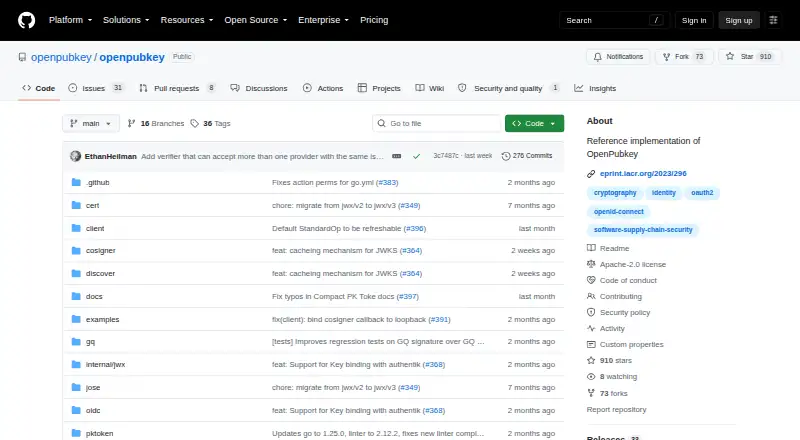
What OpenPubkey is
OpenPubkey links a user or workload identity verified through OpenID Connect to a public key, allowing that identity to sign messages and artifacts. A PK Token records proof that the identity controlled its associated private key at a particular time, if the verifier trusts the identity provider. The project lists Google, Azure/Microsoft, Okta, OneLogin, and Keycloak as compatible without provider changes, but says its client and verifier currently handle Google for users and GitHub for workloads. Workload identity use requires GQ signatures; for users, they are unnecessary when the PK Token is not public. Public tokens may reveal claims from an OIDC ID Token, such as a name or email address. OpenPubkey says it needs no added certificate authority because the identity provider fills that role. It is a free Linux Foundation project under Apache 2.0, and its repository says it is being prepared for version 1.0. The project directs technical questions and reports to GitHub issues and offers a community Slack channel.
Good
- Supports both user and workload identities.
- Compatible with several OIDC providers without provider changes.
- No additional certificate authority is required.
- Free and released under Apache 2.0.
- Go client and verifier examples cover signing and verification.
Watch out
- Current user token support is Google-based.
- Current workload token support is GitHub-based.
- Public tokens may expose name or email claims.
- MFA cosigning is unsupported for workloads.
Who it suits
It suits developers and teams who want user or workload identities to sign messages or artifacts using OIDC-based identity. Workload use requires GQ signatures, and public PK Tokens can disclose identity claims.
Verdict
OpenPubkey provides an OIDC-linked way to associate identities with signatures on messages and artifacts. Check current provider support and consider the privacy implications of making PK Tokens public.
Plans and prices
From OpenPubkey's own pricing page, checked 8 Oct 2026.
| Plan | Price | What it gives you |
|---|---|---|
| OpenPubkey | Free | Open source · Apache 2.0 license · Reference implementation |
The facts
Each one read from OpenPubkey's own pages, with the date it was checked.
What it does
- Adoption
- The README says Docker is building a public container registry that uses OpenPubkey to sign Docker Official Images, and BastionZero uses it for secure remote infrastructure access.checked 8 Oct 2026
- Current providers
- The project says its client and verifier currently create and verify PK Tokens from Google for users and GitHub for workloads.checked 8 Oct 2026
- Current provider support
- The project says its client and verifier currently create and verify PK Tokens from Google for users and GitHub for workloads.checked 7 Oct 2026
- Development status
- The README says the project is working to get the repository ready for version 1.0.checked 8 Oct 2026
- Identity providers
- The README lists Google, Azure/Microsoft, Okta, OneLogin, and Keycloak as compatible OpenID Providers without requiring provider changes.checked 8 Oct 2026
- Identity types
- OpenPubkey supports both user identities and workload identities.checked 7 Oct 2026
- Integrations
- The project identifies Docker as using OpenPubkey to sign Docker Official Images and BastionZero as using it for secure remote infrastructure access.checked 7 Oct 2026
- Key handling
- OpenPubkey assumes identity-held key pairs are ephemeral and says users generate them as needed and delete them when finished.checked 8 Oct 2026
- License
- OpenPubkey is a Linux Foundation project released under the Apache 2.0 license.checked 7 Oct 2026
- MFA cosigner
- For user identity scenarios, an optional MFA cosigner protocol independently authenticates the user and cosigns the PK Token; the FAQ says this is unsupported for workload identities.checked 8 Oct 2026
- No added CA
- The project says OpenPubkey does not require adding a certificate authority because the OpenID Provider fulfills that role.checked 8 Oct 2026
- PK Tokens
- A PK Token bundles an OpenID Connect ID Token with proof that the identity holder controls the associated private key.checked 8 Oct 2026
- Privacy consideration
- Public PK Tokens expose claims from the signer's OIDC ID Token, which may include their name or email address.checked 8 Oct 2026
- Project governance
- OpenPubkey describes itself as a Linux Foundation project licensed under Apache 2.0.checked 8 Oct 2026
- Providers
- The project says it is compatible with Google, Azure/Microsoft, Okta, OneLogin, and Keycloak without changes to the identity provider.checked 7 Oct 2026
- Purpose
- OpenPubkey binds user or workload identities to public keys through OpenID Connect, allowing identities to sign messages or artifacts.checked 8 Oct 2026
- Replay protection
- GQ signatures let the provider signature be stripped and replaced with proof, preventing the ID Token from being replayed against OIDC resource providers.checked 8 Oct 2026
- Security reporting
- The security policy asks reporters to email [email protected] privately and says the project does not currently offer bug bounties.checked 8 Oct 2026
- Support
- The project directs feature requests, bug reports, and technical questions to GitHub issues and points users to its OpenSSF Slack channel.checked 8 Oct 2026
- Usage
- The README demonstrates using the Go client and verifier to authenticate, create a PK Token, sign a message, and verify the signature.checked 7 Oct 2026
- Workload requirement
- GQ signatures are required for all current workload identity use cases; they are unnecessary for user identity scenarios where the PK Token is not public.checked 7 Oct 2026
The full review of OpenPubkey
OpenPubkey is an open-source project for tying user and workload identities to signing keys through OpenID Connect. It suits teams building identity-backed signing into systems that already trust an OpenID Provider. Its CA-free approach is appealing, but current provider support and the privacy of public tokens deserve careful consideration.
Overview
OpenPubkey links an identity to a public key through OpenID Connect. A PK Token proves that the identity controlled the associated private key at a particular time, as long as the verifier trusts the identity provider. This makes OpenPubkey a signing building block rather than a certificate service: it provides no certificate and relies on the provider in that role.
The project supports signing messages and artifacts for both people and workloads. Its Go client and verifier example walks through authentication, creating a PK Token, signing a message, and verifying the signature. Docker is building a public registry that uses OpenPubkey to sign Docker Official Images, and BastionZero uses it for secure remote infrastructure access. The project is preparing for version 1.0, so teams adopting it should account for its pre-1.0 development status.
Key features
Identity-backed signing without an added CA
Teams can associate signing keys with identities from an OpenID Provider without changing that provider or adding a separate certificate authority. That is a useful fit when an organization already has a provider it trusts. The trade-off is that verifiers inherit that trust decision: the identity provider remains central to the proof.
Provider compatibility and current coverage
OpenPubkey says it is compatible with Google, Azure/Microsoft, Okta, OneLogin, and Keycloak without provider changes. Its client and verifier currently create and verify PK Tokens from Google for user identities and GitHub for workloads. That gap between broad compatibility claims and current client coverage matters: teams relying on another provider should confirm that their intended flow is supported before building around it.
Replay protection and workload signing
GQ signatures let the OpenID Provider's signature be removed from an ID Token while preserving proof that the provider signed it. This prevents the token from being reused against OIDC resource providers. GQ signatures are required for all current workload identity use cases, adding a prerequisite for teams signing as workloads. They are unnecessary for user scenarios when the PK Token is not public.
Token privacy and key handling
Public PK Tokens expose claims from the signer's ID Token, which may include a name or email address. That is a material privacy cost when signatures or artifacts are publicly visible. OpenPubkey also assumes identity-held key pairs are ephemeral: users generate them as needed and delete them when finished, a lifecycle that teams must accommodate.
For user identity scenarios, an optional MFA cosigner protocol independently authenticates the user and cosigns the PK Token. It adds a second authentication step, but does not support workload identities.
Pricing
OpenPubkey is free and open source under the Apache 2.0 license. Its reference implementation costs nothing. That makes it accessible to teams able to integrate and operate the project themselves; it is not a priced hosted service or a certificate purchase.
Platforms
OpenPubkey supports API, Linux, macOS, self-hosted, and Windows environments. The project provides a Go client and verifier example. It targets messages and artifacts and does not provide a certificate.
Who it's for
OpenPubkey is best for developers and infrastructure teams that want signatures tied to user or workload identities from an OpenID Provider they already trust. Its strongest fit today is a Google-backed user flow or a GitHub-backed workload flow, especially where avoiding an added CA matters. Teams that need public tokens should weigh the identity claims those tokens can expose; workload teams also need to account for GQ signatures.
Support runs through GitHub issues for bugs, feature requests, and technical questions, with a community Slack channel for discussion. Security reports should be sent privately to [email protected]; the project does not offer bug bounties.
Pros and cons
Pros
- No added CA: OpenID Provider trust supplies the signing identity role, which can avoid introducing another certificate authority.
- User and workload identities: The project covers both, with message and artifact signing as targets.
- Free and Apache 2.0 licensed: Teams can use the reference implementation without a per-use charge and adapt it under the stated open-source license.
Cons
- Current provider coverage is narrow: The client and verifier currently support Google for users and GitHub for workloads, limiting immediate fit for teams using other providers.
- Public tokens can disclose identity claims: Names or email addresses from an ID Token may be exposed when PK Tokens are public.
- Workload signing requires GQ signatures: Teams must include that requirement in their workload setup.
- Pre-1.0 development: The project is still being prepared for version 1.0, a consideration for production adoption.
Alternatives
For a broader set of code-signing options, see Code Signing Software.
- Cosign is another free, open-source option for Linux, macOS, self-hosted, and Windows environments, with no hosted service or usage limits stated.
- SignPath offers a free plan for open-source projects, subject to eligibility conditions, and supports API, Linux, macOS, self-hosted, web, and Windows environments.
- SignServer has a free community plan for basic code, document, and container signing and timestamping, with source code or container deployment; it also offers a free trial.
- AWS Signer has no additional charge for use with AWS IoT Device Management, AWS Lambda, Amazon ECR, Amazon EKS, or third-party container services.
- Notation is a free Apache 2.0 licensed CLI project for Linux, macOS, and Windows.
- Sigstore is free for developers and software providers, with API, Linux, macOS, self-hosted, and Windows support.
- Aujas Automated Code Signing Platform uses signing-based licenses with custom pricing.
- DigiCert Software Trust Manager uses custom pricing.
Verdict
Choose OpenPubkey if you need free, identity-linked signing for messages or artifacts and your team can work within its current Google user or GitHub workload support. Its central advantage is tying signatures to an existing OIDC identity without adding a CA. Look elsewhere if your required provider is not covered by the current client and verifier, or if public PK Token claims create an unacceptable privacy trade-off.
Getting started
- Visit the OpenPubkey GitHub repository.
- Use the Go client and verifier to authenticate with a supported current provider.
- Create a PK Token for the user or workload identity.
- Sign a message or artifact with the identity-held key.
- Verify the signature with the verifier.
- Generate identity-held key pairs as needed and delete them when finished.
Questions
Is OpenPubkey free, and what license does it use?
The listed plan is free. OpenPubkey is a Linux Foundation project released under the Apache 2.0 license.
Which identity providers does it support?
The project describes compatibility with Google, Azure/Microsoft, Okta, OneLogin and Keycloak without provider changes. Its client and verifier currently create and verify PK Tokens from Google for users and GitHub for workloads.
What can OpenPubkey identities sign?
The project identifies messages and artifacts as signing targets.
Are GQ signatures required?
They are required for all current workload identity use cases. They are unnecessary for user scenarios where the PK Token is not public.
Can public PK Tokens reveal personal information?
Yes. Public PK Tokens expose claims from the signer’s OIDC ID Token, which may include a name or email address.
Does OpenPubkey use an additional certificate authority?
No. The project says the OpenID Provider serves that role.
Alternatives to OpenPubkey
- 1

Sigstore
Free planOpen sourceWebAPILinuxmacOS7.6Free plan - 2

SignPath
Free planWebAPILinuxmacOS7.2Free plan - 3

AWS Signer
Free planWebAPILinuxmacOS7.1Free plan - 4
Cosign
Free planLinuxmacOSSelf-hostedWindows6.6Free plan - 5

SignServer
Free planWebAPILinuxmacOS6.5Free plan - 6
Aujas Automated Code Signing Platform
WebLinuxmacOSSelf-hosted6.3