OpenNetAdmin
OpenNetAdmin is a self-hosted IP address management system for tracking network records such as DNS names, IP addresses, subnets, and MAC addresses.
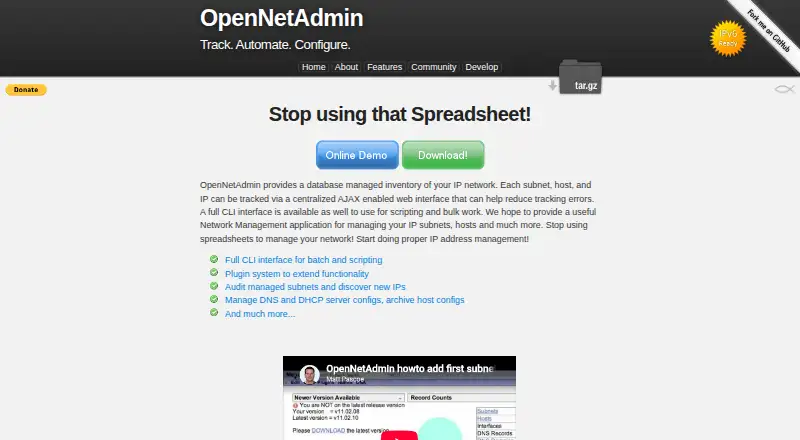
What OpenNetAdmin is
OpenNetAdmin is a self-hosted IP address management system for tracking network records such as DNS names, IP addresses, subnets, and MAC addresses. Its centralized AJAX web interface and command-line tools support routine administration as well as scripting and bulk work. The feature set includes IPv6, DNS records, overlapping DNS views, VLANs, DHCP pools, NAT tracking, and custom attributes. Templates and backend processes can generate DNS, DHCP, and router configurations, including for distributed servers. The project describes the inventory as a manually maintained authoritative source for network configuration, with discovery tools available to help populate and audit its records. Configuration archives can hold multiple device configurations and show syntax-highlighted differences. Authentication options include local accounts and LDAP, with local user and group permissions. Plugins provide an extension framework; listed connections include BIND-DLZ and host actions for applications such as Splunk, Nagios, Cacti, and Base. The core is GPLv2.0, though some modules or plugins may have separate licenses. OpenNetAdmin is free, and its documentation directs users to install it on a web server. The project notes that only MySQL is tested among its database backends.
Good
- Tracks IPv6, DNS, DHCP, VLANs, NAT, and subnets.
- Provides web and command-line interfaces.
- Generates DNS, DHCP, and router configurations.
- Archives device configurations with syntax-highlighted diffs.
- Supports LDAP authentication and local permissions.
Watch out
- Only MySQL is tested among its database backends.
- Puppet, MCollective, and several discovery tools are listed as in progress.
- Some modules or plugins may have separate licenses.
- Requires installation on a web server.
Who it suits
OpenNetAdmin suits network teams that need a self-managed inventory for address, DNS, DHCP, and configuration work. It is aimed at organizations maintaining network changes and automating repeatable configurations.
Verdict
OpenNetAdmin combines network inventory, configuration generation, and change history in a free self-hosted system. Its database testing scope and in-progress integrations are worth checking against your requirements.
Plans and prices
From OpenNetAdmin's own pricing page, checked 9 Oct 2026.
| Plan | Price | What it gives you |
|---|---|---|
| OpenNetAdmin | Free | Open-source IPAM system; no paid plans or usage limits stated |
The facts
Each one read from OpenNetAdmin's own pages, with the date it was checked.
What it does
- Authentication
- The feature page lists LDAP and local authentication backends, plus locally stored user and group permissions.checked 9 Oct 2026
- Authoritative inventory
- The maker says ONA is intended to be manually maintained as an authoritative source that drives network configuration, with discovery tools helping populate and audit its data.checked 8 Oct 2026
- Automation
- It can generate templated configurations and DNS and DHCP server configurations, including for distributed servers.checked 8 Oct 2026
- Configuration history
- Per-device configuration archives can store multiple entries and compare them with syntax-highlighted diffs.checked 9 Oct 2026
- Database support
- The site describes an ADODB abstraction layer for multiple database backends and says only MySQL has been tested.checked 9 Oct 2026
- Deployment
- The download page offers the current release, tagged releases, and add-ons; the project README instructs users to install it on a web server.checked 9 Oct 2026
- Development status
- The project README says a recent update addressed incompatibilities with newer PHP, MySQL, and operating system versions, while noting that little else fundamentally changed.checked 8 Oct 2026
- Integrations
- User-defined host action links can connect records to tools such as Splunk, Nagios, Cacti, and Base; the page describes Puppet and MCollective integration as in progress.checked 9 Oct 2026
- Intended users
- The maker describes use in small and large organizations that need to track network changes and automate repeatable configurations.checked 8 Oct 2026
- Interfaces
- It provides an AJAX web interface and a command-line interface for batch management and scripting.checked 9 Oct 2026
- IPv6 and DNS
- Features include IPv6 addressing and DNS records such as A, CNAME, PTR, NS, MX, TXT, and SRV.checked 9 Oct 2026
- License
- The project repository says OpenNetAdmin is released under the GPLv2.0 license.checked 9 Oct 2026
- Network automation
- Backend processes can build DHCP, DNS, and router configurations, while templates support configuration generation.checked 9 Oct 2026
- Network records
- The feature list includes IPv6 addressing, DNS records, overlapping DNS views, VLANs, DHCP pools, NAT tracking, and custom attributes.checked 8 Oct 2026
- Notable limits
- The site lists Puppet and MCollective integration, continuing DNS and DHCP configuration work, and several discovery tools as in progress.checked 9 Oct 2026
- Plugins and authentication
- A plugin framework supports extensions and authentication backends; the listed available backends are LDAP and local authentication.checked 8 Oct 2026
- Purpose
- OpenNetAdmin tracks IP network attributes, including subnets, hosts, IP addresses, MAC addresses, and DNS names.checked 9 Oct 2026
- Scale example
- The feature page reports a deployment handling 40,000+ subnets, 670,000+ hosts, and 721,000+ IP interfaces on a 400 MHz PPC server with 2 GB of memory.checked 9 Oct 2026
- Security and access
- The feature list describes local user and group authorization with configurable group rights, as well as LDAP authentication support.checked 8 Oct 2026
- Support
- The community page directs users to GitHub issues for questions and problem reports and provides documentation links.checked 9 Oct 2026
- Web and CLI
- It provides a centralized AJAX-enabled web interface and a command-line interface for scripting and bulk work.checked 8 Oct 2026
The full review of OpenNetAdmin
OpenNetAdmin is a self-hosted IP address management system for organizations that want a maintained, authoritative network inventory. It suits administrators who need configuration generation alongside record keeping and are comfortable operating a web server. Its broad network model and free, open-source licensing are compelling, but MySQL is the only tested database and several integrations remain unfinished.
Overview
OpenNetAdmin (ONA) consolidates IP addresses, subnets, DNS names, MAC addresses, and other network attributes in one database. The system is designed for people to maintain that inventory as the source of truth, while discovery tools assist with population and auditing. This is a good fit for controlled change: teams decide what belongs in the authoritative record before generating production configuration. It is less suitable for organizations expecting automatic discovery to replace operational ownership of network data.
The project targets both small and large organizations. Its feature page cites a deployment managing more than 40,000 subnets, 670,000 hosts, and 721,000 IP interfaces on a 400 MHz PPC server with 2 GB of memory. That example indicates substantial scale is possible, although the administrative discipline required to keep such an inventory accurate remains significant.
Key features
Inventory, subnet planning, and DNS
ONA handles IPv6 addressing, subnets, VLANs, DHCP pools, NAT tracking, custom attributes, and DNS records such as A, CNAME, PTR, NS, MX, TXT, and SRV. Overlapping DNS views are useful where different network contexts need distinct answers. This is a considerably broader record model than a simple address list, making it appropriate for teams coordinating IPAM, DNS, and DHCP data in one place.
Interfaces and automation
An AJAX web interface provides centralized administration, while the command-line interface supports scripting, batch changes, and repeatable operational tasks. Backend processes and templates can generate DHCP, DNS, and router configurations, including output for distributed servers. That can reduce repeated manual edits, but generated files are only as dependable as the inventory and templates behind them.
History, plugins, and integrations
Configuration archives retain multiple device versions and provide syntax-highlighted comparisons, giving teams a practical way to review changes and investigate regressions. A plugin framework allows extensions and authentication backends; local authentication and LDAP are supported, alongside locally stored users, groups, and configurable group rights. Host actions can connect with Splunk, Nagios, Cacti, and Base, and BIND-DLZ can let BIND query the ONA database directly.
Puppet and MCollective integration, continuing DNS and DHCP configuration work, and several discovery tools are still in progress. Those gaps matter if your rollout depends on those workflows immediately rather than on the mature inventory and generation functions.
Database and deployment considerations
The ADODB abstraction layer can work with many database backends, but MySQL is the only backend identified as tested. Treat alternative databases as an operational risk until validated in your environment. Deployment is self-hosted on a web server; downloads include the current release, tagged releases, and add-ons. The project README reports compatibility updates for newer PHP, MySQL, and operating-system versions, while noting that little else has fundamentally changed. Core code is GPLv2.0, with some modules or plugins potentially carrying separate licenses. Support is handled through GitHub issues and project documentation.
Pricing
| Plan | Price | What you get |
|---|---|---|
| OpenNetAdmin | free | Open-source IPAM system; no paid plans or usage limits stated |
There is no trial period because the software is free to deploy, and no seat or quota charge is stated. The trade-off is self-hosting: your organization handles the web server, database, upgrades, and ongoing administration rather than buying a managed service.
Platforms
ONA is delivered as a self-hosted web application with API, Linux, and web support. It also provides a command-line interface for scripting and bulk management. This model favors infrastructure teams able to operate server software; it is not a native desktop or mobile package.
Who it's for
Choose ONA when your organization needs subnet planning, DNS and DHCP management, IPv6 support, API access, audit history, and configuration generation under one manually governed inventory. It can serve small teams that want an open-source foundation as well as larger environments with extensive address and host records. Look elsewhere if you require a turnkey hosted service, a database other than MySQL without qualification, or integrations currently marked as in progress.
Pros and cons
Pros
- Wide network model: IPv6, VLANs, NAT, DHCP pools, custom attributes, and multiple DNS record types cover more than basic IP tracking.
- Configuration-led workflow: Templates and backend generation turn maintained records into DNS, DHCP, and router configurations.
- Useful change control: Archived configurations and syntax-highlighted diffs support review and troubleshooting.
- Flexible access: Web, CLI, API, LDAP, local authentication, and group rights accommodate scripted and delegated administration.
- No license fee or stated usage cap: GPLv2.0 core software can be deployed without a subscription.
Cons
- Self-hosting burden: Your team must run the web server, database, upgrades, and operational support.
- MySQL testing caveat: Other ADODB-compatible databases are not identified as tested.
- Manual authority model: Accurate generated configuration depends on people maintaining the inventory.
- Incomplete integrations: Puppet, MCollective, some discovery tooling, and ongoing DNS/DHCP work may not meet immediate automation requirements.
- Project evolution is limited: Recent updates addressed compatibility, while little else fundamentally changed.
Alternatives
Subnetly is a better fit for teams wanting hosted-style flexibility across iOS, Linux, Windows, web, and API, with a free plan capped at 256 IPAM addresses, 10 subnets, two DHCP pools, one private DNS zone, one public DNS zone, and 100 DNS records.
Tidal LightMesh suits a small deployment needing DHCP discovery and basic IPAM across more platforms; its free tier allows one user and fewer than 1,000 IPs, while Pro costs $35 a month.
ManageEngine OpUtils is worth considering for a mixed-device footprint and basic scanning, though its free plan is limited to one Class C subnet and one switch; Professional is from $138 (priced on request).
GestióIP offers free software with a standard package and a separately priced configuration-management module for up to 50 devices at $400 a year.
.NET is an open-source option with a free tier for up to 1,000 nodes and broader desktop and mobile platform coverage.
Azure IPAM is a free open-source project for Azure-oriented deployments, with infrastructure and hosting costs separate.
IPplan is a free GPL self-hosted web application for Linux, Windows, and web environments.
NIPAP is a free, MIT-licensed open-source IPAM system with API, Linux, self-hosted, and web support.
Verdict
OpenNetAdmin is a strong choice for infrastructure teams that want a free, self-hosted authoritative inventory to drive DNS, DHCP, and router configuration while retaining history and access controls. Choose it for breadth, scripting, and ownership of the data; look elsewhere if you need managed hosting, a validated non-MySQL database, or fully completed discovery and automation integrations.
Alternatives to OpenNetAdmin
- 1
GestióIP
Free planOpen sourceWebAPILinuxSelf-hosted8.2From $400 a year - 2

ManageEngine DDI Central
WebAPILinuxSelf-hosted6.6From $3,199 a year - 3
SolarWinds IPAM
WebSelf-hostedWindows6.3 - 4
ApplianSys DNSBOX
WebLinuxSelf-hosted6.0 - 5

FusionLayer DDI
WebAPILinuxSelf-hosted5.9 - 6
Microsoft Windows Server IPAM
APISelf-hostedWindows5.9$1,176 one-time