OpenMES
OpenMES is a web-based, open-source Manufacturing Execution System that connects factory-floor activity with office operations.
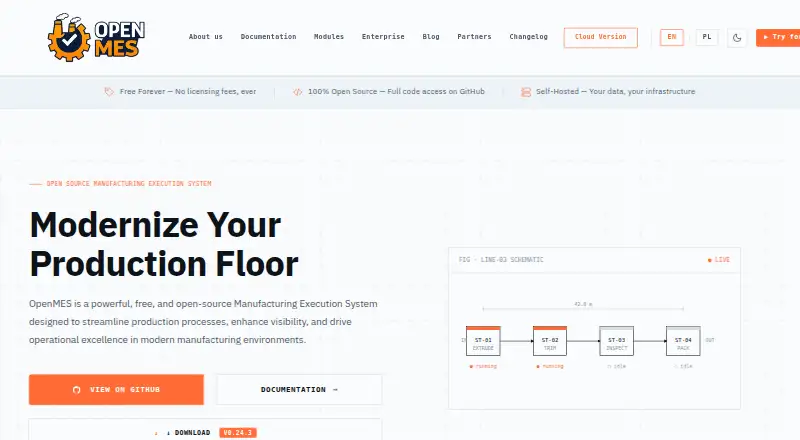
What OpenMES is
OpenMES is a web-based, open-source Manufacturing Execution System that connects factory-floor activity with office operations. Its core includes real-time production monitoring, automatic OEE calculation, drag-and-drop Gantt scheduling, work orders, maintenance, and analytics. For traceability and quality, it supports LOT and serial-number tracking, inline quality control with SPC charts, and audit trails. It connects to IoT and SCADA equipment through OPC UA, MQTT, and Modbus. A REST API can link OpenMES with ERP, CMMS, LIMS, or other systems; listed integration modules include Wapro Mag and Subiekt NEXO PRO.
The free Community plan is designed for single-site operations. Enterprise adds advanced reports, organizational structure, workforce tools, inspection workflows, advanced warehouse functions, and advanced BOM visualization. OpenMES can be self-hosted; Enterprise deployments are offered on-premise or in cloud, with Docker or Kubernetes options. Documentation describes installing the progressive web app on iOS and Android tablets, with offline work and automatic sync. The core is described as AGPL-3.0 and modules as AFL-3.0; commercial licenses are available for certain use cases.
Good
- Core includes production monitoring and automatic OEE calculation.
- Supports LOT and serial-number traceability.
- Connects to equipment through OPC UA, MQTT, and Modbus.
- Can be self-hosted.
Watch out
- Community plan is designed for single-site operations.
- Advanced reports and workforce tools are Enterprise capabilities.
- Hosted cloud subscription is still being explored.
Who it suits
OpenMES is described as built for small and mid-sized manufacturers. Its Enterprise offering addresses large-scale, multi-site, and regulated operations.
Verdict
OpenMES offers production monitoring, scheduling, traceability, and equipment connectivity in a free Community plan designed for single-site use. Larger or more regulated operations may need Enterprise capabilities, for which no price is listed.
Plans and prices
From OpenMES's own pricing page, checked 15 Oct 2026.
| Plan | Price | What it gives you |
|---|---|---|
| Community | Free | Core MES features · self-hosted deployment |
| Enterprise monthly | €500 a month | One installation · Enterprise module · automatic renewal · €500 net per month |
| Enterprise annual | €5,000 a year | One installation · Enterprise module · automatic renewal · €5,000 net per year |
| Enterprise | Priced on request | Advanced modules · dedicated SLA support · professional services |
The facts
Each one read from OpenMES's own pages, with the date it was checked.
What it does
- Access controls
- The documentation lists role-based access control and two-factor login in settings.checked 5 Oct 2026
- API
- OpenMES exposes a REST API, including ERP synchronization endpoints and API-token administration.checked 15 Oct 2026
- API documentation
- The documentation includes REST API examples using bearer tokens and JSON work-order requests.checked 15 Oct 2026
- Cloud status
- The cloud version page says the hosted subscription platform is being explored and invites users to sign up for early access.checked 5 Oct 2026
- Deployment
- OpenMES can be self-hosted; Enterprise deployments are offered on-premise or in cloud, with Docker or Kubernetes options described.checked 5 Oct 2026
- Desktop and mobile distribution
- The project publishes Windows, macOS and Linux desktop installers plus an Android APK that connects to an OpenMES server.checked 15 Oct 2026
- Documentation depth
- The official guide covers dashboards, alerts, planning, work orders, traceability, inventory, reports, HR structure, maintenance, connectivity, packaging, administration and installation.checked 15 Oct 2026
- Enterprise-only capabilities
- Enterprise adds advanced reports, organizational structure, workforce tools, inspection workflows, advanced warehouse functions, and advanced BOM visualization.checked 5 Oct 2026
- ERP integrations
- Listed integration modules cover Tally, Odoo, SAP Business One, Microsoft Dynamics 365 Business Central, SAP S/4HANA, Comarch ERP Optima and enova365.checked 15 Oct 2026
- Extensibility
- Community and core-team modules can be installed separately from the main application, including ZIP-installed modules.checked 15 Oct 2026
- Integrations
- Machine connectivity supports MQTT, Modbus and OPC UA protocols.checked 15 Oct 2026
- Intended users
- The documentation describes OpenMES as built for small and mid-sized manufacturers, while Enterprise addresses large-scale, multi-site, and regulated operations.checked 5 Oct 2026
- Inventory
- Warehouse and inventory tools support barcode and RFID workflows.checked 15 Oct 2026
- Latest release
- The official changelog identifies v0.26.0 dated 13 October 2026 as the current release.checked 15 Oct 2026
- Licence
- The core is distributed under GNU AGPL-3.0; modules use AFL-3.0 and commercial licensing is offered for some use cases.checked 15 Oct 2026
- License
- The repository describes the core as AGPL-3.0 and modules as AFL-3.0, and says commercial licenses are available for certain use cases.checked 5 Oct 2026
- Limit: beta support scope
- The security policy states that OpenMES is in beta and that releases older than the latest 0.x version are unsupported.checked 15 Oct 2026
- Limit: enterprise licensing dependency
- Enterprise subscriptions require one installation per subscription and periodic connectivity to licenses.getopenmes.com for key activation.checked 15 Oct 2026
- Limit: missing extension point
- An open issue requests an extension point allowing modules to display a banner above the application chrome.checked 15 Oct 2026
- Limit: offline synchronization
- The PWA documentation says iOS Safari has limited background-sync support and synchronizes when the app is opened.checked 15 Oct 2026
- Limit: unresolved permissions work
- Open GitHub issues include requests to clarify admin-tab access and read-only permissions for roles.checked 15 Oct 2026
The company
- Company legal name
- The Enterprise terms identify the seller as NICE CODE spółka z ograniczoną odpowiedzialnością.checked 15 Oct 2026
- Company size
- LinkedIn lists OpenMES as a 2–10 employee partnership in manufacturing.checked 15 Oct 2026
- Headquarters
- The seller address is ul. Irzykowskiego 3/40, 42-200 Częstochowa, Poland.checked 15 Oct 2026
The full review of OpenMES
OpenMES is an open-source, web-based manufacturing execution system that connects shop-floor work with office operations. It best suits small and mid-sized manufacturers seeking production visibility and traceability with the option to self-host. Its Community plan covers a broad core, but single-site scope and Enterprise-only tools set clear boundaries for larger operations.
Overview
OpenMES brings production monitoring, work orders, scheduling, maintenance, quality, and traceability into one system. Real-time dashboards and automatic OEE calculation can help teams see production performance as it changes, while LOT and serial-number tracking and audit trails support product accountability. The breadth is notable for a free plan; the trade-off is that advanced reporting, workforce tools, and other enterprise functions sit outside Community.
The core is open source under AGPL-3.0, while modules are described as AFL-3.0. Commercial licenses are available for certain use cases. Daily usage reporting is enabled by default; it excludes entered production and personal data and can be disabled in settings or with OPENMES_TELEMETRY=false. Role-based access control and two-factor login are documented settings.
Key features
Production and scheduling
OpenMES combines real-time production monitoring, automatic OEE calculation, drag-and-drop Gantt scheduling, work orders, maintenance, and analytics. That makes it a practical fit for manufacturers wanting production status and planning in the same system rather than a standalone dashboard. The feature set is substantial, though advanced reports are reserved for Enterprise.
Quality, traceability, and connectivity
LOT and serial-number traceability, inline quality control with SPC charts, and audit trails give quality teams tools to connect production records with inspection data. OPC UA, MQTT, and Modbus connectivity links IoT and SCADA equipment, while a REST API supports ERP, CMMS, LIMS, and other connections. Wapro Mag and Subiekt NEXO PRO integration modules are also listed.
Mobile access and deployment
OpenMES is web-based and supports self-hosting. Its progressive web app can be installed on iOS and Android tablets, with offline work and automatic sync. Enterprise deployments can be on-premise or in the cloud, with Docker or Kubernetes options. A hosted subscription platform is being explored, so teams looking for an established hosted OpenMES subscription should not treat that as the current Community deployment model.
Pricing
| Plan | Price | What it suits |
|---|---|---|
| Community | free | Single-site operations seeking the full MES experience |
| Enterprise | Custom pricing | Organizations needing advanced modules, dedicated SLA support, or professional services |
Community includes the core MES capabilities, including work order and quality management, traceability, shop-floor data capture, real-time dashboards, and ERP integration. It is the natural starting point for a single site, but it does not include Enterprise additions such as advanced reports, organizational structure, workforce tools, inspection workflows, advanced warehouse functions, and advanced BOM visualization.
Enterprise also includes a named support engineer with guaranteed SLA response times; Community support is through documentation, existing issues, and discussions at no charge. No seat or usage quota is stated for either plan, so the key stated dividing line is operational scale and access to Enterprise capabilities and support.
Platforms
OpenMES supports Android, iOS, API, self-hosted, and web access. The documented tablet PWA supports offline work and automatic synchronization, while self-hosting gives teams control over deployment. Enterprise adds on-premise or cloud deployment options, including Docker or Kubernetes.
Who it's for
OpenMES is best aligned with small and mid-sized manufacturers that want production monitoring, scheduling, quality controls, and traceability without a Community subscription charge. It is also a fit for teams with technical capacity to self-host and connect factory equipment or business systems through supported protocols and the API. Large-scale, multi-site, or regulated operations should weigh Enterprise, since those needs align with its added organizational, workforce, inspection, and support capabilities.
Pros and cons
Pros
- Broad free core: Community combines production monitoring, scheduling, work orders, quality, traceability, dashboards, and ERP integration at no cost.
- Factory connectivity: OPC UA, MQTT, and Modbus cover common IoT and SCADA connection needs, with a REST API for other systems.
- Flexible deployment: Self-hosting and tablet PWA access with offline work and automatic sync suit facilities that need local control and mobile shop-floor use.
Cons
- Community is scoped for one site: Multi-site or larger organizations may need Enterprise capabilities rather than assuming the free plan will scale to their structure.
- Several advanced functions are gated: Advanced reports, workforce tools, inspection workflows, warehouse functions, and BOM visualization require Enterprise.
- Free support is community-based: Teams needing guaranteed response times and a named support contact must look to Enterprise.
- Telemetry starts enabled: Daily usage reporting is on by default, although it excludes production and personal data and can be disabled.
Alternatives
Readers comparing category options can browse Manufacturing Execution Systems.
- MES AI is another free, open-source MES framework at no cost; consider it if its Linux, macOS, or Windows platform support better fits your environment.
- Leading2Lean Smart Manufacturing Platform is a paid option for teams considering a platform spanning Android, iOS, macOS, web, and Windows.
- NETVIBES is a paid alternative with a free plan and free trial; its listed Enterprise Data Science plan includes 17 portfolio roles.
- ABB Manufacturing Execution System is a paid MES option with pricing and purchase information by inquiry.
- Aptean Industrial Manufacturing ERP Traverse Edition is a paid option with pricing on request and a free trial, but no free plan.
- GE Vernova Proficy Plant Applications is a paid option for hosted or on-premises mixes across process, discrete, and mixed manufacturing.
- FactoryLogix is a paid option whose pricing is unpublished and whose vendor invites demo requests.
- Plex MES is a paid alternative with one annual subscription fee, unlimited users and machines, no overage charges, and no limit on data transfers.
Verdict
OpenMES is a strong choice for a small or mid-sized manufacturer that wants a capable, self-hostable MES without a Community subscription cost. Its combination of production visibility, equipment connectivity, quality controls, and traceability is the main reason to choose it. Look elsewhere or evaluate Enterprise if your operation needs multi-site scale, advanced modules, or guaranteed support response times.
Getting started
- Visit https://getopenmes.com/
- Choose the free Community plan for single-site operations
- Self-host OpenMES
- Use the web interface, or install the progressive web app on an iOS or Android tablet
- For Enterprise, consider an on-premise or cloud deployment with Docker or Kubernetes options
Limits worth knowing
The Community plan is designed for single-site operations. Advanced reports, organizational structure, workforce tools, inspection workflows, advanced warehouse functions, and advanced BOM visualization are Enterprise capabilities.
Questions
Is OpenMES free?
The Community plan is free and costs nothing.
What does the Community plan include?
It provides the full MES experience and is designed for single-site operations. Enterprise adds advanced reports, workforce tools, inspection workflows, and other advanced modules.
Can OpenMES be self-hosted?
Yes. OpenMES can be self-hosted; Enterprise deployments are offered on-premise or in cloud, with Docker or Kubernetes options described.
What equipment and business systems can it connect to?
It connects IoT and SCADA equipment through OPC UA, MQTT, and Modbus. Its REST API supports ERP, CMMS, LIMS, and other system connections.
What license does OpenMES use?
The core is described as AGPL-3.0 and modules as AFL-3.0. Commercial licenses are available for certain use cases.
Does OpenMES support mobile use?
Documentation describes installing its progressive web app on iOS and Android tablets, with offline work and automatic sync.
Alternatives to OpenMES
- 1

GE Vernova Proficy Plant Applications
AndroidiOSWebAPI7.7From $5,800 a month - 2
qcadoo MES
AndroidWebSelf-hosted7.0From €195 a month - 3

Siemens Opcenter
WebAPISelf-hostedWindows7.0 - 4

MIE Trak Pro
AndroidiOSWebAPI6.9 - 5
Statii
AndroidiOSWeb6.9From £8.50 a month - 6
Sepasoft MES
WebAPILinuxSelf-hosted6.7From $16 a year