OpenJuris
OpenJuris is a web-based legal research service for searching US case law and examining cases with AI assistance.
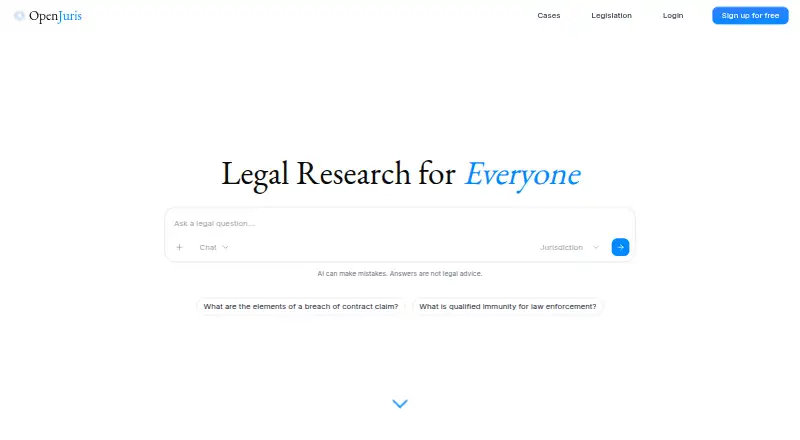
What OpenJuris is
OpenJuris is a web-based legal research service for searching US case law and examining cases with AI assistance. Case Search covers federal and state case law, while Case Chat provides an interactive way to read and analyze US cases. Research Chat returns answers with citations, and users can check claims against relevant passages in full primary sources. Readers can also select text in an opinion to ask focused follow-up questions or see supporting quotes in context. The listed primary-source coverage is case law, with national jurisdiction scope; the site says federal and state legislation coverage is planned. OpenJuris describes law students, lawyers, academics, and people seeking legal help as its audience. A free tier is listed as free, with access to AI models. The service provides research information rather than legal advice, and the site cautions that AI answers may be mistaken. Its privacy policy says personal information is not sold, though it may be shared with service providers and in specified legal or safety circumstances.
Good
- Search covers federal and state case law.
- Answers include citations that readers can verify.
- Case Chat supports interactive case analysis.
- Free tier is listed as free.
Watch out
- Federal and state legislation coverage is only planned.
- AI answers can make mistakes.
- The service does not provide legal advice.
Who it suits
OpenJuris may suit law students, lawyers, academics, or individuals researching US cases. It is for legal information and research, not a substitute for advice from a qualified attorney.
Verdict
OpenJuris combines case search with AI-assisted reading and citation checking. Treat its output as research information, verify cited material in primary sources, and consult a qualified attorney for legal advice.
Plans and prices
From OpenJuris's own pricing page, checked 8 Oct 2026.
| Plan | Price | What it gives you |
|---|---|---|
| Free tier | Free | access to the latest state-of-the-art AI models |
The facts
Each one read from OpenJuris's own pages, with the date it was checked.
What it does
- AI limitation
- The site warns that AI can make mistakes and that answers are not legal advice.checked 8 Oct 2026
- Audience
- OpenJuris says it is for law students, lawyers, academics, and individuals who need legal help.checked 8 Oct 2026
- Case Chat
- Case Chat is an interactive reader for analyzing US cases, with tabs for each opinion and an AI headnote with verifiable citations.checked 8 Oct 2026
- Case Search
- Case Search provides access to US federal and state case law.checked 8 Oct 2026
- Citation verification
- The site says users can view relevant sections in full primary sources and verify cited claims.checked 7 Oct 2026
- Data security
- The privacy policy says the company uses appropriate technical and organizational measures, but cannot guarantee absolute security.checked 7 Oct 2026
- Legal advice limitation
- OpenJuris says it provides research tools and information, not legal advice, and advises consulting a qualified attorney for legal advice.checked 7 Oct 2026
- Privacy data
- The privacy policy says it collects account credentials, search queries and research history, AI chat conversations, usage data, and preferences.checked 8 Oct 2026
- Privacy practices
- The privacy policy says OpenJuris does not sell personal information and may share it with service providers that assist its operations.checked 7 Oct 2026
- Privacy sharing
- The privacy policy says it does not sell personal information and may share it with service providers or in specified legal or safety circumstances.checked 8 Oct 2026
- Product
- OpenJuris provides legal research and information services, including case law, statutes, and AI-powered research assistance.checked 8 Oct 2026
- Purpose
- OpenJuris provides legal research and information services, including access to case law, statutes, and AI-powered research assistance.checked 7 Oct 2026
- Research Chat
- Research Chat provides comprehensive answers with real, verifiable citations.checked 8 Oct 2026
- Security
- The privacy policy says it uses appropriate technical and organizational measures but cannot guarantee absolute security.checked 8 Oct 2026
- Source coverage
- The site says users can view full primary sources, including US case law at federal and all state levels.checked 8 Oct 2026
- Support
- The site invites users to contact [email protected] with questions or feature feedback.checked 8 Oct 2026
- Terms
- The terms say the service is provided as is and as available without warranties.checked 8 Oct 2026
- Text questions
- Users can select text within an opinion to ask targeted follow-up questions or view relevant supporting quotes in context.checked 8 Oct 2026
Money
- Free tier
- OpenJuris says it aims to maintain a generous free tier with access to the latest state-of-the-art AI models, subsidized by enterprise functions.checked 7 Oct 2026
- Planned coverage
- The site says it aims to add federal and state legislation coverage soon.checked 8 Oct 2026
The full review of OpenJuris
Overview
OpenJuris is a web-based legal research service built around US case law and AI-assisted research. It is best suited to students, lawyers, academics, and people seeking legal information who want to explore cases and check cited material in primary sources. Its case search and citation trail are useful; its focus on case law means it is not the choice for research that depends on legislation coverage.
Key features
Case Search covers US federal and state case law, and readers can open full primary sources. That makes it possible to check a passage directly instead of relying only on an AI summary. Research Chat answers research questions with citations, while Case Chat supports interactive reading and analysis of US cases.
Readers can select text in an opinion to ask a targeted follow-up or view supporting quotes in context. This is useful for narrowing a question to the passage at hand, but the service warns that AI can make mistakes. Its answers should guide research, not settle legal questions.
OpenJuris aims to add federal and state legislation coverage, but its stated research scope is case law. Readers who need statutes as a core part of their workflow should look elsewhere for now.
Pricing
The Free tier costs free and includes access to the latest state-of-the-art AI models. OpenJuris says it aims to maintain a generous free tier, subsidized by enterprise functions. That makes it a sensible starting point for individual readers exploring its research tools, though the plan details do not establish specific usage caps or seats.
There is no paid plan described for individual users, so readers comparing subscription tiers should not assume that added capacity or features are available. OpenJuris is freemium, and the free tier is its stated option.
Platforms
OpenJuris is available on the web. Its described work—searching cases, reading opinions, and asking questions about text—fits browser-based research, but it does not offer a stated native mobile or desktop platform.
Who it's for
Law students and academics can use OpenJuris to explore US opinions and trace research answers to source material. Lawyers and individuals who need legal information may also find the case-focused tools useful, provided they verify citations and do not treat the output as legal advice. It is a weaker fit for work centered on legislation or for anyone seeking a tool that makes legal decisions on their behalf.
Pros and cons
- Pro: Federal and state case-law search pairs with full primary sources, giving readers a way to verify cited claims in context.
- Pro: Text selection supports focused follow-up questions and contextual supporting quotes while reading an opinion.
- Pro: A free tier includes access to the latest state-of-the-art AI models, making the research tools accessible without a stated subscription price.
- Con: Its described coverage centers on case law; legislation coverage is only an aim, so it may not suit statute-led research.
- Con: AI answers can be wrong, and the service is not legal advice; users must check primary sources and consult a qualified attorney for advice.
- Con: The privacy policy says the service collects credentials, search and research history, chat conversations, usage data, and preferences. It does not sell personal information, but may share it with service providers and in specified legal or safety circumstances; security measures do not guarantee absolute security.
Alternatives
For a broader comparison, browse AI Legal Research Software.
Choose CaseRead if its free plan's daily research and citation-check quotas, document analysis, projects, and storage limits match your needs. Clauselex is another freemium web option, with daily quick research, a limited number of deep research runs, drafts, uploads, and one matter on its free plan. Curia offers a free five-credit plan and a paid Starter plan with 25 monthly credits, cited case research, and document analysis.
Kvasir may suit readers who want an API as well as a web app; its free Hobby plan includes 2,000 monthly sips, while its Pro plan is described as not yet available. LawGlance is a free web and self-hosted alternative; its public development and hosted deployment are distinct. Legalcode is worth considering for research across 40 jurisdictions, with a free request allowance and non-patent sources.
Align Research is another freemium web option, with three research jobs per month on its free plan. IURIX is a paid web option with a free trial, though its current test places are shown as filled.
Verdict
Choose OpenJuris if you want a free, web-based way to search US case law, ask AI-assisted research questions, and inspect cited material in primary sources. Its strongest reason to choose it is that connection between case research and source verification; its main limitation is the case-law focus, alongside the need to treat AI output as fallible research assistance. Look elsewhere if your work depends on legislation coverage or you need legal advice.
Getting started
- Visit https://openjuris.org/
- Use the web service
- Start with the free tier
Limits worth knowing
The listed free tier is access to AI models. OpenJuris describes the service as research and information support, not legal advice, and warns that AI can make mistakes.
Questions
Is OpenJuris free?
Yes. A free tier is listed as free, with access to AI models.
What legal materials can I search?
Case Search covers US federal and state case law. The listed primary-source coverage is case law; federal and state legislation coverage is a stated future aim.
Can I verify the citations?
Yes. Users can view relevant passages in full primary sources and check cited claims.
Which platforms does OpenJuris support?
Web is the listed platform.
Does OpenJuris give legal advice?
No. The service provides research tools and information, and advises consulting a qualified attorney for legal advice.
How does OpenJuris handle personal information?
Its privacy policy says it does not sell personal information, but may share it with service providers and in specified legal or safety situations.
Alternatives to OpenJuris
- 1
ModulawAI
WebAPIExtensionLinux7.3From 48,000 NGN a year - 2
Manupatra AI Search
AndroidiOSWebWindows6.9From ₹5,000 a year - 3

ArkLegal AI
AndroidiOSWeb6.8From $39.99 a month - 4

Curia
Free planWeb6.8From C$39 a month - 5

Bloomberg Law
AndroidiOSWebAPI6.7 - 6
CaseCraft
AndroidiOSWeb6.6From $10 a month