CaseRead
CaseRead is legal research software that searches a firm's project files alongside public law and provides citations to both.
What CaseRead is
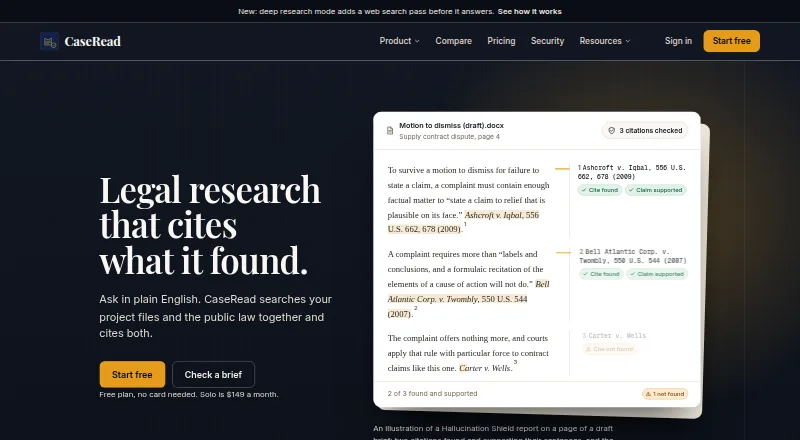
CaseRead is legal research software that searches a firm's project files alongside public law and provides citations to both. Its public-law coverage includes federal statutes and regulations, laws from all 50 states, DC and Puerto Rico, as well as case law and federal materials. Deep research adds a web search pass before an answer. Hallucination Shield checks whether citations exist and support the claims, with up to 50 citations per run. Users can edit Word documents in the browser and receive AI revisions as tracked changes. Listed plan connectors include Google Drive and OneDrive or SharePoint; confirmed document dates can also be sent to Google Calendar. CaseRead says document vaults use separate database schemas, are private by default, and are not used to train AI models. Its database and files are hosted in the United States on AWS via Supabase, with AES-256 encryption at rest and HTTPS on every page. The free plan includes three research messages and two citation checks per day, 25-page document analysis, three projects, 100 MB storage, and one user.
Good
- Searches project files together with public law.
- Covers statutes, regulations, and case law nationally.
- AI revisions to Word documents arrive as tracked changes.
- Free plan includes research and citation checks.
- Firm document vaults are private by default.
Watch out
- Solo pricing is $71 per seat monthly when billed annually.
- Free plan limits daily research messages and citation checks.
- The maker has not completed a SOC 2 audit.
- Customer accounts lack multi-factor sign-in and SSO.
Who it suits
CaseRead is intended for solo practitioners, small firms, and multi-lawyer firms. It may suit legal teams that need to search internal project files alongside public law.
Verdict
CaseRead combines legal research across firm files and public law with citation checks and document editing. Consider its account security limitations and annual-billing price when assessing fit.
Plans and prices
From CaseRead's own pricing page, checked 28 Sep 2026.
| Plan | Price | What it gives you |
|---|---|---|
| Free | Free | 3 research messages/day · 2 citation checks/day · 25-page document analysis · 3 projects · 100 MB storage · 1 user |
| Team | $119 a month | Unlimited research · 300-page analysis · 100 GB storage · unlimited projects · seat count chosen by firm · billed annually at $119 per seat/month |
| Solo | $8,971 a month | Unlimited research · 100-page analysis · 10 GB storage · 50 projects · 1 seat · billed annually at $71 per seat/month |
| Enterprise | Priced on request | Unlimited seats · unlimited storage · custom data retention · custom SLA and DPA · API access |
The facts
Each one read from CaseRead's own pages, with the date it was checked.
What it does
- Citation verification
- Hallucination Shield checks whether citations exist and support the claims, with up to 50 citations per run.checked 28 Sep 2026
- Coming soon
- The pricing page marks the Clio connector as coming soon on paid plans and Slack notifications as coming soon for Team and Enterprise.checked 28 Sep 2026
- Compliance limit
- CaseRead says it has not completed a SOC 2 audit and does not offer multi-factor sign-in or SSO for customer accounts.checked 28 Sep 2026
- Data hosting
- CaseRead says its database and files are hosted in the United States on AWS via Supabase, with AES-256 encryption at rest and HTTPS on every page.checked 28 Sep 2026
- Deep research
- Deep research adds a web search pass before it answers.checked 28 Sep 2026
- Drafting
- CaseRead can edit Word documents in the browser, with AI revisions delivered as tracked changes.checked 28 Sep 2026
- Integrations
- Plans list Google Drive and OneDrive or SharePoint connectors, and the homepage says confirmed document dates can be sent to Google Calendar.checked 28 Sep 2026
- Intended users
- The maker describes CaseRead as built for solo practitioners, small firms and multi-lawyer firms.checked 28 Sep 2026
- Legal coverage
- Its public-law sources include statutes and regulations for federal law, all 50 states, DC and Puerto Rico, plus case law and federal materials.checked 28 Sep 2026
- Product
- CaseRead searches a firm's project files and public law together and provides citations to both.checked 28 Sep 2026
- Security
- The maker says firm document vaults use separate database schemas, are private by default, and are not used to train AI models.checked 28 Sep 2026
- Support
- Team includes priority support, while Enterprise includes a dedicated account manager.checked 28 Sep 2026
The company
- Company
- The About page describes a small team of engineers and legal-tech builders but does not state a headquarters or founding year.checked 28 Sep 2026
The full review of CaseRead
Overview
CaseRead brings a firm’s project files and public legal materials into one research workflow, with citations to both. It suits solo practitioners and firms that want research, citation checks, and Word editing together; its account-security gaps and annual-billing commitment deserve careful consideration.
Its reach is broad: public-law coverage spans federal law, all 50 states, DC, and Puerto Rico, including statutes, regulations, case law, and federal materials. Deep research adds a web-search pass before answering, while Hallucination Shield checks whether citations exist and support the claims, up to 50 citations per run. Those checks are a useful guardrail, not a substitute for legal judgment.
Key features
- Combined research: Search firm project files alongside public law and receive citations to both. This is the central advantage for firms that want internal matter materials and legal authorities in the same research process.
- Document analysis and drafting: Upload documents for analysis, then edit Word files in the browser with AI revisions delivered as tracked changes. The page limits on document analysis vary by plan, so large-document workflows need to match the chosen tier.
- Connectors and notifications: Plans include Google Drive and OneDrive or SharePoint connectors. Confirmed document dates can be sent to Google Calendar. Clio on paid plans and Slack notifications for Team and Enterprise are marked as coming soon, so they are not present-day reasons to buy.
- Security: Firm vaults use separate database schemas, are private by default, and are not used to train AI models. CaseRead says data is hosted in the United States on AWS via Supabase, encrypted at rest with AES-256, and served over HTTPS. However, it has not completed a SOC 2 audit and does not offer customer-account MFA or SSO. Firms requiring those controls should look elsewhere.
Pricing
CaseRead has a free plan, paid plans from $71/user/mo (annual), and a 7-day trial. The annual commitment matters: compare the per-seat rates against expected use and firm headcount before choosing a paid tier.
- Free — free: One user gets 3 research messages per day, 2 citation checks per day, analysis of documents up to 25 pages, 3 projects, and 100 MB of storage. It is a practical way to evaluate basic workflows, but the daily caps and small storage allowance constrain regular practice use.
- Solo — $8,971 a month: Billed annually at $71 per seat/month, with unlimited research, 100-page analysis, 10 GB storage, 50 projects, and one seat. It suits an individual practitioner who has outgrown the free quotas; the fixed single seat and annual billing make it a poor fit for a growing team.
- Team — $149,119 a month: Billed annually at $119 per seat/month, with unlimited research, 300-page analysis, 100 GB storage, unlimited projects, and a seat count chosen by the firm. The higher per-seat rate buys substantially more document capacity and shared scale, making it the more relevant option for multi-lawyer firms.
- Enterprise — custom pricing: Unlimited seats and storage, custom data retention, a custom SLA and DPA, API access, and a dedicated account manager. This tier is aimed at firms needing negotiated terms or broader deployment; price depends on a custom quote.
Team also includes priority support. Free is the only tier with daily research and citation-check caps; paid plans specify unlimited research, though document-analysis page limits still apply to Solo and Team.
Platforms
CaseRead supports web and API access. The browser-based Word editing workflow is useful for lawyers who want tracked revisions without leaving the document process; API access is reserved for Enterprise.
Who it's for
CaseRead is strongest for solo practitioners and small or multi-lawyer firms that need public-law research alongside their own project files, and value citations and document drafting in one product. Solo is sized for one practitioner, while Team accommodates a firm-selected number of seats. It is a weaker fit for organizations that require SOC 2 assurance, MFA, or SSO, or for buyers unwilling to take on annual billing for paid seats.
Pros and cons
- Pro: Searches internal project files and a broad national set of primary legal sources together, with citations to both.
- Pro: Citation checks, deep research, document analysis, and Word tracked changes cover several stages of legal work in one workflow.
- Pro: Paid tiers expand document limits and storage, with Team offering unlimited projects and firm-chosen seats.
- Con: No customer-account MFA or SSO, and no completed SOC 2 audit, may rule it out for firms with strict security requirements.
- Con: Free-plan daily quotas, 25-page analysis, and 100 MB storage are restrictive for sustained work.
- Con: Paid pricing is tied to annual billing, and the published Solo and Team figures are substantial commitments for each seat.
Alternatives
For a wider comparison, see AI Legal Research Software.
- Clauselex is another freemium web option for readers comparing legal research and drafting plans.
- Curia is a freemium web alternative with a credit-based Starter plan for cited case research, document analysis, and memos.
- Legalcode is a freemium API and web option whose free tier covers non-patent sources across 40 jurisdictions.
- Align Research is a freemium web alternative for readers considering another research-focused tool.
- CaseCraft is available on Android, iOS, and web, with one-time credit packs as well as subscription plans.
- ArkLegal AI offers Android, iOS, and web access, with a free trial and paid plans.
- Judicio supports macOS, web, and Windows and offers a free trial rather than a free plan.
- ModulawAI is a paid alternative available on web, Windows, macOS, and Linux.
Verdict
Choose CaseRead if your practice wants one place to search firm files and broad public law, verify citations, and revise Word documents with tracked changes. The combination is compelling for solo lawyers and firms that can use its annual seat plans. Look elsewhere if MFA, SSO, or completed SOC 2 assurance is a requirement, or if the yearly per-seat cost outweighs the value of the combined workflow.
Getting started
- Open the CaseRead website.
- Choose the free plan or review paid plans starting at $71/user/mo billed annually.
- Use the seven-day trial if you want to try a paid plan.
- Access CaseRead on the web or through its API.
- Connect Google Drive or OneDrive or SharePoint through a plan that includes the connector.
Limits worth knowing
The free plan permits three research messages and two citation checks per day, analysis of documents up to 25 pages, three projects, 100 MB of storage, and one user. Solo, the lowest listed paid plan, includes 100-page analysis, 10 GB storage, 50 projects, and one seat.
Questions
Does CaseRead have a free plan?
Yes. It includes three research messages and two citation checks per day, 25-page document analysis, three projects, 100 MB storage, and one user.
How much does CaseRead cost?
A seven-day trial is listed.
What platforms does CaseRead support?
The listed platforms are web and API.
What legal sources does CaseRead cover?
Its public-law sources include federal statutes and regulations, laws for all 50 states, DC and Puerto Rico, case law, and federal materials.
Which integrations are available?
Plans list Google Drive and OneDrive or SharePoint connectors. Confirmed document dates can be sent to Google Calendar; Clio and Slack features are marked as coming soon for specified plans.
What does CaseRead say about security and compliance?
The maker says firm document vaults use separate database schemas, are private by default, and are not used to train AI models. It says files and databases are hosted in the United States with AES-256 encryption at rest and HTTPS, but the service has not completed a SOC 2 audit and customer accounts do not have multi-factor sign-in or SSO.
Alternatives to CaseRead
- 1
ModulawAI
WebAPIExtensionLinux7.3From 48,000 NGN a year - 2
Manupatra AI Search
AndroidiOSWebWindows6.9From ₹5,000 a year - 3

ArkLegal AI
AndroidiOSWeb6.8From $39.99 a month - 4

Curia
Free planWeb6.8From C$39 a month - 5
Bloomberg Law
AndroidiOSWebAPI6.7 - 6
CaseCraft
AndroidiOSWeb6.6From $10 a month