openHAB
openHAB is free, open-source home automation software that runs on the user’s own hardware.
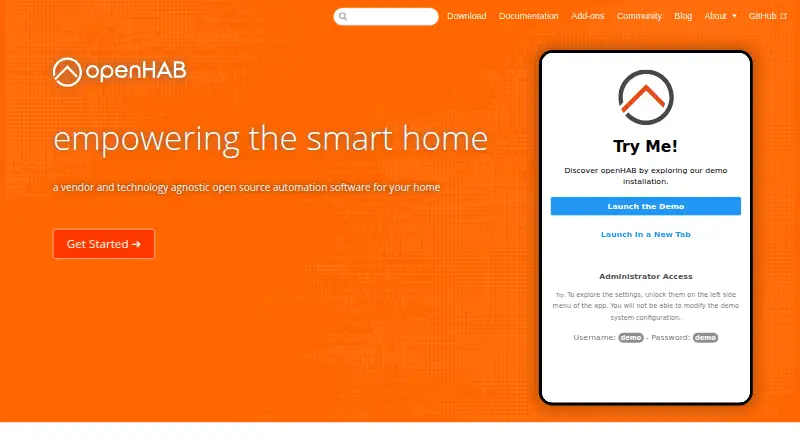
What openHAB is
openHAB is free, open-source home automation software that runs on the user’s own hardware. It can operate without a cloud service, and the project says data stays privately at home while local devices are contacted directly when possible. It supports more than 400 technologies and systems, with over 3,000 supported things available through add-ons. Its automation engine includes rules, time and event triggers, scripts, actions, notifications, and voice control. Servers can run on Linux, macOS, Windows, Raspberry Pi, Docker, and Synology. Access is available through web, iOS, Android, and other apps. Integrations include Google Assistant, Amazon Alexa, and Apple HomeKit. The myopenhab.org cloud service is free when used with the openHAB Cloud connector. The project describes itself as vendor-neutral and says it avoids lock-in. For Raspberry Pi, openHABian provides an image with preconfigured settings and software. Community members share examples and tutorials and help users.
Good
- Can run without a cloud service.
- Supports more than 400 technologies and systems.
- Offers rules, triggers, scripts, and notifications.
- Servers can run on several operating systems and devices.
- myopenhab.org cloud service is free with its connector.
Watch out
- The page does not state team-sharing or administrator features.
- The page does not state a trial or refund policy.
Who it suits
openHAB suits people who want to run home automation on their own hardware and keep operation independent of a cloud service. It may also suit users seeking broad technology support and a vendor-neutral system.
Verdict
openHAB provides free, locally hosted automation with broad integrations and a choice of server platforms. Its setup is a fit for people comfortable running software on their own hardware.
Plans and prices
From openHAB's own pricing page, checked 27 Sep 2026.
| Plan | Price | What it gives you |
|---|---|---|
| myopenhab.org | Free | Free cloud service for the openHAB Cloud connector. |
The facts
Each one read from openHAB's own pages, with the date it was checked.
What it does
- Automation engine
- The engine supports rules, time and event triggers, scripts, actions, notifications, and voice control.checked 27 Sep 2026
- Camera integration
- Yeschecked 24 Sep 2026
- Cloud integrations
- Integrations include Google Assistant, Amazon Alexa, Apple HomeKit, and more.checked 27 Sep 2026
- Community size
- The page lists 23000+ discussions, 240000+ posts, and 22000+ members.checked 27 Sep 2026
- Community support
- The community provides daily examples and tutorials and helps users.checked 27 Sep 2026
- Energy monitoring
- Yeschecked 24 Sep 2026
- Foundation support
- The openHAB Foundation, a registered non-profit organisation, supports openHAB and its development.checked 27 Sep 2026
- Local control
- Yeschecked 24 Sep 2026
- Local operation
- It runs on the user's hardware and does not require a cloud service.checked 27 Sep 2026
- Matter support
- Yeschecked 24 Sep 2026
- Open-source software
- openHAB is open-source software and the page lists no paid price.checked 27 Sep 2026
- Open-source stack
- openHAB is developed in Java and built on Apache Karaf, an OSGi runtime.checked 27 Sep 2026
- Private data
- The page says data stays privately at home and local devices are contacted directly when possible.checked 27 Sep 2026
- Raspberry Pi image
- The openHABian image provides a hassle-free setup with pre-configured settings and software.checked 27 Sep 2026
- Sharing and admin
- The page does not state team-sharing or administrator features.checked 27 Sep 2026
- Technology integrations
- It supports more than 400 different technologies and systems.checked 27 Sep 2026
- Vendor neutrality
- The project says it has no company behind it, remains vendor-neutral, and avoids lock-in.checked 27 Sep 2026
- Voice assistant support
- Yeschecked 24 Sep 2026
Where it runs
- Client apps
- Access is available through web, iOS, Android, and other apps.checked 27 Sep 2026
- Server platforms
- Servers can run on Linux, macOS, Windows, Raspberry Pi, Docker, and Synology.checked 27 Sep 2026
- Supported devices
- The page says more than 3000 supported things are available through add-ons.checked 27 Sep 2026
Money
- Free cloud service
- The myopenhab.org service is free when used with the openHAB Cloud connector.checked 27 Sep 2026
- Free plan
- Yeschecked 24 Sep 2026
- Trial and refunds
- The page does not state a trial period or refund policy.checked 27 Sep 2026
The full review of openHAB
Overview
openHAB is a self-hosted home automation platform for connecting devices and services across a smart home. It suits people willing to run and maintain software on their own hardware; its strongest case is broad, vendor-neutral automation without requiring cloud control.
The platform brings together more than 400 technologies and systems, with add-ons covering over 3,000 supported things. That breadth can help when a home mixes equipment from different vendors, though it also makes openHAB a better fit for users prepared to configure a flexible system than for those seeking a managed, turnkey service.
Local operation is a meaningful privacy and reliability advantage: openHAB runs on your hardware, can contact local devices directly when possible, and does not require cloud service. It also supports cloud integrations such as Google Assistant, Amazon Alexa, and Apple HomeKit, so local control does not rule out those services. The project is open-source, vendor-neutral, and not backed by a company; the openHAB Foundation, a registered non-profit, supports its development.
Compare it with other Home automation platforms if you are weighing self-hosted control against app-led alternatives.
Key features
- Wide integration coverage: Add-ons connect thousands of supported things across hundreds of technologies. This is openHAB's central strength for mixed-device households, although users should expect to choose and configure integrations rather than rely on one vendor's closed ecosystem.
- Flexible automation: Rules can respond to time or events and use scripts, actions, notifications, and voice control. That range supports tailored routines, but it rewards users who are comfortable shaping their own automation logic.
- Local-first operation: The system does not need a cloud service, and data can remain at home while local devices are contacted directly when possible. The optional myopenhab.org service is free with the openHAB Cloud connector, providing a cloud service without making it a requirement for core operation.
- Smart-home capabilities: openHAB supports Matter, Zigbee, Z-Wave, voice assistants, cameras, and energy monitoring. These capabilities make it relevant beyond basic lighting or appliance control, while actual device coverage depends on the available add-ons.
- Community resources: The community offers examples, tutorials, and user help, with more than 23,000 discussions, 240,000 posts, and 22,000 members. That is a substantial pool to draw on for a community-supported project, rather than a promise of company-backed support.
Pricing
openHAB is free and open-source, with no paid price for the platform. That makes it a strong option for users who want broad automation without a software subscription; the trade-off is that you run it on your own hardware rather than buying a hosted service.
The myopenhab.org cloud service is free when used with the openHAB Cloud connector. No trial or refund terms are stated. The project does not state team-sharing or administrator features, so households needing defined multi-user administration should verify that those needs can be met before choosing it.
Platforms
Servers can run on Linux, macOS, Windows, Raspberry Pi, Docker, or Synology. Clients can access openHAB through web, iOS, Android, and other apps. The openHABian Raspberry Pi image offers pre-configured settings and software, reducing setup work for people choosing that hardware, but the broader platform still expects you to operate a server.
Its software stack is built in Java on Apache Karaf, an OSGi runtime. The available platforms span common desktop and server systems, while the self-hosted model means choosing and maintaining a suitable host remains part of the experience.
Who it's for
Choose openHAB if you want local control, value vendor neutrality, and need integrations across a varied smart home. It is especially compelling for people comfortable managing a home server or Raspberry Pi and willing to invest effort in rules and add-ons.
Look elsewhere if your priority is a polished, low-maintenance setup managed through a single vendor's ecosystem, or if you need clearly defined team administration. openHAB's flexibility and privacy strengths do not remove the work involved in running your own automation platform.
Pros and cons
- Pro: Broad device and technology coverage. More than 3,000 supported things across 400-plus technologies give mixed-brand homes substantial integration potential.
- Pro: Local control without mandatory cloud use. The system runs on your hardware and can keep private data at home, appealing to users who want more control over their smart-home setup.
- Pro: Free, open-source platform. There is no paid platform price, and the vendor-neutral project avoids tying the system to one company's product line.
- Con: Self-hosting is part of the bargain. Users must provide and run a server; the Raspberry Pi image helps with setup but does not turn openHAB into a hosted service.
- Con: Community-led help rather than stated company support. The project has an active community and Foundation support, but users seeking a formal support arrangement should consider whether that model suits them.
- Con: No stated team or administrator features. Those who need explicit multi-user controls should confirm their requirements before committing.
Alternatives
Homey is worth considering if you prefer a cross-platform app and cloud service with a free allowance capped at five devices. Its free tier trades openHAB's self-hosted model for a stated device limit.
Google Home is a straightforward free app option for compatible smart-home devices, especially if Android, iOS, or web access matters more than running your own server. Compatibility and some products or features may vary by region.
Apple Home suits households already using Apple devices and compatible accessories that want a free option on iOS and macOS. Its platform range is narrower than openHAB's.
ioBroker is another free, open-source platform with Linux, macOS, Windows, web, API, and self-hosted availability. Consider it if you want to compare self-hosted alternatives rather than move to a consumer smart-home app.
eWeLink may fit users who prefer an app-based freemium service with Android, iOS, web, API, macOS, Windows, and self-hosted platforms, plus a stated free trial. Its Advanced plan costs $9.90 a year, billed yearly.
Bosch Smart Home is an option for users considering a Bosch-focused smart-home service and its Home+ plan, which costs €4.99 a month, billed monthly, for up to three systems, 400 camera clips, 30-day cloud storage, and clips up to 60 seconds.
Hubitat Elevation is a hardware-based alternative for users willing to make a one-time purchase; its Model C-8 Pro North America version is priced at $184.95, paid once-time purchase.
Aqara Home is another free smart-home option to compare.
Verdict
openHAB is the right choice for technically comfortable users who want wide integrations, local control, and a free, vendor-neutral platform they can run on their own hardware. Its main reason to choose it is the combination of breadth and independence; its main reason to look elsewhere is the responsibility for setup and ongoing self-hosting.
Alternatives to openHAB
- 1
Google Home
Free planAndroidiOSWebAPI8.1From $10 a month - 2
eWeLink
Free planAndroidiOSWebAPI8.0From $9.90 a year - 3
Homey
Free planAndroidiOSWeb8.0From $2.99 a month - 4
HomeSeer HS4
Free planAndroidiOSWebLinux7.8From $39.95 a year - 5
Amazon Alexa
Free planAndroidiOSWeb7.5Free plan - 6
Aqara Home
Free planAndroidiOS7.1Free plan