
openGemini
openGemini is a free, open-source distributed database for storing and analyzing time-series data such as metrics, logs, and traces.
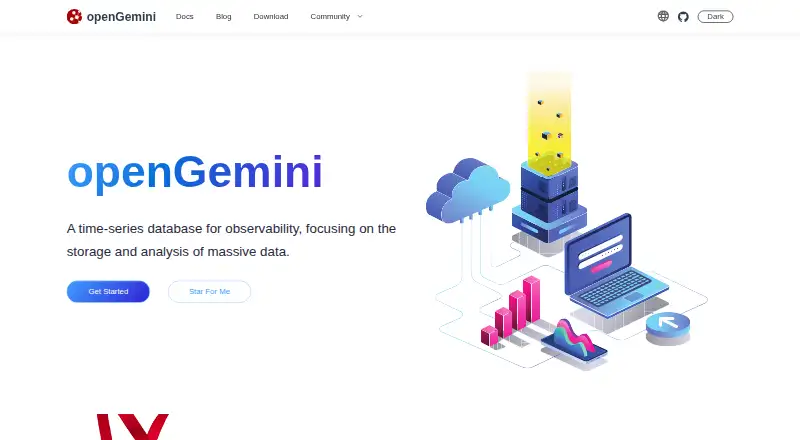
What openGemini is
openGemini is a free, open-source distributed database for storing and analyzing time-series data such as metrics, logs, and traces. The project positions it for monitoring and observability, IoT, and operations data analysis. Its MPP design uses ts-sql, ts-meta, and ts-store components that can scale independently. Column-based storage, compression, automatic partitioning, and LSM-based techniques form part of its storage approach. A built-in AI data analysis platform provides real-time anomaly detection. openGemini supports SQL and the query languages InfluxQL, PromQL, and GeminiQL, with HTTP APIs for expression and metadata queries and remote reads and writes. Ingestion options include InfluxDB Line Protocol, Apache Arrow Flight, and Prometheus remote_write. It supports Linux, macOS, and Windows, as well as Docker and Kubernetes deployment. Authentication is disabled by default and must be enabled in configuration. The project reports 90% overall PromQL function and operator support, with some functions and operators unsupported; its backup guide describes an interface but no CLI backup command.
Good
- Free, open-source time-series database.
- Stores metrics, logs, and traces for analysis.
- Supports PromQL and three listed query languages.
- Components can be scaled independently.
- Offers Docker and Kubernetes deployment options.
Watch out
- Authentication is disabled by default.
- PromQL support covers 90% of functions and operators.
- Backup has an interface but no CLI command.
Who it suits
openGemini suits teams managing time-series workloads for monitoring, IoT, or operations analysis, especially those seeking a self-hosted distributed database. It is available for Linux, macOS, and Windows, with container deployment options.
Verdict
openGemini combines distributed time-series storage with multiple query and ingestion paths. Teams should plan to enable authentication and account for the listed PromQL and backup limitations.
Plans and prices
From openGemini's own pricing page, checked 9 Oct 2026.
| Plan | Price | What it gives you |
|---|---|---|
| openGemini | Free | Open-source time-series database; standalone and distributed versions |
The facts
Each one read from openGemini's own pages, with the date it was checked.
What it does
- Analysis
- The built-in AI data analysis platform provides real-time anomaly detection for time-series data.checked 9 Oct 2026
- Architecture
- It uses an MPP architecture with ts-sql, ts-meta, and ts-store components, and says components can be scaled independently.checked 9 Oct 2026
- Backup limitation
- The backup and restore guide says backup requests are supported through an interface, but there is no CLI command for backup.checked 9 Oct 2026
- Community
- The project invites users to join its Slack developer community and contribute code.checked 9 Oct 2026
- Community and support
- The project invites users to join its developer community on Slack and contribute alongside enterprises, universities, and developers.checked 9 Oct 2026
- Container deployment
- The project documents Docker deployment and Kubernetes deployment through openGemini-operator.checked 9 Oct 2026
- Deployment
- The installation guide describes Linux, macOS, and Windows support; it recommends macOS and Windows for development and debugging.checked 9 Oct 2026
- HTTPS
- HTTPS can be enabled by configuring a certificate and private key; the documentation includes instructions for using a self-signed certificate.checked 9 Oct 2026
- Notable limitation
- The PromQL compatibility documentation reports that overall support for Prometheus functions and operators is 90%, and lists unsupported functions and operators.checked 9 Oct 2026
- Observability data
- The project says metrics, logs, and traces can be stored in openGemini for analysis.checked 9 Oct 2026
- Performance and scaling
- It uses automatic partitioning and LSM-based storage techniques, and supports distributed cluster deployment with MPP architecture.checked 9 Oct 2026
- Project affiliation
- The site identifies openGemini as a Cloud Native Computing Foundation sandbox project.checked 9 Oct 2026
- Project status
- The project describes itself as a Cloud Native Computing Foundation sandbox project.checked 9 Oct 2026
- Prometheus integration
- openGemini supports Prometheus remote read and write, and its documentation describes using Grafana optionally with that setup.checked 9 Oct 2026
- Purpose
- openGemini is an open-source, cloud-native distributed time-series database for storing and analyzing large volumes of time-series data.checked 9 Oct 2026
- Query and ingestion compatibility
- The documentation says openGemini supports PromQL and HTTP APIs for expression and metadata queries, remote reads, and remote writes.checked 9 Oct 2026
- Query compatibility
- The project supports PromQL and provides HTTP APIs for expression queries, metadata queries, and remote data reading and writing.checked 9 Oct 2026
- Security
- Username and password authentication is supported, but authentication is disabled by default and must be enabled in the configuration.checked 9 Oct 2026
- Storage
- It uses column-based storage and describes data compression, automatic partitioning, and LSM-based storage techniques.checked 9 Oct 2026
- Supported operating systems
- The installation guide lists Linux, macOS (Darwin), and Windows as supported; macOS and Windows are recommended for development and debugging.checked 9 Oct 2026
- Use cases
- The project describes monitoring and observability, IoT, and operations data analysis as typical application scenarios.checked 9 Oct 2026
- What it does
- openGemini is an open-source, cloud-native distributed time-series database for storing and analyzing massive time-series data.checked 9 Oct 2026
Money
- Storage costs
- The project says column-based storage and compression can reduce storage cost to 1/20 of relational databases and 1/10 of NoSQL for the same data volume.checked 9 Oct 2026
Alternatives to openGemini
- 1

TDengine
Free planOpen sourceWebAPILinuxmacOS8.3Free plan - 2

Amazon Timestream
Free planWebAPILinuxmacOS7.9Free plan - 3

Apache IoTDB
Free planOpen sourceWebAPILinuxmacOS7.7Free plan - 4

InfluxDB
Free planWebAPILinuxmacOS7.4$0.01 usage-based - 5

VictoriaMetrics
Free planWebAPILinuxmacOS7.4From $200 a month - 6

LinDB
Free planWebAPILinuxmacOS6.9Free plan