OpenEWS
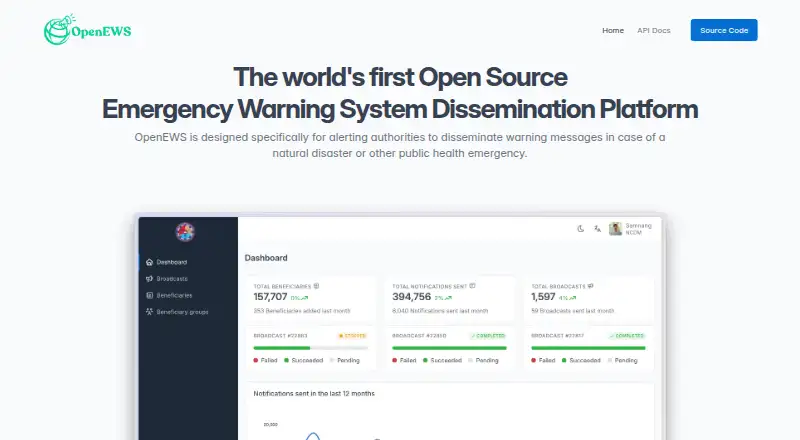
The facts below are what the maker publishes about OpenEWS, checked and dated. Our editors have not written about it yet.
The facts
Each one read from OpenEWS's own pages, with the date it was checked.
What it does
- API
- The API follows JSON:API, uses HTTPS, and requires a bearer API token for requests.checked 11 Oct 2026
- API security
- API access uses bearer tokens, which the documentation says should be treated as sensitive and not exposed in client-side code.checked 11 Oct 2026
- Audience
- The API documentation is intended for developers, system integrators, and technical stakeholders working on early warning systems.checked 11 Oct 2026
- Beneficiary management
- The API supports managing beneficiary data and groups.checked 11 Oct 2026
- Broadcasts
- The API documents voice call, text message, and audio broadcasts, including starting and stopping broadcasts.checked 11 Oct 2026
- Certification and license
- OpenEWS is listed as a Digital Public Good and its profile identifies the license as MIT.checked 11 Oct 2026
- Channels
- The maker describes support for messages, interactive voice response, and Cell Broadcast through Somleng.checked 11 Oct 2026
- Current status
- The project describes OpenEWS as actively in development.checked 11 Oct 2026
- Delivery integration
- OpenEWS integrates with Somleng to deliver emergency warning messages.checked 11 Oct 2026
- Deployment
- The repository's getting-started guide runs the web app and PostgreSQL with Docker Compose, and says Terraform configuration is provided for AWS deployment.checked 11 Oct 2026
- Development setup
- The local development instructions require Docker and Docker Compose and start the web app with PostgreSQL.checked 11 Oct 2026
- Integrations
- OpenEWS says its API supports integration with external systems and follows the JSON:API standard.checked 11 Oct 2026
- Intended users
- The maker says the platform is intended for alerting authorities to warn beneficiaries during natural disasters or other public emergencies.checked 11 Oct 2026
- Localization
- The project says OpenEWS supports localization, including right-to-left and non-Latin scripts such as Khmer and Lao.checked 11 Oct 2026
- Open source
- The project describes OpenEWS as free and open source under the MIT License.checked 11 Oct 2026
- Privacy and security
- The Digital Public Goods profile reports that personal data is collected and stored but not distributed, and describes encryption in transit and role-based access controls as security measures.checked 11 Oct 2026
- Purpose
- OpenEWS is designed for alerting authorities to send warnings during natural disasters or public health emergencies.checked 11 Oct 2026
- Support
- The repository directs users with issues to open a GitHub issue or discussion.checked 11 Oct 2026
- Webhook security
- The API documentation says webhook deliveries include a signed JWT using HS256 and recommends verifying the signature before processing events.checked 11 Oct 2026
Alternatives to OpenEWS
- 1
Text-Em-All (formerly Call-Em-All)
Free planAndroidiOSWebAPI8.1From $19 a month - 2
NetSupport Notify
AndroidiOSWebExtension7.6$2 one-time - 3
Open Paging Server
Free planOpen sourceWebLinuxSelf-hosted7.1Free plan - 4

OnPage
AndroidiOSWebAPI7.0From $13.99 a month - 5
PushPulse
AndroidiOSWebmacOS6.9From $540 a year - 6
SA-Announce
AndroidiOSAPImacOS6.8