OpenBoxes
OpenBoxes is an open-source supply chain management system for handling supplies and medications across healthcare facilities and disaster relief efforts.
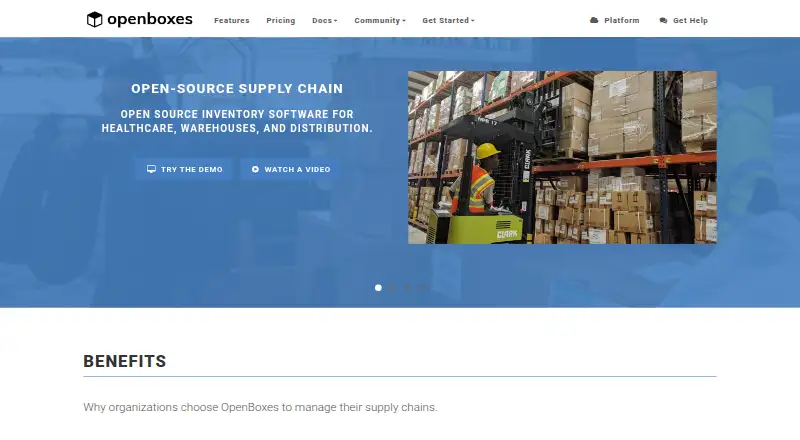
What OpenBoxes is
OpenBoxes is an open-source supply chain management system for handling supplies and medications across healthcare facilities and disaster relief efforts. It tracks inventory across multiple facilities, bins, lots or serial numbers, and expiration dates, with an audit history of stock movements. Barcode scanning, stock alerts and first-expiry-first-out picking support warehouse and expiry workflows. Procurement tools cover purchase orders, suppliers, invoices, requisitions, receiving and shipments. Built-in reports include consumption, stockouts, expirations, transactions, stock analytics and quantities on hand.
Its mobile-optimized interface supports picking, putaway, inventory lookups, barcode scanning, receiving and shipping. Named integrations include a REST API, webhooks, n8n, OpenFn, Boomi, Crowdin and DHIS2. The free Community Edition is self-hosted and includes community support; hosting and operations depend on the chosen deployment. Managed OpenBoxes Lift plans add hosting and support, with plans also listing backups and API access. The maker says OpenBoxes was built at Partners In Health after the 2010 Haiti earthquake to track medical supplies, and describes it as adapted for healthcare, warehousing, distribution and other supply chain settings. Cloud deployment requires consistent internet connectivity; on-premise deployment requires hardware and staff to support it.
Good
- Tracks stock across facilities, bins, lots or serial numbers.
- Purchase orders, supplier management and shipment workflows are included.
- Expiry alerts and first-expiry-first-out picking help manage stock.
- Reports cover consumption, stockouts, transactions and quantities on hand.
- Mobile workflows include barcode scanning, receiving and shipping.
- Named integrations include REST API, webhooks and DHIS2.
Watch out
- Cloud deployment requires consistent internet connectivity.
- On-premise deployment needs hardware and people to support it.
- Community Edition includes community support.
Who it suits
OpenBoxes suits healthcare facilities, disaster relief efforts and other organizations managing supplies across multiple locations. Its inventory, procurement, expiry controls and warehouse workflows also fit distribution and broader supply chain operations, including resource-scarce settings.
Verdict
Choose OpenBoxes if you need open-source inventory and procurement workflows across facilities, especially for healthcare or distribution. The free Community Edition keeps hosting and operations in your hands; look at Lift if you need managed hosting and support, and account for its plan-specific costs and limits.
Plans and prices
From OpenBoxes's own pricing page, checked 8 Oct 2026.
| Plan | Price | What it gives you |
|---|---|---|
| Community Edition | Free | Unlimited users · self-hosted on-premise or cloud · community support · Free Forever; starting at $0/mo |
| Self-Hosted | $24 a month | Self-hosted with DigitalOcean · dedicated support · Starting at $24/mo; paid to DigitalOcean, actual cost depends on droplet options |
| OpenBoxes Lift | $75 a month | Fully managed hosting · Support · Data backups · API access · Founding-member price available for a limited time; pricing depends on users, storage, and support level. |
| Shared OpenBoxes Lift | $75 a month | Up to 10 users · 10 GB storage · 99.0% uptime SLA · API access: 1k per hour · From $75 per month. |
| Dedicated OpenBoxes Lift | $899 a month | Up to 50 users · 100 GB storage · 99.5% uptime SLA · API access: 25k per hour · 12-month minimum term · From $899 per month; 12-month minimum term. |
| Enterprise OpenBoxes Lift | — | 99.9% uptime SLA · 24/7 including holidays |
| OpenBoxes Lift Shared | $75 a month | Up to 10 users · 10GB storage · 1,000 API calls/hour · 99.0% uptime SLA · 30-day backup retention · Starting at $75/mo; founding-member price for a limited time |
| OpenBoxes Lift Shared (current Lift pricing page) | $75 a month | Up to 10 users · 10GB storage · 1,000 API calls/hour · 99.0% uptime SLA · 30-day backup retention · 30-day free trial · $150 $75 /month; monthly option shown |
| OpenBoxes Lift Dedicated (current Lift pricing page) | $300 a month | Up to 50 users · 100GB storage · 25,000 API calls/hour · 99.5% uptime SLA · 30-day backup retention · 30-day free trial · $600 $300 /month; monthly option shown |
| OpenBoxes Lift Dedicated | $899 a month | Up to 50 users · 100 GB storage · 99.5% uptime SLA · 12-month minimum term · From $899 per month |
| OpenBoxes Lift Enterprise (current Lift pricing page) | $1,800 a month | 100 users · 250 GB storage · 50,000 API calls/hour · 99.9% availability target · $1,800 /month |
| OpenBoxes Lift Enterprise | Priced on request | Custom users and storage · 99.9% uptime SLA · 24x7 support including holidays · Custom |
The facts
Each one read from OpenBoxes's own pages, with the date it was checked.
What it does
- Barcode scanning
- Yeschecked 21 Sep 2026
- Expiry control
- OpenBoxes supports expiry alerts and first-expiry-first-out picking to help reduce waste.checked 8 Oct 2026
- Hosting and location
- OpenBoxes Lift says production data is hosted on Google Cloud Platform in the us-east1 region in the United States.checked 8 Oct 2026
- Integrations
- The features page names REST API, webhooks, n8n, OpenFn, Boomi, Crowdin, and DHIS2 integrations.checked 8 Oct 2026
- Intended users
- The maker describes OpenBoxes as built for resource-scarce settings and says it has been adapted for healthcare, warehouse management, distribution, and other supply chain contexts.checked 8 Oct 2026
- Inventory
- It tracks stock across multiple facilities, bins, lots or serial numbers, and expiration dates, with stock movement audit history.checked 8 Oct 2026
- Mobile
- The mobile-optimized interface supports warehouse workflows including picking, putaway, barcode scanning, inventory lookups, receiving, and shipping.checked 8 Oct 2026
- Notable deployment requirement
- The features page says cloud deployment requires consistent internet connectivity, while on-premise deployment requires hardware and people to support it.checked 8 Oct 2026
- Origin
- OpenBoxes was built at Partners In Health after the 2010 Haiti earthquake to track medical supplies across health facilities.checked 8 Oct 2026
- Paid from
- 24checked 21 Sep 2026
- Procurement
- Features include purchase orders, supplier management, invoices, requisitions, receiving, and shipment workflows.checked 8 Oct 2026
- Purchase orders
- Yeschecked 21 Sep 2026
- Purpose
- OpenBoxes is an open-source supply chain management system for managing supplies and medications for healthcare facilities and disaster relief efforts.checked 8 Oct 2026
- Reporting
- Built-in reporting includes consumption, stockout, expiration, transaction, stock analytics, and quantity-on-hand reports.checked 8 Oct 2026
- Security
- OpenBoxes Lift lists MFA, role-based access control, TLS 1.2+ in transit, AES-256 at rest, tenant data isolation, and security patches for managed Kubernetes.checked 8 Oct 2026
- Stock alerts
- Yeschecked 21 Sep 2026
- Support
- The community edition includes community support, while Lift plans include managed support with tier-dependent availability and response times.checked 8 Oct 2026
- Support contact
- The OpenBoxes site lists [email protected] and +1-617-475-0619 as contact details.checked 8 Oct 2026
The company
- Founded
- 2010checked 23 Sep 2026
Money
- Free plan
- Yeschecked 21 Sep 2026
The full review of OpenBoxes
Overview
OpenBoxes is an open-source supply chain system for tracking supplies and medications across healthcare facilities, with workflows that also suit distribution and warehouse operations. It is strongest for organizations that need to coordinate stock and procurement across sites, particularly in resource-scarce settings.
Its broad inventory and procurement coverage is balanced by a consequential deployment choice: run and maintain it yourself, or pay for managed hosting with plan-specific limits.
Key features
OpenBoxes tracks inventory across facilities, bins, lots or serial numbers, and expiration dates, with an audit history of stock movements. That depth is useful when teams need to know not just how much stock they have, but where it is and how it has moved. Expiry alerts and first-expiry-first-out picking help prioritize stock before it goes to waste, a practical advantage for medications and other time-sensitive supplies.
Procurement runs from requisitions and purchase orders through supplier management, invoices, receiving and shipment workflows. Built-in reports cover consumption, stockouts, expirations, transactions, stock analytics and quantities on hand. Together, these functions make OpenBoxes a more cohesive fit for supply operations than a tool limited to counting stock; teams should still confirm that its workflows align with their own processes.
The mobile-optimized interface supports warehouse tasks including picking, putaway, barcode scanning, inventory lookups, receiving and shipping. REST API, webhooks and named integrations including n8n, OpenFn, Boomi, Crowdin and DHIS2 provide options for connecting it to other systems. The features are substantial, but they also make deployment and operational support important parts of the purchase decision.
Community Edition can be deployed on-premise or in the cloud. Cloud use requires consistent internet connectivity; on-premise operation requires hardware and staff to maintain it. OpenBoxes Lift instead provides managed hosting. Its security provisions include MFA, role-based access controls, TLS 1.2+ in transit, AES-256 at rest, tenant data isolation and security patches for managed Kubernetes; production data is hosted on Google Cloud Platform in the us-east1 region in the United States.
Pricing
Community Edition is free, billed Free Forever. It allows unlimited users and self-hosted on-premise or cloud deployment, with community support. This is the clearest fit for organizations that can operate their own infrastructure; the absence of a software charge does not remove hosting and operational responsibilities.
Self-Hosted starts at $24/mo, paid to DigitalOcean, with actual cost depending on droplet options. It adds dedicated support while leaving the deployment self-hosted. This suits teams wanting help without moving to fully managed Lift, but it does not remove the responsibility to run the system.
OpenBoxes Lift Shared is shown at $75 per month, with a founding-member price for a limited time. It includes up to 10 users, 10GB storage, 1,000 API calls per hour, a 99.0% uptime SLA and 30-day backup retention. A current monthly option shows $150 reduced to $75 per month and a 30-day free trial. The small team cap and API quota make this the entry point for modest deployments, not an unconstrained shared service.
OpenBoxes Lift Dedicated has differing published prices: one offer is from $899 per month with a 12-month minimum, while the current monthly option shows $600 reduced to $300 per month and a 30-day free trial. Both describe up to 50 users, 100GB storage, 25,000 API calls per hour and a 99.5% uptime SLA; the current option includes 30-day backup retention. Buyers should confirm which price and term apply before committing.
OpenBoxes Lift Enterprise is shown as custom pricing in one offer and at $1,800 per month on the current pricing page. The current offer includes 100 users, 250GB storage, 50,000 API calls per hour and a 99.9% availability target. Another enterprise description gives custom users and storage, a 99.9% uptime SLA and 24/7 support including holidays. The differing terms make it important to confirm the applicable package; this is the option for larger organizations needing the higher availability target and round-the-clock support.
A separate OpenBoxes Lift price is $75 a month, with pricing dependent on users, storage and support level; it includes fully managed hosting, support, data backups and API access. Lift plans include managed support, with availability and response times varying by tier. The site also offers a free trial, but the 30-day duration is attached to the current Shared and Dedicated monthly options.
Platforms
OpenBoxes supports Android, iOS, Linux, web, API and self-hosted deployment. The mix accommodates mobile warehouse work and organizations choosing their own hosting environment, while cloud use depends on consistent internet access.
Who it's for
OpenBoxes is a strong fit for healthcare organizations, disaster-relief operations and distributors coordinating supplies across facilities, especially where expiry control, procurement and auditable stock movement matter. Its origins at Partners In Health after the 2010 Haiti earthquake reflect that operational focus. Organizations without the people or infrastructure to manage a self-hosted system should favor Lift; those with only basic inventory needs may find its supply-chain scope more than they need.
Pros and cons
- Pros: Multi-facility, bin, lot and serial tracking with movement history supports accountable stock control.
- Pros: Expiry alerts, FEFO picking and consumption, stockout and expiration reports address common risks for time-sensitive supplies.
- Pros: Procurement spans requisitions, purchasing, suppliers, invoices, receiving and shipping, reducing the need to treat replenishment as a separate workflow.
- Cons: Community Edition leaves hosting and operations to the user; cloud deployment also depends on reliable connectivity.
- Cons: Managed Lift plans cap users, storage and API usage, and Dedicated has conflicting published price and contract terms.
Alternatives
For a wider inventory management software comparison, consider the trade-offs between OpenBoxes' supply-chain workflows and more bounded inventory plans.
Zoho Inventory is a better fit for a very small operation that can work within its free plan's 50 orders per month, one user and one location. Cin7 Omni may suit buyers prioritizing e-commerce and app integrations alongside unlimited inventory locations; its Standard plan is $349 a month and includes five integrations.
Blue Link ERP is another ERP option with hosted subscription pricing based on users, functionality, implementation services and deployment model. InvenTree is worth considering when a free, MIT-licensed self-hosted system is the priority and included support or maintenance is not required.
Cin7 Core is an alternative for teams seeking a paid inventory plan with a free trial; its Standard plan is $349 a month for five users, two integrations and 6,000 sale orders per year. inFlow Inventory is aimed at smaller teams that can use its Entrepreneur plan's two members, one location and 1,200 orders per year for $161 a month.
MIE Trak Pro is another inventory and operations option. Katana is an alternative with a permanent free tier capped at 30 SKUs.
Verdict
Choose OpenBoxes when your organization needs open-source inventory and procurement workflows across facilities, especially for healthcare or distribution. Community Edition avoids a software fee but leaves hosting and operations in your hands; Lift is the more suitable route for managed service, provided its user, storage, API and contract limits fit your operation. Look elsewhere if you need a simpler inventory tool or cannot support the operational demands of self-hosting and the cost of managed hosting.
Getting started
- Visit https://www.openboxes.org/.
- Choose the free Community Edition for self-hosting, or review paid hosting options.
- For self-hosting, select an on-premise or cloud deployment and arrange the required hardware or connectivity.
- Consider a Lift plan for managed hosting, support, backups and API access.
- Use the mobile-optimized interface for warehouse activities such as receiving, picking and barcode scanning.
Limits worth knowing
The free Community Edition is self-hosted and includes community support. Shared OpenBoxes Lift is $75 per month with up to 10 users, 10 GB storage, 1,000 API calls per hour and a 99.0% uptime SLA; the current listing includes a 30-day free trial. Dedicated Lift is $300 per month on the current monthly option, with up to 50 users, 100 GB storage, 25,000 API calls per hour and a 99.5% uptime SLA; it also lists a 30-day trial.
Questions
Is OpenBoxes free?
The Community Edition is free forever, with unlimited users and community support. It is self-hosted on-premise or in the cloud.
What paid plans are listed?
Self-Hosted is listed at $24 per month, with actual DigitalOcean costs depending on droplet options. Current Lift monthly options list Shared at $75 per month and Dedicated at $300 per month; Enterprise is listed at $1,800 per month.
Is there a free trial?
The current Shared and Dedicated OpenBoxes Lift monthly listings each include a 30-day free trial.
Which platforms are supported?
Listed platforms are Android, API, iOS, Linux, self-hosted and web.
What integrations does OpenBoxes name?
Named integrations include REST API, webhooks, n8n, OpenFn, Boomi, Crowdin and DHIS2.
Who makes OpenBoxes?
The maker is listed as OpenBoxes. It was built at Partners In Health after the 2010 Haiti earthquake.