InvenTree
InvenTree is a free, open-source inventory management system for parts management and stock control.
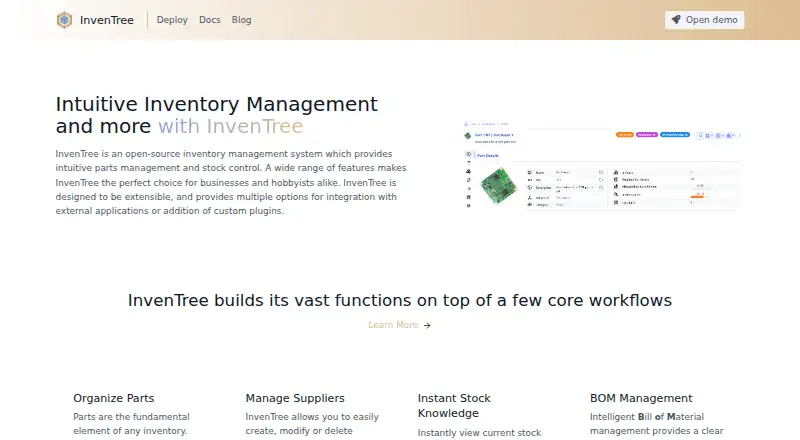
What InvenTree is
InvenTree is a free, open-source inventory management system for parts management and stock control. Its documentation describes it as lightweight software for small and medium businesses and hobbyist applications. Parts can be organized into categories, with suppliers and supplier items linked to them. Users can inspect stock by part, location, or build, and serialize stock items with test results recorded against them. InvenTree supports BOM uploads in multiple formats and build management with automatic or manual stock allocation. It also offers barcode-based stock actions in its Android and iOS app, which can edit part and stock information and receive purchase orders. Other listed functions include stock alerts, purchase and sales orders, reports from custom templates, and a REST API with a native Python binding library. Deployment choices include Docker, a single-line installer, FreeBSD AppJail, bare metal, and a DigitalOcean marketplace app. The project provides documentation and public issue tracking; paid support contracts and customizations may be requested. Its free MIT-licensed plan has self-hosted deployment options and no included support or maintenance obligation.
Good
- Organizes parts, categories, suppliers, and supplier items.
- Tracks stock by part, location, or build.
- Supports BOM uploads and build allocation.
- Mobile apps support barcode-based stock actions.
- Provides a REST API and Python binding library.
Watch out
- Free plan has no included support obligation.
- Community plugins may lack security and compatibility checks.
- The project has no legal entity governing it.
Who it suits
InvenTree may suit small and medium businesses or hobbyists managing parts and stock who can operate a self-hosted system. Its mobile apps and API may fit workflows involving barcode actions or software integrations.
Verdict
InvenTree provides inventory, parts, order, and build management in a free, self-hosted system. Buyers should account for deployment and maintenance themselves, and review the support status of community plugins.
Plans and prices
From InvenTree's own pricing page, checked 10 Oct 2026.
| Plan | Price | What it gives you |
|---|---|---|
| Open-source InvenTree | Free | MIT licensed software · self-hosted deployment options · no included support or maintenance obligation |
The facts
Each one read from InvenTree's own pages, with the date it was checked.
What it does
- Audience
- The documentation describes it as lightweight software designed for small and medium businesses and hobbyist applications.checked 10 Oct 2026
- Barcode scanning
- Yeschecked 21 Sep 2026
- BOMs and builds
- It supports BOM uploads in multiple formats and build management with automatic or manual stock allocation.checked 10 Oct 2026
- Deployment
- The project lists Docker, a single-line installer, FreeBSD AppJail, bare-metal installation, and a DigitalOcean marketplace app as deployment options.checked 10 Oct 2026
- Governance
- The project is managed by volunteer developers and states that it has no legal entity governing it.checked 10 Oct 2026
- Integrations
- Community integrations listed by the project include Ki-n-Tree, part import tools for DigiKey, LCSC and Mouser, and a PartKeepr migration tool.checked 10 Oct 2026
- Parts and suppliers
- It organizes parts into structured categories and lets users manage suppliers and supplier items linked to parts.checked 10 Oct 2026
- Plugin limits
- The project says listed community plugins are not necessarily core-team supported and are not checked for security, privacy, performance, or compatibility with the latest version.checked 10 Oct 2026
- Purchase orders
- Yeschecked 21 Sep 2026
- Purpose
- InvenTree is an open-source inventory management system for parts management and stock control.checked 10 Oct 2026
- Reports and API
- Users can generate reports from custom templates, and the software exposes a REST API plus a native Python binding library.checked 10 Oct 2026
- Sales orders
- Yeschecked 21 Sep 2026
- Security
- The project documents reviewed contributions, CI security checks, dependency monitoring, and code coverage above 90%.checked 10 Oct 2026
- Stock alerts
- Yeschecked 21 Sep 2026
- Stock tracking
- Users can inspect stock by part, location, or build, and stock items can be serialized with test results recorded against them.checked 10 Oct 2026
- Support
- Public issue tracking and documentation are available; paid support contracts and customizations may be requested through the project’s support contact.checked 10 Oct 2026
The company
- Founded
- 2017checked 28 Sep 2026
Money
- Free plan
- Yeschecked 21 Sep 2026
Where it runs
- Mobile app
- The Android and iOS app supports barcode-based stock actions, editing part and stock information, and receiving purchase orders.checked 10 Oct 2026
- Mobile apps
- Yeschecked 21 Sep 2026
The full review of InvenTree
InvenTree is an open-source inventory system for organizing parts, suppliers, stock, orders, and production builds. It suits small and medium businesses and hobbyists willing to run their own software. The strongest case is parts-led traceability and build control; the trade-off is taking responsibility for deployment, maintenance, and plugin risk.
Overview
InvenTree ties structured part records to suppliers, stock locations, purchasing, sales, and builds. Stock can be viewed by part, location, or build, while serialized items can carry test results. That structure is valuable when components must be followed through production, but it is more involved than a simple quantity ledger and requires a self-hosted operating model.
Key features
Parts, stock, and orders
Parts are organized into categories and linked to suppliers and supplier items. Purchase orders, sales orders, stock alerts, and barcode scanning cover core inventory routines. Serialization and attached test results add useful traceability for controlled components. Organizations that only count finished goods may find this depth unnecessary.
Builds and bills of materials
Bills of materials can be uploaded in multiple formats, and build management supports automatic or manual stock allocation. This connects component availability with assembly work instead of leaving production planning separate from inventory. It is a meaningful advantage for makers and manufacturers managing parts-based builds.
Mobile, reporting, and integration
Android and iOS apps support barcode stock actions, editing part and stock information, and receiving purchase orders. Custom report templates provide adaptable reporting, while a REST API and native Python binding library support integrations and automation. Community projects include Ki-n-Tree, import tools for DigiKey, LCSC, and Mouser, and a PartKeepr migration tool. Those extensions broaden the system, but community plugins are not necessarily core-team supported and are not checked for security, privacy, performance, or current-version compatibility.
Deployment and security
Deployment options include Docker, a single-line installer, FreeBSD AppJail, bare-metal installation, and a DigitalOcean marketplace app. The project documents reviewed contributions, CI security checks, dependency monitoring, and code coverage above 90%. These practices are reassuring, but they do not remove the operational work of securing and maintaining an installation.
Pricing
The Open-source InvenTree plan costs free. It is MIT-licensed software with self-hosted deployment options and no included support or maintenance obligation. This is a strong fit for technically capable teams and hobbyists that can provide their own infrastructure and administration. It is less suitable for buyers who need a vendor-managed service or guaranteed upkeep. Paid support contracts and customizations may be requested through the project’s support contact, with pricing handled separately.
Platforms
InvenTree supports web access, Android and iOS mobile apps, an API, and self-hosted deployment. The mix covers desktop administration, mobile warehouse actions, and programmatic integration, while self-hosting remains central to how the software is operated.
Who it's for
Small and medium businesses, engineering teams, workshops, and hobbyist projects are the clearest audience, especially when they need supplier-linked parts, serialized stock, bills of materials, and build allocation. It is a poor fit for organizations seeking a hands-off hosted inventory subscription or formal vendor responsibility for maintenance.
Pros and cons
Pros
- Parts-focused control: Structured categories, supplier items, serialization, and test results support traceable component workflows.
- Production connection: BOM uploads and automatic or manual allocation link inventory to builds.
- Broad operating surface: Mobile apps, barcode actions, reports, REST access, and Python bindings support varied workflows.
- No license charge: The MIT-licensed plan costs nothing.
Cons
- Self-hosting responsibility: Deployment, upgrades, security, and maintenance sit with the user.
- No included support: The free plan carries no support or maintenance obligation.
- Plugin uncertainty: Community extensions may lack security, privacy, performance, or compatibility review.
- Volunteer governance: The project has no legal entity governing it, which may matter to risk-sensitive buyers.
Alternatives
For a broader directory of choices, see Inventory Management Software. Choose Zoho Inventory instead if a freemium Windows service with a 0.00 USD free tier, one user, one location, and 50 orders per month fits better. OpenBoxes is another free, self-hosted option with Android, iOS, API, Linux, and web support. Pick Cin7 Omni when a paid web-and-mobile product with inventory locations and e-commerce integrations is the priority. Blue Link ERP suits buyers seeking hosted ERP pricing tailored to users, functionality, implementation, and deployment. Cin7 Core is a paid alternative with a $349 a month Standard plan, five users, two integrations, and 6,000 sale orders per year. inFlow Inventory is a paid option whose Entrepreneur plan costs $161 a month for two members, 1,200 orders per year, one integration, and one location. MIE Trak Pro is sold by quote. Katana offers a permanent free tier with 30 SKUs, unlimited users, integrations, and inventory locations.
Verdict
Choose InvenTree if you need detailed parts and stock control tied to purchasing, traceability, and builds, and have the capability to self-host it. Look elsewhere if you require vendor-managed infrastructure, included maintenance, or stronger assurance around third-party plugins.