
Open TMS
Open TMS is an open-source transportation management system for coordinating logistics from order intake through delivery.
What Open TMS is
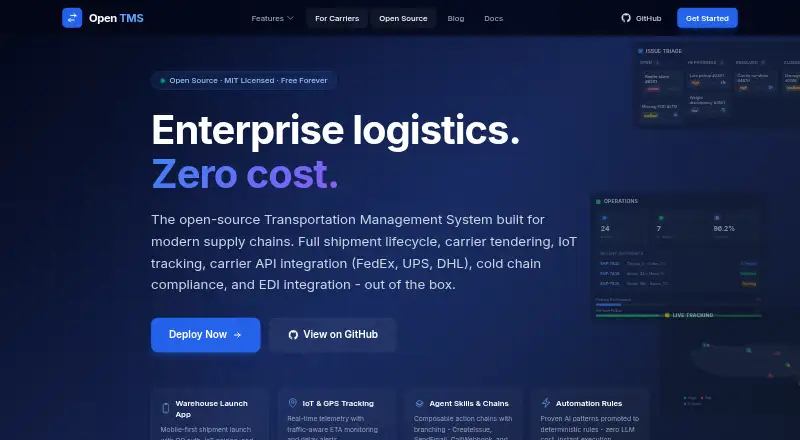
Open TMS is an open-source transportation management system for coordinating logistics from order intake through delivery. Orders can be entered by CSV, EDI 850, REST API, or manual entry, then tracked alongside lane matching and multi-stop routing. Carrier operations include broadcast and waterfall tenders, a bidding portal, and EDI tendering. Its EDI hub handles multiple X12 transaction types through SFTP or HTTP, and tracking integrations are described for FedEx, UPS, and DHL APIs. GPS and sensor data can feed traffic-aware ETA monitoring using TomTom, HERE, or self-hosted Valhalla routing. The warehouse module brings receiving, putaway, picking, packing, load planning, inventory, and returns into the same system. Warehouse staff can use a scan-first progressive web app with barcode scanning. Open TMS supports Docker Compose deployment to cloud or self-hosted infrastructure, and consultancy services are available for installation, setup, and ongoing support. The free plan is free, with no per-user fees, transaction costs, or feature gates.
Good
- Accepts orders by CSV, EDI, REST API, or manual entry
- Combines shipment and warehouse operations
- Tracks GPS and sensor telemetry for ETA monitoring
- Free plan has no per-user or transaction fees
Watch out
- Deployment requires Docker Compose or infrastructure hosting
- Installation and ongoing support are consultancy services
Who it suits
It suits shippers, 3PLs, carriers, and warehouse teams coordinating shipments and inventory. Quality managers and compliance officers may also find its temperature logging and quarantine workflows relevant.
Verdict
Open TMS brings order management, carrier workflows, shipment tracking, and warehouse tasks together. Its free plan and multiple deployment options may suit logistics organizations prepared to manage the infrastructure.
Plans and prices
From Open TMS's own pricing page, checked 15 Oct 2026.
| Plan | Price | What it gives you |
|---|---|---|
| Free Forever | Free | no per-user fees · no transaction costs · no feature gates |
| Open TMS | Free | MIT licensed · no per-user fees · no transaction costs · no feature gates · Free forever |
The facts
Each one read from Open TMS's own pages, with the date it was checked.
What it does
- Architecture
- The codebase uses CQRS, immutable event storage, read-model projections, dependency injection and repository patterns.checked 15 Oct 2026
- Carrier APIs
- The product documents shipment-status integrations for FedEx, UPS and DHL using OAuth 2.0 or API keys.checked 15 Oct 2026
- Carrier management
- The system supports broadcast and waterfall carrier tenders, a carrier bidding portal, and EDI 204/990 tendering.checked 30 Sep 2026
- Carrier tendering
- Carrier sourcing supports broadcast and waterfall tenders, carrier bidding and EDI 204/990.checked 15 Oct 2026
- Cloud deployment
- The GCP guide deploys separate frontend and backend services on Cloud Run with PostgreSQL on Cloud SQL.checked 15 Oct 2026
- Cold-chain compliance
- Cold-chain monitoring is described as CFR 21 Part 11 compliant with SHA-256 integrity hashes and automated excursion handling.checked 15 Oct 2026
- Deployment
- The maker says Open TMS can be deployed with Docker Compose and describes deployments for AWS, GCP, Azure, DigitalOcean, or self-hosted infrastructure.checked 30 Sep 2026
- Developer webhooks
- Webhooks use HMAC-SHA256 signatures and retry failed deliveries at 2, 4, 8, 16 and 30 minutes for up to five attempts.checked 15 Oct 2026
- Documentation depth
- The repository includes deployment, self-hosting, integration and architecture documentation alongside the application source.checked 15 Oct 2026
- EDI integration
- The platform lists X12 transactions including 850, 856, 204, 990, 997, 214, 210, 810 and 820.checked 15 Oct 2026
- EDI integrations
- Its EDI hub supports X12 transaction types including 850, 855, 856, 204, 990, 997, 214, 210, 810, and 820, with SFTP and HTTP delivery.checked 30 Sep 2026
- Exception management
- Its Triage Centre detects exceptions and supports Kanban workflow, escalation and CAPA reporting.checked 15 Oct 2026
- Financial operations
- Financial functions include delivery-triggered invoicing, carrier freight audit, quotes, LTL rating, AR aging and accounting CSV exports.checked 15 Oct 2026
- Intended users
- The maker presents the product for shippers, 3PLs, carriers, warehouse teams, quality managers, and compliance officers.checked 30 Sep 2026
- IoT and routing
- It accepts GPS and sensor telemetry and supports traffic-aware ETA monitoring with TomTom, HERE, or self-hosted Valhalla routing.checked 30 Sep 2026
- Licence
- The repository distributes Open TMS under the MIT License, including rights to use, modify, distribute and sell copies.checked 15 Oct 2026
- Limit: release maturity
- The README states that the project is in active development and has no release version yet.checked 15 Oct 2026
- Limit: return-carrier APIs
- Live FedEx, UPS and DHL return-label APIs are listed as coming soon; the current return provider interface uses manual shipping in version one.checked 15 Oct 2026
- Limit: roadmap
- Driver mobile, route optimization, advanced reporting, carrier intelligence and indoor RTLS are listed as coming soon rather than shipped.checked 15 Oct 2026
- Maintainer location
- LinkedIn lists Dominic Finn, associated with System Loco, in Nottingham, England.checked 15 Oct 2026
- Mobile warehouse use
- A scan-first progressive web app supports warehouse tasks and barcode scanning with Zebra and Honeywell RF guns through a barcode wedge hook.checked 30 Sep 2026
- Order intake
- Orders can enter through CSV, EDI 850, REST API or manual entry and be converted into shipments.checked 15 Oct 2026
- Public API
- The README says self-deployed instances expose interactive Swagger/OpenAPI documentation at /docs.checked 15 Oct 2026
- Purpose
- Open TMS is an open-source transportation management system for managing the logistics lifecycle from order ingestion through delivery.checked 30 Sep 2026
The full review of Open TMS
Overview
Open TMS is an open-source system for coordinating freight and warehouse operations from order intake through delivery. It best suits shippers, 3PLs, carriers and warehouse teams that need these workflows under one roof. Its free, MIT-licensed plan avoids per-user and transaction fees, but organizations should be ready to handle deployment and setup.
Key features
Orders, carrier workflows and tracking
Orders can enter by CSV, EDI 850, REST API or manual entry, then move through lane matching, multi-stop routing and shipment tracking. Broadcast and waterfall tenders, a carrier bidding portal and EDI 204/990 tendering support different approaches to sourcing capacity. This breadth is useful for operations with varied carrier processes; a business that only needs a tracking view may find the system broader than necessary.
The EDI hub supports X12 transactions 850, 855, 856, 204, 990, 997, 214, 210, 810 and 820, delivered over SFTP or HTTP. Tracking integrations for FedEx, UPS and DHL use OAuth 2.0 or API keys. GPS and sensor telemetry feed traffic-aware ETA monitoring, using TomTom, HERE or self-hosted Valhalla routing. Together, these options can connect order, carrier and location workflows, while teams should expect to configure the integrations that fit their operation.
Warehouse, mobile and compliance
The warehouse module handles receiving, putaway, picking, packing, load planning, inventory and returns alongside shipments and orders. A scan-first progressive web app supports warehouse tasks and barcode scanning with Zebra and Honeywell RF guns through a barcode wedge hook. That makes it relevant to teams that want warehouse execution in the same system, rather than a separate inventory-only tool.
For temperature-sensitive operations, the maker describes CFR 21 Part 11 compliant logging with SHA-256 integrity hashes, excursion detection and automatic quarantine workflows. Developer webhooks use HMAC-SHA256 signatures, a five-minute tolerance window and exponential-backoff retries of up to five attempts. These are practical controls for compliance-sensitive workflows and integrations; organizations should assess whether the workflows meet their own requirements.
Pricing
The Open TMS plan costs nothing, billed Free forever. It is MIT licensed, has no per-user fees or transaction costs, and imposes no feature gates. Inventory tracking, shipment tracking, order management and document management are included. This is an unusually open cost structure for teams expecting multiple users or transaction volume, though it does not remove the work of running the system.
Open TMS can be deployed with Docker Compose, on AWS, GCP, Azure or DigitalOcean, or on self-hosted infrastructure. Professional installation, setup and ongoing support are available as consultancy services, so teams that need implementation help should account for that service relationship.
Platforms
Open TMS is available as a web application and supports API and self-hosted deployment. Docker Compose and deployments across major cloud providers give organizations choices about where to operate it, but those choices also place infrastructure decisions with the customer.
Who it's for
The product is aimed at shippers, 3PLs, carriers, warehouse teams, quality managers and compliance officers. Its strongest fit is an organization that needs transportation, warehouse and compliance workflows together and has the resources to manage an open-source deployment. Teams looking for a narrowly focused tracking product or a turnkey hosted service should consider whether this operational scope and deployment responsibility suit them.
Pros and cons
- Pro: The free-forever MIT plan has no per-user fees, transaction costs or feature gates, making it suitable for operations that need broad access without usage-based charges.
- Pro: Transportation, carrier, warehouse and inventory workflows share one system, reducing the need to split those tasks across separate tools.
- Pro: Multiple deployment options, EDI delivery methods and carrier tracking integrations give technically equipped teams flexibility in how they connect and operate the system.
- Con: Deployment and setup require infrastructure ownership or consultancy, which may not suit teams seeking a managed, ready-to-use service.
- Con: The wide operational scope may be unnecessary for organizations that only need basic shipment visibility.
Alternatives
For a wider category comparison, browse Logistics Management Software.
- CargoWise is a paid option with Android, iOS, web, Windows, API and self-hosted platforms; consider it if those platform choices or its per-package eCommerce and warehouse value packs better match your operation.
- Shipwell TMS is a paid web, API, Android and iOS option with customized quote pricing; choose it if you prefer to discuss a sales quote rather than use a free open-source plan.
- e2open Transportation Management is a paid API and web alternative.
- Fleetbase has a free plan and trial, plus Android, iOS, API, web and self-hosted platforms; its Fleetbase Cloud plan costs $29 a month for unlimited orders and users. Consider it if those cloud terms or its platform coverage fit better.
- Descartes 3G TMS is a paid web alternative.
- FreightPOP is a paid API and web option with quote-based plans, including parcel and freight offerings; consider it if those shipping plan structures are a better fit.
- Rose Rocket TMS is a paid Android, iOS, API and web platform; its Full Service Platform costs $2,080 a month. Consider it if that paid platform better fits your requirements.
- Logiware is a paid Android, iOS, API and web option with seat-based SaaS pricing and no per-transaction charges; consider it if that pricing structure suits you.
Verdict
Choose Open TMS if your logistics operation needs transportation, carrier, warehouse and compliance workflows together and you can manage its deployment. Its free-forever, feature-unrestricted plan is the clearest reason to start here. Look elsewhere if you need a managed service or only a focused shipment-tracking tool.
Getting started
- Open the Open TMS website
- Deploy with Docker Compose
- Choose AWS, GCP, Azure, DigitalOcean, or self-hosted infrastructure
- Configure order intake through CSV, EDI 850, REST API, or manual entry
- Connect carrier, routing, warehouse, or EDI integrations
- Arrange professional installation or support consultancy if needed
Limits worth knowing
The free plan is listed as free forever with no per-user fees, transaction costs, or feature gates. No usage quota or seat limit is stated.
Questions
How much does Open TMS cost?
The Open TMS plan is free, billed free forever.
Is Open TMS open source?
Yes. It is described as MIT licensed.
Which platforms are supported?
Open TMS supports API, self-hosted, and web use.
What logistics functions does it include?
It includes order management, shipment tracking, inventory, warehouse operations, carrier tendering, EDI, routing, and returns.
Can it connect to carrier systems?
Tracking integrations are described for FedEx, UPS, and DHL APIs, with OAuth 2.0 and API-key authentication.
Alternatives to Open TMS
- 1

Fleetbase
Free planOpen sourceAndroidiOSWebAPI8.6From $29 a month - 2

Extensiv 3PL Warehouse Manager
AndroidiOSWebAPI7.6From $500 a month - 3

Logiware
AndroidiOSWebAPI7.0 - 4

CargoWise
AndroidiOSWebAPI6.9$0.20 one-time - 5
Rose Rocket TMS
AndroidiOSWebAPI6.8From $2,080 a month - 6
Freightos
AndroidiOSWebAPI6.7From $119 a month