Open SEO Crawler
Open SEO Crawler is a free, self-hosted, open-source tool for auditing websites for technical SEO issues.
What Open SEO Crawler is
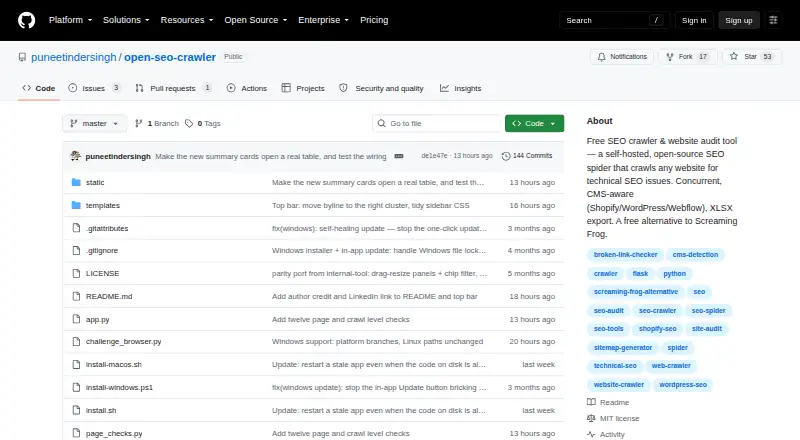
Open SEO Crawler is a free, self-hosted, open-source tool for auditing websites for technical SEO issues. It checks page titles, meta descriptions, H1s, canonicals, structured data, redirects, HTTP errors, indexability, hreflang, mobile viewport, mixed content, images, and security headers. It detects CMS platforms including Shopify, WordPress, Webflow, Wix, Squarespace, Kajabi, Ghost, Drupal, HubSpot, and Joomla, then applies crawl recommendations. Optional Playwright rendering supports JavaScript-heavy websites, while a compare mode identifies content absent from raw HTML. Bulk reports can be exported to XLSX, and the tool can export sitemaps. Default settings allow 1,500 pages, five workers, a 0.4-second per-host delay, and depth 10; the page cap can be made unlimited. It runs locally without accounts, telemetry, or API calls, but contacts the target site and checks GitHub for updates when requested. Installers are documented for Linux Mint, Ubuntu, Debian, macOS 11 or newer on Intel and Apple Silicon, and Windows 10/11. It is MIT-licensed. The README reports a 1,500-page WordPress crawl taking under three minutes with five workers and default delay settings.
Good
- Local operation without accounts or telemetry
- Checks a broad set of technical SEO elements
- Optional rendering for JavaScript-heavy sites
- Exports XLSX reports and sitemaps
Watch out
- Default page limit is 1,500 unless changed
- Installers are documented for specified operating systems
- It contacts GitHub when updates are requested
Who it suits
It suits SEO professionals, developers, and site owners conducting technical audits, migration checks, or competitor research. It is also relevant to users who prefer a self-hosted crawler.
Verdict
Open SEO Crawler offers local technical audits, configurable crawl limits, and export options under an MIT license. Its documented installers cover Linux, macOS 11 or newer, and Windows 10/11.
Plans and prices
From Open SEO Crawler's own pricing page, checked 7 Oct 2026.
| Plan | Price | What it gives you |
|---|---|---|
| Open SEO Crawler | Free | Free and MIT-licensed · self-hosted · unlimited URLs · no account, API key, or per-URL billing |
The facts
Each one read from Open SEO Crawler's own pages, with the date it was checked.
What it does
- CMS support
- Detects Shopify, WordPress, Webflow, Wix, Squarespace, Kajabi, Ghost, Drupal, HubSpot, and Joomla, and applies crawl recommendations.checked 7 Oct 2026
- Competitor research
- Yeschecked 21 Sep 2026
- Crawl checks
- Checks page titles, meta descriptions, H1s, canonicals, structured data, redirects, HTTP errors, indexability, hreflang, mobile viewport, mixed content, images, and security headers.checked 7 Oct 2026
- Crawl configuration
- The default crawl settings are 1,500 pages, five workers, a 0.4-second per-host delay, and depth 10; the page cap can be set to unlimited.checked 7 Oct 2026
- Exports
- Bulk reports can be exported to XLSX, and the tool also provides sitemap export.checked 7 Oct 2026
- Installation
- Installers are documented for Linux Mint/Ubuntu/Debian, macOS 11 or newer on Intel and Apple Silicon, and Windows 10/11.checked 7 Oct 2026
- Intended users
- The README describes it as built for SEO professionals, web developers, and site owners, with use cases including technical audits, migration checks, and competitor research.checked 7 Oct 2026
- JavaScript rendering
- Optional Playwright rendering supports JavaScript-heavy sites, with a compare mode that identifies content missing from raw HTML.checked 7 Oct 2026
- License
- The project is released under the MIT license.checked 7 Oct 2026
- Performance
- The README reports that a 1,500-page WordPress site crawled in under three minutes using five workers and default delay settings.checked 7 Oct 2026
- Privacy
- The crawler runs locally with no accounts, telemetry, or API calls; it contacts the target site and checks GitHub for updates when requested.checked 7 Oct 2026
- Purpose
- A self-hosted, open-source SEO crawler that audits websites for technical SEO issues.checked 7 Oct 2026
- Site audit
- Yeschecked 21 Sep 2026
- Support
- The maintainer directs bug reports to GitHub Issues and other inquiries to LinkedIn.checked 7 Oct 2026
Money
- Free plan
- Yeschecked 21 Sep 2026
The full review of Open SEO Crawler
Open SEO Crawler is a self-hosted, open-source crawler for technical SEO audits. It is best suited to SEO professionals, developers, and site owners who want to inspect sites locally, including for migrations or competitor research. Its unlimited-URL free plan is attractive, but using it means installing and running the software yourself.
Overview
This is a focused crawler rather than an all-in-one SEO suite. It combines a broad set of technical checks with CMS-aware recommendations, optional JavaScript rendering, and export tools. Local operation without accounts, telemetry, or API calls is a meaningful advantage for privacy-conscious teams; the trade-off is that the crawler is not a hosted service that manages the work for you.
The default crawl is capped at 1,500 pages, with five workers, a 0.4-second delay per host, and depth 10. The page cap can be changed to unlimited, so the default is a starting point rather than a hard ceiling. The README reports a 1,500-page WordPress site finishing in under three minutes with those default worker and delay settings; treat that as a reference for that setup, not a promise for every site.
Key features
Checks cover page titles, meta descriptions, H1s, canonicals, structured data, redirects, HTTP errors, indexability, hreflang, mobile viewports, mixed content, images, and security headers. That range makes it useful for finding common technical problems in one pass, especially during site audits and migrations. It does not replace broader tools for SEO work beyond crawling and technical inspection.
CMS detection spans Shopify, WordPress, Webflow, Wix, Squarespace, Kajabi, Ghost, Drupal, HubSpot, and Joomla, with crawl recommendations tailored to the detected platform. This can make results more relevant to the site being audited. Optional Playwright rendering supports JavaScript-heavy pages, and compare mode identifies content missing from raw HTML—valuable when the rendered page may differ from its source.
Bulk reports can be exported to XLSX, and sitemap export is also supported. These options make it easier to carry crawl findings into spreadsheets or retain a sitemap, though the documented export formats are not a substitute for a full reporting platform.
Pricing
The Open SEO Crawler plan costs nothing. It is free and MIT-licensed, self-hosted, and offers unlimited URLs without an account, API key, or per-URL billing. There is no free trial because the free plan is the product's stated offering. The unlimited URL allowance is especially useful for large crawls; the cost is the responsibility of installing and operating it locally.
Platforms
Installers are documented for Linux Mint, Ubuntu, and Debian; macOS 11 or newer on Intel and Apple Silicon; and Windows 10/11. The software is self-hosted and also categorized for web use, but the documented installation paths center on those desktop operating systems.
Who it's for
SEO professionals, developers, and site owners who need local technical audits, migration checks, or competitor research are the clearest fit. It is particularly compelling when URL limits or account requirements are undesirable. Readers who want a managed, browser-based service or a broader SEO suite should consider other tools instead.
Pros and cons
- Pros: Unlimited URLs and no per-URL billing make extensive crawls possible without moving to a paid tier.
- Pros: Broad technical checks, CMS-aware recommendations, and optional JavaScript rendering cover varied audit needs.
- Pros: Local execution without accounts, telemetry, or API calls offers stronger operational privacy.
- Pros: XLSX reports and sitemap export provide practical ways to use crawl results elsewhere.
- Cons: Self-hosting requires installation and local operation rather than delegating crawls to a hosted service.
- Cons: Default settings cap crawls at 1,500 pages and depth 10; larger jobs require changing the configuration.
- Cons: Its focus is crawling and technical audits, not a complete SEO suite.
Alternatives
Lighthouse is another free, open-source option for automated web page audits; choose it when that page-audit focus better fits your task.
Checkbot suits readers who prefer a browser extension and want unlimited crawls and sites on its free Basic plan, accepting a 100-URL cap per crawl and ads.
Screaming Frog SEO Spider is worth considering when a 500-URL free crawl cap is sufficient or when you want its paid licence for unlimited URLs.
WebSite Auditor offers a free option capped at 500 URLs and one project, with no paid report exports; choose it if that smaller project scope fits.
A1 Website Analyzer is an alternative for macOS and Windows users who want a free mode after a 30-day evaluation period, with a 500-page-URL-per-website allowance.
Beam Us Up is another free crawler with no limits stated.
Crab is a free, open-source crawler for Linux, macOS, and Windows.
FreeCrawl is another free option with unlimited URLs and self-hosted support.
Browse more options in SEO Audit Software, SEO Crawler Software, and SEO tools.
Verdict
Open SEO Crawler is a strong choice for SEO professionals, developers, and site owners who want broad local audits without URL-based charges. Its combination of unlimited crawling, CMS-aware checks, and optional rendering is the main reason to choose it. Look elsewhere if you need a hosted workflow or a more comprehensive SEO platform.
Getting started
- Open the project website on GitHub
- Select the installer for Linux Mint, Ubuntu, Debian, macOS 11 or newer, or Windows 10/11
- Install the crawler locally
- Start a crawl using the default settings or change the page cap to unlimited
- Enable Playwright rendering for JavaScript-heavy sites when needed
- Export bulk results to XLSX or export a sitemap
Limits worth knowing
Default settings allow 1,500 pages, five workers, a 0.4-second per-host delay, and depth 10. The page cap can be changed to unlimited.
Questions
Is Open SEO Crawler free?
Yes. The plan costs nothing, with unlimited URLs and no per-URL billing.
Does it require an account or API key?
No. It runs locally without an account, API key, telemetry, or API calls.
Which platforms can install it?
Installers are documented for Linux Mint, Ubuntu, Debian, macOS 11 or newer on Intel and Apple Silicon, and Windows 10/11.
Can it crawl JavaScript-heavy websites?
Yes. Optional Playwright rendering supports JavaScript-heavy sites, and compare mode identifies content missing from raw HTML.
What license does it use?
The project is released under the MIT license.
What does the default crawl allow?
The defaults are 1,500 pages, five workers, a 0.4-second per-host delay, and depth 10; the page cap can be set to unlimited.
Alternatives to Open SEO Crawler
- 1

DefiniteSEO
Free planOpen sourceAndroidiOSWebAPI9.0From $4.99 a month - 2

Marketing Miner
Free planAndroidiOSWebAPI8.8From €19 a month - 3

Rank Math SEO
Free planOpen sourceWebAPISelf-hosted8.7Free plan - 4
Yoast SEO
Free planOpen sourceWebAPISelf-hosted8.7From $118.80 a year - 5
Screaming Frog SEO Spider
Free planAPILinuxmacOSSelf-hosted8.6Free plan - 6
SEO PowerSuite
Free planAPILinuxmacOSWindows8.5From $349 a year