OERSI
OERSI is a search engine for open educational resources in higher education, jointly provided by hbz and TIB since 2020.
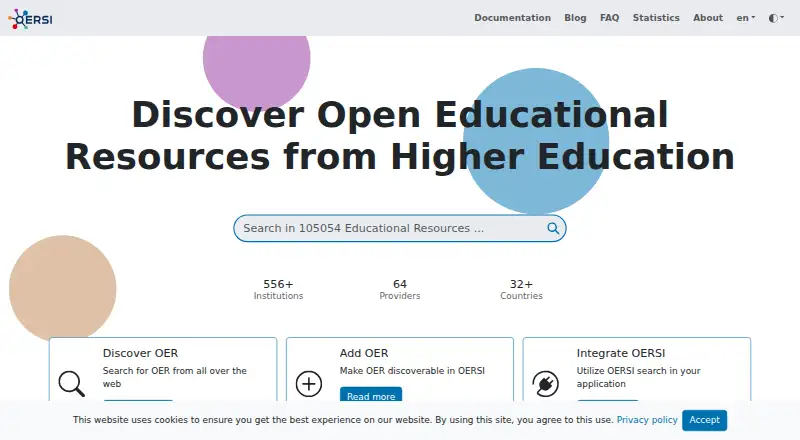
What OERSI is
OERSI is a search engine for open educational resources in higher education, jointly provided by hbz and TIB since 2020. It gathers and standardizes metadata from distributed national and international providers, then presents a central search with filters. OERSI does not host learning materials; users find records that point to resources held by providers. Included resources must relate to higher-education teaching or learning, be web-accessible, have at least partial open licensing, and include acceptable basic metadata. Developers can query the catalog through a JSON-based Elasticsearch API and use point-in-time searches for bulk access. Search requests should target the oer_data index because the generic endpoint can return results from multiple indexes and create duplicates. Metadata downloads are also available. Providers can submit metadata through schema.org and sitemaps, JSON over HTTP, OAI-PMH XML, structured HTML, or metadata dumps such as JSON and CSV. OERSI code is MIT-licensed, with reusable software called SIDRE. Integrations named by the project include twillo, ORCA.nrw, BASE, finc, and library search interfaces. A fifth-anniversary report said it indexed over 90,000 resources from 45 collections.
Good
- Central search across OER collections
- Open-license filtering
- JSON Elasticsearch API
- Bulk metadata access
- MIT-licensed open-source code
Watch out
- Does not host educational content
- Search requests must target oer_data
- No authoring or publishing workflow
- Users cannot upload learning materials
Who it suits
It suits higher-education learners, teachers, librarians, and developers seeking openly licensed educational resources or metadata access. Providers can connect collections through the listed submission formats and APIs.
Verdict
OERSI provides a metadata-focused discovery layer for higher-education open resources, with filters, downloads, and an open API. Its value is in unified searching and reuse rather than hosting or creating educational content.
The facts
Each one read from OERSI's own pages, with the date it was checked.
What it does
- API and downloads
- An open API supports integrations, and prepared metadata is also available as regular downloads.checked 7 Oct 2026
- API format
- The search API returns JSON and is based on Elasticsearch.checked 7 Oct 2026
- API usage
- API users are asked to send a meaningful, recurring User-Agent string with contact information where applicable.checked 7 Oct 2026
- API usage guidance
- API users are asked to send a meaningful, recurring User-Agent string with client and contact information where applicable.checked 7 Oct 2026
- Bulk access
- The API documentation describes querying metadata directly and downloading it in bulk using point-in-time searches.checked 7 Oct 2026
- Collection requirements
- Resources considered for inclusion must be relevant to higher education, accessible on the web, at least partly openly licensed, and have acceptable basic metadata.checked 7 Oct 2026
- Deployment
- The OERSI team says it uses Ansible scripts to install the service, and the SIDRE software is available for reuse.checked 7 Oct 2026
- Does not host learning materials
- OERSI does not store educational content; it harvests metadata from OER providers.checked 7 Oct 2026
- Integrations
- The about page names twillo and ORCA.nrw as platforms integrating OERSI search; it also lists reuse in BASE, finc, and library search interfaces.checked 7 Oct 2026
- Limits
- Users cannot upload educational content to OERSI because it does not store the content itself.checked 7 Oct 2026
- Metadata formats accepted
- OERSI accepts collection metadata as schema.org markup with a sitemap, JSON over HTTP, XML via OAI-PMH, structured HTML with a sitemap, or metadata dumps such as JSON and CSV.checked 7 Oct 2026
- Metadata only
- OERSI does not host educational resources; it collects and harmonizes their metadata for unified search.checked 7 Oct 2026
- Metadata search
- OERSI collects and standardizes metadata from distributed national and international providers to offer a central search with filters.checked 7 Oct 2026
- Metadata sources
- OERSI accepts collection metadata through schema.org markup and sitemap, JSON HTTP APIs, OAI-PMH, structured HTML, and metadata dumps, among other methods.checked 7 Oct 2026
- Metadata standard
- OERSI's internal metadata profile largely matches the General Metadata Profile for Educational Resources (AMB).checked 7 Oct 2026
- Notable API limit
- Search requests must target the oer_data index; the FAQ warns that querying the generic search endpoint can return results from multiple indexes and cause duplicates.checked 7 Oct 2026
- Open API
- OERSI provides a JSON-based Elasticsearch API for querying metadata and supports bulk access using point-in-time searches.checked 7 Oct 2026
- Open development
- OERSI says its planning and development are documented on GitLab and invites feedback, bug reports, and feature requests.checked 7 Oct 2026
- Open source
- The OERSI code is available under the MIT licence, and the underlying reusable software is called SIDRE.checked 7 Oct 2026
- Purpose
- OERSI is a search engine for open educational resources in higher education, provided jointly by hbz and TIB since 2020.checked 7 Oct 2026
- Scale
- In its fifth-anniversary post, OERSI reported indexing over 90,000 educational resources from 45 collections.checked 7 Oct 2026
- Search
- It provides a central search across educational resources from national and international providers, with filter options.checked 7 Oct 2026
- Single-resource submission
- OER can be listed automatically from GitLab, GitHub, or Codeberg repositories when metadata is provided and the open-educational-resources topic is set.checked 7 Oct 2026
The company
- Founded
- 2020checked 28 Sep 2026
Alternatives to OERSI
- 1

OpenStax
Free planAndroidiOSWebAPI7.9Free plan - 2

DIKSHA
Free planOpen sourceAndroidiOSWebAPI7.8Free plan - 3
CK-12 FlexBook 2.0
Free planAndroidiOSWebExtension7.6Free plan - 4

Pressbooks
Open sourceWebAPILinuxSelf-hosted7.5From $120 a year - 5
LibreTexts
Free planAndroidiOSWeb7.4From $1,250 a year - 6

African Storybook
Free planAndroidiOSWeb7.3Free plan