
Obfuscator.io
Obfuscator.io transforms JavaScript into code that is harder to read, including custom bytecode executed by an embedded JavaScript virtual machine.
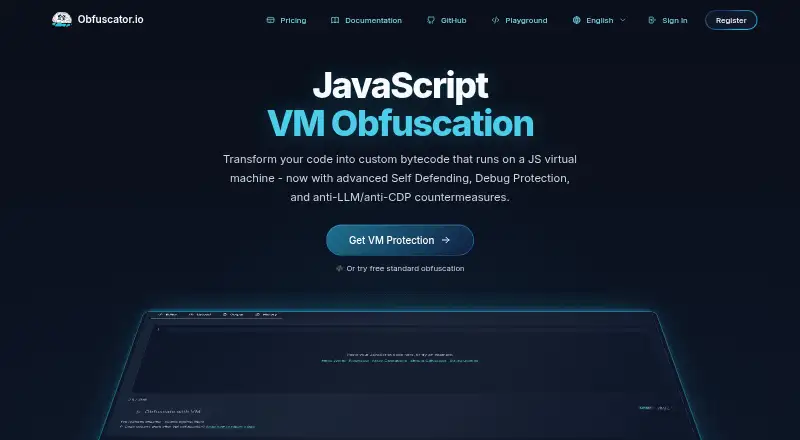
What Obfuscator.io is
Obfuscator.io transforms JavaScript into code that is harder to read, including custom bytecode executed by an embedded JavaScript virtual machine. Its standard obfuscation runs in the browser, is free without usage limits, and the playground says submitted code stays on the device. VM obfuscation offers defenses such as integrity checks, hook detection, breakpoint neutralization, and environment fingerprinting. Developers can select functions for VM treatment using comments and a configuration mode. The service provides REST API and npm package access, and its API can be used from build runners such as GitHub Actions, GitLab CI, and Jenkins. Teams can share presets and service tokens and keep versions and presets consistent across builds. The Free plan is free, with unlimited standard obfuscation, a 25 MB lifetime VM quota, and a 4 MB VM file limit. Pro costs $19 a month; Team is $59 a month and Business is $149 a month. The maker cautions that obfuscation is not encryption or a guarantee against reverse engineering.
Good
- Unlimited standard obfuscation is free
- Standard processing runs in the browser
- Offers REST API and npm package access
- Teams can share presets and service tokens
- Supports browser, Node, and other targets
Watch out
- Free VM quota is 25 MB lifetime
- Free VM file limit is 4 MB
- Obfuscation does not prevent reverse engineering
- VM output may not work with all code
Who it suits
It suits developers who want to make JavaScript harder to read, from individual users applying standard obfuscation to teams integrating VM processing into builds. Those evaluating it should consider its security caveat and test VM output before production use.
Verdict
Obfuscator.io offers free browser-based standard processing and paid plans with VM quotas and API access. It should not be treated as encryption, and VM output needs testing in its intended environment.
Plans and prices
From Obfuscator.io's own pricing page, checked 29 Sep 2026.
| Plan | Price | What it gives you |
|---|---|---|
| Free | Free | 25 MB lifetime VM quota · 4 MB VM file size limit · unlimited standard obfuscation |
| Pro | $19 a month | 100 MB/month VM quota · 30 MB/day · API access (REST + npm package) · up to 10 files per batch · HTML files with inline JS · billed monthly |
| Team | $59 a month | 500 MB/month shared VM quota · 150 MB/day per member · up to 5 members · 7 MB VM file size limit · flexible version pinning · billed monthly |
| Business | $149 a month | 2.5 GB/month shared VM quota · 600 MB/day per member · up to 15 members · 10 MB VM file size limit · priority support · billed monthly |
The facts
Each one read from Obfuscator.io's own pages, with the date it was checked.
What it does
- Code targeting
- Users can select individual functions for VM obfuscation by marking them with a comment and configuring the target functions mode.checked 29 Sep 2026
- Compatibility
- The output is actively supported and tested on evergreen desktop browsers and iOS 16 or later; older browser support is best effort down to ES2015 module support, with Internet Explorer out of scope.checked 29 Sep 2026
- Integrations
- The service offers REST API and npm package access, and its API can be called from GitHub Actions, GitLab CI, Jenkins, or any runner with Node.checked 29 Sep 2026
- Limitations
- VM obfuscation may not work correctly with all input code or runtime environments, and the terms require users to test obfuscated code before production use.checked 29 Sep 2026
- Purpose
- Obfuscator.io transforms JavaScript into harder-to-read code, including custom bytecode that runs in an embedded JavaScript virtual machine.checked 29 Sep 2026
- Security limit
- The maker cautions that frontend secrets can be extracted and says obfuscation is not encryption or a guarantee against reverse engineering.checked 29 Sep 2026
- Source handling
- The site says it does not keep source code; VM and HTML obfuscation send source to its servers for processing and discard it, while uploads larger than 4.4 MB on Team and Business use temporary storage deleted after processing.checked 29 Sep 2026
- Standard obfuscation
- Standard obfuscation runs in the browser, is always free with no limits, and the playground says submitted code never leaves the device.checked 29 Sep 2026
- Support
- The site lists [email protected] as its support contact and includes priority support with Business.checked 29 Sep 2026
- Supported inputs
- The documentation says to compile TypeScript and JSX and bundle applications before obfuscation, and the site supports HTML files through its HTML parsing option.checked 29 Sep 2026
- Usage metadata
- For abuse handling and usage analysis, the service says it retains a SHA-256 hash of each obfuscated output and selected settings for three months, but not the code or its content.checked 29 Sep 2026
- Usage restriction
- The terms prohibit using the API to operate an obfuscation SaaS or online tool for third parties, or reselling or white-labeling the service.checked 29 Sep 2026
- VM defenses
- VM obfuscation offers self defending and debug protection features, including integrity checks, hook detection, breakpoint neutralization, and environment fingerprinting.checked 29 Sep 2026
The company
- Team workflow
- Teams can share presets and service tokens and enforce obfuscator versions and presets across members and builds.checked 29 Sep 2026
The full review of Obfuscator.io
Overview
Obfuscator.io makes JavaScript harder to read, with a free browser-based standard mode and paid virtual-machine (VM) processing for stronger, more involved obfuscation. It suits developers protecting browser-facing code or adding obfuscation to a build pipeline, especially when they can test the resulting code in its target environment. Its free standard mode is unusually open-ended, but obfuscation is not encryption and cannot keep frontend secrets safe.
Key features
Standard obfuscation runs in the browser, and the playground says submitted code stays on the device. It has no usage limit, making it a practical starting point for routine code transformation without consuming a VM quota.
VM obfuscation adds self-defending and debugging protections, including integrity checks, hook detection, breakpoint neutralization and environment fingerprinting. You can target selected functions by marking them with comments and configuring target-functions mode, rather than applying VM processing indiscriminately. That selectivity can help reserve quota for code that merits extra protection, though VM output may not work correctly with every program or runtime.
For build workflows, the REST API and npm package can be called from GitHub Actions, GitLab CI, Jenkins or another Node-capable runner. Teams can share presets and service tokens, and keep versions and presets consistent across members and builds. The API is not licensed for running an obfuscation service for third parties, reselling or white-labeling.
The service says it discards source after processing. VM and HTML jobs send source to its servers; uploads over 4.4 MB on Team and Business use temporary storage that is deleted after processing. It retains a SHA-256 hash of each output and selected settings for three months for abuse handling and usage analysis, not the code itself. This distinction matters for teams with strict data-handling needs.
Obfuscated output is actively supported and tested on evergreen desktop browsers and iOS 16 or later. Older browsers receive best-effort support down to ES2015 module support; Internet Explorer is out of scope. Compile TypeScript and JSX and bundle applications before processing. HTML files are supported through the HTML parsing option. The maker warns that frontend secrets can be extracted and that obfuscation cannot guarantee protection from reverse engineering; VM output should be tested before production use.
Pricing
Obfuscator.io is freemium, with no free trial. Standard obfuscation is free without limits, while VM work is governed by plan quotas and file-size limits.
- Free — free: 25 MB lifetime VM quota and a 4 MB VM file-size limit, alongside unlimited standard obfuscation. This is enough to try VM processing or handle occasional small jobs, but the lifetime allowance is not suited to regular builds.
- Pro — $19 a month, billed monthly: 100 MB/month VM quota, 30 MB/day, API access through REST and npm, batches of up to 10 files, and HTML files with inline JavaScript. It is the entry point for individual developers who need automated processing; the quota and daily cap constrain heavier usage.
- Team — $59 a month, billed monthly: 500 MB/month shared VM quota, 150 MB/day per member, up to 5 members, a 7 MB VM file-size limit and flexible version pinning. Shared usage and team controls make it the more relevant choice for a small group maintaining consistent builds.
- Business — $149 a month, billed monthly: 2.5 GB/month shared VM quota, 600 MB/day per member, up to 15 members, a 10 MB VM file-size limit and priority support. It fits larger teams with heavier processing needs, though the higher spend is difficult to justify without those quotas, seats or support.
Platforms
The service is available on the web and through an API. Supported targets are browser, browser-no-eval, Node, service-worker, userscript and bytenode. Its hybrid deployment means standard processing can stay in the browser, while VM and HTML processing use the service’s servers.
Who it's for
Choose Obfuscator.io if you need unlimited, local-in-browser standard processing, or want VM obfuscation integrated into JavaScript builds with quotas that can scale from an individual to a small team. It is a weaker fit if your requirement is to conceal secrets in frontend code, guarantee resistance to reverse engineering, support Internet Explorer, or process code that cannot be sent to a server for VM or HTML obfuscation.
Pros and cons
- Pro: Unlimited standard obfuscation runs in the browser, avoiding a paid quota and keeping submitted playground code on the device.
- Pro: VM protections can be focused on selected functions, while API and npm access support automated builds on Pro and above.
- Pro: Team and Business add shared quotas, member limits and version controls for coordinated builds.
- Con: The free VM allowance is only 25 MB lifetime, with a 4 MB file limit; continuing VM use requires a paid plan.
- Con: VM and HTML source is sent to the service for processing, and VM compatibility needs validation in the intended runtime.
- Con: Obfuscation cannot secure frontend secrets or rule out reverse engineering, so it is not a substitute for encryption or sound security design.
Alternatives
JavaScript Obfuscator is the closest alternative for readers seeking a free JavaScript obfuscator: its free plan includes the same stated lifetime VM quota, file-size limit and unlimited standard obfuscation, and it also offers API, extension, self-hosted and web platforms.
ByteHide Shield is worth considering if you need a broader range of platforms, including mobile, desktop and self-hosted options; it has a free plan for individuals and small projects, with paid plans at custom pricing.
.NET Reactor is an option for readers looking at a paid product with a perpetual single-developer license and one year of update support, rather than Obfuscator.io’s monthly JavaScript plans.
DashO, Tigress, Jscrambler, Allatori and DexProtector are other options to compare.
Browse more options in Code Obfuscation Software.
Verdict
Obfuscator.io is a strong fit for JavaScript developers who want unlimited browser-based standard processing and a path to quota-based VM obfuscation in automated builds. Its paid plans add meaningful API and team controls, but VM processing brings compatibility testing and server submission, while obfuscation itself cannot protect secrets. Look elsewhere if either limitation conflicts with your deployment or security requirements.
Alternatives to Obfuscator.io
- 1
Enigma Protector
WebAPILinuxSelf-hosted7.4 - 2
JS-Confuser
Free planOpen sourceWebAPILinuxmacOS7.4Free plan - 3
Jscrambler
AndroidiOSWebAPI7.0 - 4
Tigress
Free planAndroidLinuxmacOSWindows6.8Free plan - 5

ByteHide Shield
Free planAndroidiOSWebLinux6.7Free plan - 6
JavaScript Obfuscator
Free planWebAPIExtensionSelf-hosted6.7From $19 a month