
ByteHide Shield
ByteHide Shield protects application code from decompilation, reverse engineering and tampering using obfuscation and runtime protections.
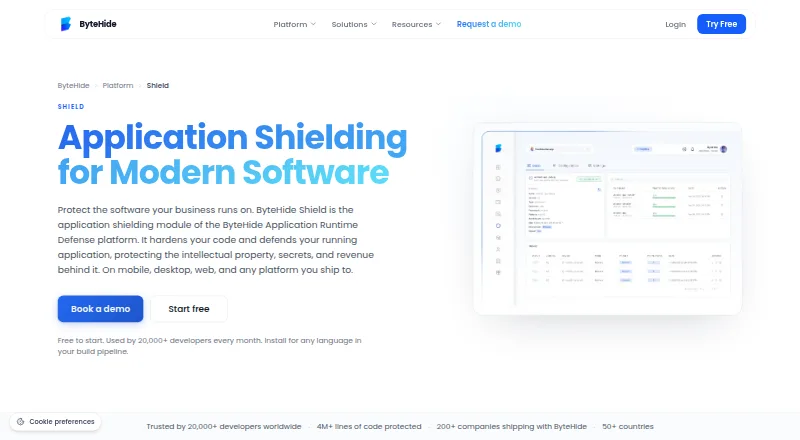
What ByteHide Shield is
ByteHide Shield protects application code from decompilation, reverse engineering and tampering using obfuscation and runtime protections. It supports .NET, JavaScript and TypeScript, Android, and iOS applications, applying protection as a build-time pipeline step. Listed techniques include identifier renaming, string encryption and control-flow transformation, along with anti-debugging and anti-tamper measures. Android resource protection and iOS anti-jailbreak support are also listed. Build integrations include a .NET NuGet package, Visual Studio extension, CLI, Unity, JavaScript plugins for Webpack, Vite and Next.js, an Android Gradle plugin, and iOS Xcode integration. Its JavaScript coverage includes React, Next.js, Node.js, Vue, Angular, TypeScript and standard JavaScript. The Free plan is free and covers core obfuscation. Code virtualization, advanced encryption and enterprise features are available on paid plans, for which no price is listed. ByteHide says obfuscation has a performance cost, with added overhead when virtualized methods run, and that obfuscation can theoretically be worked through with enough time and skill. The first .NET build connects to a free ByteHide account using a project token.
Good
- Supports four application target groups
- Includes anti-debugging and anti-tamper protections
- Offers multiple build integrations
- Free plan covers core obfuscation
Watch out
- Obfuscation has a performance cost
- Virtualized methods add execution overhead
- Advanced protections require paid plans
- Obfuscation can be worked through with enough time and skill
Who it suits
Shield suits developers who want build-time code protection for .NET, JavaScript or TypeScript, Android, and iOS applications. Listed use cases include financial applications, games, enterprise software, security tools and mobile apps.
Verdict
ByteHide Shield applies a range of code protections during the build process and supports several common application targets. The free plan covers core obfuscation, while advanced techniques require paid plans and may add runtime overhead.
Plans and prices
From ByteHide Shield's own pricing page, checked 28 Sep 2026.
| Plan | Price | What it gives you |
|---|---|---|
| Free | Free | Core obfuscation for individual developers and small projects |
| Paid plans | Priced on request | Advanced techniques including code virtualization, advanced encryption, and enterprise features |
The facts
Each one read from ByteHide Shield's own pages, with the date it was checked.
What it does
- Account requirement
- The first .NET build connects to a free ByteHide account using a project token.checked 28 Sep 2026
- Build integrations
- Integrations include a .NET NuGet package, Visual Studio extension, CLI and Unity integration, JavaScript Webpack, Vite and Next.js plugins, Android Gradle plugin, and iOS Xcode integration.checked 28 Sep 2026
- Build workflow
- Shield applies protection at build time as a pipeline step and the JavaScript page says it requires no proxies or infrastructure changes.checked 28 Sep 2026
- JavaScript frameworks
- The JavaScript product page lists React, Next.js, Node.js, Vue, Angular, TypeScript, and standard JavaScript coverage.checked 28 Sep 2026
- Obfuscation
- Protections include identifier or name obfuscation, string encryption, and control flow transformation.checked 28 Sep 2026
- Performance tradeoff
- ByteHide says obfuscation has a performance cost and that code virtualization adds overhead when virtualized methods execute.checked 28 Sep 2026
- Purpose
- Shield protects application code from decompilation, reverse engineering, and tampering through obfuscation and runtime protection.checked 28 Sep 2026
- Reversibility
- ByteHide states that obfuscation can theoretically be worked through with enough time and skill.checked 28 Sep 2026
- Runtime protections
- Shield lists anti-debugging and anti-tamper protections, with Android resource protection and iOS anti-jailbreak support.checked 28 Sep 2026
- Supported targets
- Shield supports .NET, JavaScript and TypeScript, Android, and iOS applications.checked 28 Sep 2026
- Use cases
- The documentation names financial applications, games, enterprise software, security tools, and mobile applications as use cases.checked 28 Sep 2026
Money
- Free tier limitation
- ByteHide says code virtualization, advanced encryption, and enterprise features are available on paid plans.checked 28 Sep 2026
The full review of ByteHide Shield
Overview
ByteHide Shield is a build-time code protection tool for developers shipping .NET, JavaScript or TypeScript, Android, and iOS applications. It is best suited to teams that want obfuscation and runtime defenses integrated into an existing build pipeline. Its free plan provides core obfuscation; advanced techniques cost extra, and stronger protection can bring performance overhead.
Key features
Shield combines transformations that make code harder to read with protections aimed at deterring inspection and tampering while an application runs. Identifier obfuscation, string encryption, and control-flow transformation can raise the effort required to understand an application, but they are not a guarantee: ByteHide acknowledges that sufficiently skilled and persistent analysis can work through obfuscation.
Runtime protections include anti-debugging and anti-tamper controls, plus Android resource protection and iOS anti-jailbreak support. These make Shield more relevant to applications exposed to device-level inspection than a tool focused only on renaming code. Its build integrations span .NET NuGet, Visual Studio, CLI and Unity; JavaScript Webpack, Vite and Next.js; Android Gradle; and iOS Xcode. JavaScript coverage includes React, Next.js, Node.js, Vue, Angular, TypeScript, and standard JavaScript.
Shield applies protection as a build-pipeline step, rather than requiring a separate runtime service. ByteHide says the JavaScript workflow needs no proxies or infrastructure changes. The first .NET build does require a free ByteHide account and project token, so that workflow is not entirely account-free.
Protection has a cost: ByteHide says obfuscation affects performance, and code virtualization adds overhead when virtualized methods execute. That makes selective use important, especially for performance-sensitive code.
Pricing
The Free plan costs nothing and provides core obfuscation for individual developers and small projects. It is a useful way to protect a modest project without an upfront plan cost, but it excludes code virtualization, advanced encryption, and enterprise features.
Paid plans use custom pricing and add those advanced techniques and enterprise features. They are the relevant option for teams that need more than core obfuscation, though virtualization's execution overhead should be weighed against the protection it adds. ByteHide also offers a 14-day trial.
Platforms
Shield's supported application targets are .NET, JavaScript and TypeScript, Android, and iOS. Its listed platform coverage also includes Linux, macOS, Windows, web, and self-hosted environments. The range of build plugins makes it a fit for projects already using the supported toolchains; target and platform labels do not mean every combination has the same integration.
Who it's for
ByteHide names financial applications, games, enterprise software, security tools, and mobile applications as use cases. Developers in those areas may value the combination of build-time obfuscation and runtime defenses, particularly when shipping code to environments they do not control. The free plan suits individuals and small projects that can rely on core obfuscation; teams needing virtualization, advanced encryption, or enterprise features should consider paid plans. It is a weaker fit when execution overhead is unacceptable or when the expectation is that obfuscation will make code unrecoverable.
Pros and cons
- Pros: Multiple obfuscation methods and runtime defenses cover more than simple renaming.
- Pros: Build integrations span .NET, JavaScript, Android, and iOS workflows, helping teams add protection at build time.
- Pros: Core obfuscation is available on a free plan for individual developers and small projects.
- Cons: Virtualization, advanced encryption, and enterprise features require paid plans with custom pricing.
- Cons: Obfuscation is reversible with enough time and skill, so it should be treated as a deterrent, not a guarantee.
- Cons: Obfuscation can affect performance, and virtualized methods add runtime overhead.
Alternatives
Code Obfuscation Software is a useful starting point for comparing tools in the same category. For a JavaScript-focused free and open-source option, consider JS-Confuser. JavaScript Obfuscator is another free option, with unlimited standard obfuscation but a 25 MB lifetime VM quota and 4 MB VM file-size limit on its free plan. Obfuscator.io offers a similar free quota structure and a Pro plan at $19 a month.
For .NET assembly protection on Windows, Skater .NET Obfuscator has a Standard Edition at $119.99, paid once, with string encryption and member-name obfuscation. Tigress is another option to compare. Allatori and DashO are alternatives with freemium plans; DashO has no free plan and offers a trial. Redgate SQL Provision is also an alternative.
Verdict
Choose ByteHide Shield if you need build-integrated obfuscation and runtime defenses across supported .NET, JavaScript, Android, or iOS projects, and its plugins match your workflow. The free plan makes core protection accessible, while paid plans cover advanced needs. Look elsewhere if you need a guarantee against reverse engineering, cannot accept performance costs, or require advanced features at a published price.
Getting started
- Visit the ByteHide Shield website.
- Choose the integration for your target, such as a .NET package, JavaScript plugin, Android Gradle, or iOS Xcode.
- For a first .NET build, connect a free ByteHide account using a project token.
- Use the free plan for core obfuscation or a paid plan for advanced features.
Limits worth knowing
The free plan covers core obfuscation.
Questions
Is ByteHide Shield free?
Yes. The Free plan is free and covers core obfuscation. A 14-day trial is also listed.
Which applications does Shield support?
Supported targets include .NET, JavaScript and TypeScript, Android, and iOS applications.
Which protections does it offer?
Listed protections include identifier obfuscation, string encryption, control-flow transformation, anti-debugging, and anti-tamper measures. Android resource protection and iOS anti-jailbreak support are also listed.
What integrations are available?
Options include a .NET NuGet package, Visual Studio extension, CLI, Unity, JavaScript plugins for Webpack, Vite, and Next.js, Android Gradle, and iOS Xcode.
Does the first .NET build require an account?
Yes. The first .NET build connects to a free ByteHide account using a project token.
Alternatives to ByteHide Shield
- 1
Enigma Protector
WebAPILinuxSelf-hosted7.4 - 2
JS-Confuser
Free planOpen sourceWebAPILinuxmacOS7.4Free plan - 3
Jscrambler
AndroidiOSWebAPI7.0 - 4
Tigress
Free planAndroidLinuxmacOSWindows6.8Free plan - 5
JavaScript Obfuscator
Free planWebAPIExtensionSelf-hosted6.7From $19 a month - 6

Obfuscator.io
Free planWebAPI6.7From $19 a month