NuSMV
NuSMV is a free software tool for formally verifying finite state systems.
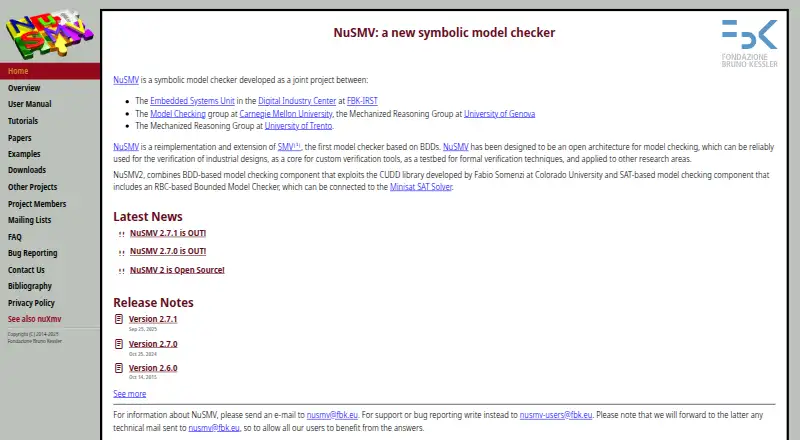
What NuSMV is
NuSMV is a free software tool for formally verifying finite state systems. It checks systems against CTL specifications and supports LTL and PSL model checking. NuSMV 2 combines BDD-based model checking with SAT-based bounded model checking. Its input language supports hierarchical system descriptions, reusable components, and finite data types including booleans, scalars, bit vectors, and fixed arrays. The tool includes an interactive text shell, invariant analysis, partitioning methods, and SAT-based bounded model checking; its SAT component can connect to the Minisat solver. NuSMV is intended for industrial design verification, as a foundation for custom verification tools, and as a research testbed. It runs on Linux, macOS, and Windows, and is self-hosted under the LGPL v2.1 license. The project directs questions and bug reports to its users mailing list, with a separate announcements list. Its FAQ says processes are deprecated because they may behave incorrectly with relational constructs such as TRANS, INIT, or INVAR.
Good
- Free and open source under LGPL v2.1.
- Supports CTL, LTL, and PSL checking.
- Combines BDD and SAT-based methods.
- Runs on Linux, macOS, and Windows.
- Supports reusable hierarchical model descriptions.
Watch out
- Processes are deprecated in the FAQ.
- No developer-extension tutorial is currently available.
- Downloads may retain IP address and timestamp for one year.
Who it suits
NuSMV suits users verifying finite-state designs, building custom verification tools, or researching formal verification methods. It is relevant to teams working with CTL, LTL, or PSL specifications.
Verdict
NuSMV offers multiple model-checking approaches and a flexible input language for finite-state systems. Be mindful of the documented process limitation when modeling with relational constructs.
Plans and prices
From NuSMV's own pricing page, checked 7 Oct 2026.
| Plan | Price | What it gives you |
|---|---|---|
| NuSMV v2 | Free | Open source · LGPL v2.1 |
The facts
Each one read from NuSMV's own pages, with the date it was checked.
What it does
- Additional features
- Features include an interactive text shell, invariant analysis, partitioning methods, LTL model checking, PSL model checking, and SAT based bounded model checking.checked 7 Oct 2026
- Audience
- The project says NuSMV is designed for verifying industrial designs, serving as a core for custom verification tools, and as a testbed for formal verification techniques and other research areas.checked 7 Oct 2026
- Developer guidance
- The FAQ says there is currently no tutorial for developers extending NuSMV, though users may email questions.checked 7 Oct 2026
- Download privacy
- The privacy policy says downloads may collect an IP address and timestamp, which are retained for one year; it also describes encryption, access controls, and access logging as safeguards.checked 7 Oct 2026
- Integrations
- NuSMV2's SAT based component can connect to the Minisat SAT solver, and the project describes cooperation to integrate NuSMV into ICS's SCL Visual Modeler.checked 7 Oct 2026
- License
- NuSMV v2 is open source software distributed under the LGPL v2.1 license.checked 7 Oct 2026
- Model checking
- NuSMV 2 combines BDD based model checking with SAT based bounded model checking.checked 7 Oct 2026
- Modeling limitation
- The FAQ says processes are deprecated because they can behave incorrectly with relational constructs such as TRANS, INIT, or INVAR.checked 7 Oct 2026
- Model language
- Its input language supports modular hierarchical descriptions, reusable components, and finite data types including booleans, scalars, bit vectors, and fixed arrays.checked 7 Oct 2026
- Purpose
- NuSMV is a software tool for formally verifying finite state systems.checked 7 Oct 2026
- Specifications
- It checks finite state systems against CTL specifications and supports LTL and PSL model checking.checked 7 Oct 2026
- Support
- The project directs general questions and bug reports to its users mailing list and provides a separate list for announcements.checked 7 Oct 2026
Where it runs
- Platforms
- The downloads page lists current binaries for GNU/Linux, macOS, and Windows.checked 7 Oct 2026