Noplag Engine
Noplag Engine is an open-source tool for finding verbatim and near-verbatim matches against a corpus you control.
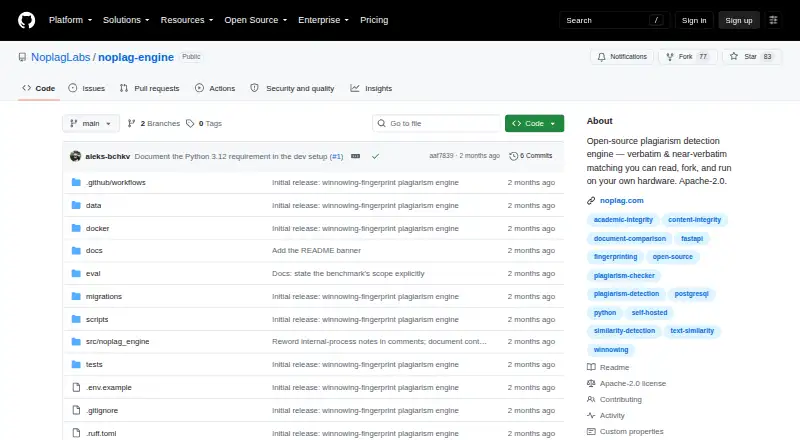
What Noplag Engine is
Noplag Engine is an open-source tool for finding verbatim and near-verbatim matches against a corpus you control. It uses winnowing fingerprints to locate candidate sources, then aligns matching character ranges. Reports provide similarity by source, passage offsets and coverage accounting. The engine accepts .txt, .md, .pdf and .docx files through folder ingestion or HTTP upload, and exposes a /v1 API for checks, reports, uploads, progress events and corpus management. That API ships without authentication. The open-source engine searches a local corpus; the hosted product also searches the live web. It does not detect paraphrase, semantic similarity or AI-written text. The engine can run on your own hardware with Docker Compose and uses the Apache 2.0 license. For development, the repository lists Python 3.12 or newer and PostgreSQL in its Docker Compose setup. Hosted plans list detection calibrated for English, Spanish, Portuguese, Polish and Ukrainian. The free hosted plan provides three checks per month, while self-hosting allows unlimited local checks.
Good
- Open-source under Apache 2.0.
- Can run on the user's own hardware.
- Reports include matching passage offsets.
- Supports folder ingestion and HTTP uploads.
- Free self-hosting allows unlimited local checks.
Watch out
- Does not detect paraphrase or semantic similarity.
- Does not detect AI-written text.
- The API ships without authentication.
- Hosted free plan includes three checks per month.
Who it suits
The engine may suit developers or organizations that want to run plagiarism checks against a corpus they manage. Hosted plans are positioned for makers, teams, agencies, publishers, universities and regulated organizations, depending on tier.
Verdict
Noplag Engine provides corpus-based verbatim matching with an API and self-hosting option. It is not a solution for paraphrase or AI-text detection, and its unauthenticated API needs careful deployment.
Plans and prices
From Noplag Engine's own pricing page, checked 29 Sep 2026.
| Plan | Price | What it gives you |
|---|---|---|
| Free | Free | 2,500 words per check · public web + Common Crawl · self-host for unlimited local checks · 3 checks per month |
| Pro | $9.99 a month | 50 checks per month · 25,000 words per check · Noplag Database · academic index · REST API + webhooks · Monthly |
| Premium | $19.99 a month | 200 checks per month · 50,000 words per check · Live Web search · branded PDF reports · priority support · Monthly |
| Enterprise | Priced on request | Custom check volume · all corpora + Live Web · on-prem or private cloud · SSO/SAML · LMS integrations · dedicated support + SLA · Custom |
The facts
Each one read from Noplag Engine's own pages, with the date it was checked.
What it does
- API
- The engine exposes a `/v1` API with checks, reports, uploads, progress events, and corpus management, and ships without authentication.checked 29 Sep 2026
- Corpus
- The open-source engine searches a local corpus, while the hosted product additionally searches the live web.checked 29 Sep 2026
- Detection limits
- The engine does not detect paraphrase, semantic similarity, or AI-written text; the README describes those capabilities as roadmap work.checked 29 Sep 2026
- Input and ingestion
- The engine supports corpus ingestion from .txt, .md, .pdf, and .docx files, including folder ingestion and HTTP file upload.checked 29 Sep 2026
- Integrations
- The Enterprise plan lists Canvas, Moodle, and Blackboard LMS integrations; the features page also names Brightspace via LTI 1.3.checked 29 Sep 2026
- Languages
- The hosted product says detection is calibrated for English, Spanish, Portuguese, Polish, and Ukrainian at launch.checked 29 Sep 2026
- License and deployment
- The engine is licensed under Apache 2.0 and can be run on the user's own hardware with Docker Compose.checked 29 Sep 2026
- Matching
- The engine uses winnowing fingerprints to retrieve candidate sources and a seed-and-extend aligner to locate matching character ranges.checked 29 Sep 2026
- Privacy
- The maker says submitted documents are never used to train models; hosted-plan retention is configurable and EU data residency is available on request.checked 29 Sep 2026
- Purpose
- Noplag Engine is an open-source plagiarism detection engine for verbatim and near-verbatim matching against a corpus you control.checked 29 Sep 2026
- Reports
- Reports include per-source similarity, matching passage offsets, and coverage accounting.checked 29 Sep 2026
- Runtime requirements
- The repository says development requires Python 3.12 or newer and uses PostgreSQL in its Docker Compose setup.checked 29 Sep 2026
- Who it serves
- The maker positions Free for trying the service or self-hosting, Pro for makers and small teams, Premium for agencies and publishers, and Enterprise for universities and regulated organizations.checked 29 Sep 2026
The company
- Founded
- 2014checked 28 Sep 2026
- Headquarters
- San Francisco, United Stateschecked 28 Sep 2026
The full review of Noplag Engine
Noplag Engine is an open-source plagiarism checker for verbatim and near-verbatim matches in a corpus you control. It is best suited to developers, publishers and institutions that need configurable corpus searches or self-hosted deployment. Its passage-level reports and API are useful strengths, but it cannot identify paraphrases or AI-written text.
Overview
Noplag Engine combines a local matching engine with hosted plans that add access to external corpora, including live-web search on Premium and Enterprise. Apache 2.0 licensing and Docker Compose deployment give technical teams room to run it on their own hardware; the trade-off is that they must manage the deployment themselves. Development requires Python 3.12 or newer, and the Compose setup uses PostgreSQL.
Key features
Winnowing fingerprints surface candidate sources, then a seed-and-extend aligner identifies matching character ranges. Reports break similarity down by source and include passage offsets and coverage accounting, so reviewers can locate matches rather than rely on a single score.
Corpus ingestion supports .txt, .md, .pdf and .docx files, including folder ingestion and HTTP uploads. The /v1 API covers checks, reports, uploads, progress events and corpus management, which can suit teams building checking into another workflow. It ships without authentication, however, so exposing it to users or a network requires careful security planning.
The engine does not detect paraphrase, semantic similarity or AI-written text. Those capabilities are described as roadmap work, not current functionality. The open-source engine searches a local corpus; the hosted product adds live-web search. Hosted detection is calibrated for English, Spanish, Portuguese, Polish and Ukrainian at launch.
The maker says submitted documents are not used to train models. Hosted-plan retention is configurable, and EU data residency is available on request—useful options for organizations assessing document handling.
Pricing
Free is free and allows three checks per month at up to 2,500 words per check, with public web and Common Crawl access. Self-hosting allows unlimited local checks, making it a practical route for evaluation or teams able to supply their own corpus and infrastructure; hosted use remains tightly capped.
Pro costs $9.99 a month, billed monthly, for 50 checks per month at up to 25,000 words each, plus the Noplag Database, academic index, REST API and webhooks. It fits makers and small teams that need recurring checks and integrations, but has no stated Live Web search.
Premium costs $19.99 a month, billed monthly, and raises the allowance to 200 checks per month and 50,000 words per check. Live Web search, branded PDF reports and priority support make it better suited to agencies and publishers with higher volumes or client-facing output.
Enterprise has custom pricing and custom check volume, with all corpora and Live Web, on-premises or private-cloud deployment, SSO/SAML, LMS integrations, dedicated support and an SLA. Its Canvas, Moodle and Blackboard integrations are joined by Brightspace via LTI 1.3. Those controls and deployment choices suit universities and regulated organizations, but require a custom engagement rather than a fixed-price subscription.
The pricing model also describes a 14-day free trial. The free plan’s three-check monthly allowance is distinct from that trial.
Platforms
Noplag Engine is offered for API, Linux, macOS, self-hosted, web and Windows environments. The repository’s stated development prerequisites—Python 3.12 or newer and PostgreSQL in Docker Compose—are relevant for teams maintaining their own instance.
Who it's for
Choose Noplag Engine when you need corpus-based verbatim matching, inspectable passage locations and an API, and have the technical capacity to manage self-hosting or secure an API deployment. It is less suitable when paraphrase or AI-text detection is central, or when a small monthly hosted quota cannot meet your checking volume.
Pros and cons
Pros
- Passage offsets, per-source similarity and coverage accounting make findings more actionable than a lone similarity score.
- Apache 2.0 licensing, Docker Compose deployment and unlimited local checks give technical teams control over where and how they run the engine.
- File ingestion and a broad /v1 API provide multiple ways to connect corpus checks to existing workflows.
- Configurable hosted retention and EU data residency on request address two document-handling concerns for organizations.
Cons
- No paraphrase, semantic-similarity or AI-writing detection, so it cannot cover those review needs.
- The API has no built-in authentication, placing security responsibility on the operator.
- Free hosted use is limited to three monthly checks of 2,500 words each; larger needs require a paid plan or self-hosting.
- Live Web search is reserved for Premium and Enterprise, limiting lower paid tiers to other listed corpora.
Alternatives
Noplag is a close alternative with the same free allowance of three checks per month and 2,500 words per check, plus public web and Common Crawl corpus access and Community Discord support; consider it if those support terms are a better fit.
Plagium offers five free daily searches with a 4,000-character limit and no Deep Search or API access, making it a different option for lighter searches.
GPTZero is the better direction when AI detection matters: its free plan includes AI detection, while Noplag Engine does not detect AI-written text.
JPlag is another free, open-source local option; choose it if Java SE 25 is suitable for your environment.
Originality.ai offers an AI-detection-only free plan with three scans per day and a 2,000-word scan limit, so it fits a narrower AI-detection need rather than corpus-based matching.
Pangram is an alternative for readers prioritizing AI detection, with a free allowance of 2,000 words per day, image detection scans, OCR, more than 20 languages, a browser extension and Google Docs integration.
Plagiarisma is another option.
Quetext AI Detector bundles an AI detector and plagiarism checker, each capped at 1,000 words on its free plan, alongside a summarizer and humanizer capped at 2,000 words.
For a broader comparison, see Plagiarism Detection Software.
Verdict
Noplag Engine is a strong fit for technically capable teams that want self-hosted or corpus-controlled verbatim matching, detailed passage reports and API access. Choose it for that control and traceability; look elsewhere if you need paraphrase or AI-text detection, or a larger hosted allowance without moving to a higher plan.
Getting started
- Visit https://github.com/NoplagLabs/noplag-engine.
- For self-hosting, run it on your hardware with Docker Compose; the repository lists Python 3.12 or newer for development and PostgreSQL in the Compose setup.
- Ingest .txt, .md, .pdf, or .docx files from folders or by HTTP upload.
- Use the /v1 API for checks, reports, uploads, progress events, and corpus management.
- For hosted use, choose Free, Pro, Premium, or Enterprise; Enterprise pricing is custom.
Limits worth knowing
The hosted Free plan includes three checks per month and 2,500 words per check. Pro includes 50 checks per month at 25,000 words per check; self-hosting allows unlimited local checks. The engine does not detect paraphrase, semantic similarity, or AI-written text.
Questions
Is Noplag Engine free?
The hosted Free plan is free and includes three checks per month, with 2,500 words per check. Self-hosting allows unlimited local checks.
What do the paid plans cost?
Pro costs $9.99 a month, and Premium costs $19.99 a month. Enterprise pricing is custom.
Is Noplag Engine open source?
Yes. It is licensed under Apache 2.0.
Which platforms are listed?
The listed platforms are API, Linux, macOS, self-hosted, web, and Windows.
Does it integrate with learning management systems?
The Enterprise plan lists Canvas, Moodle, and Blackboard integrations. The features page also names Brightspace via LTI 1.3.
Does it detect AI-written text or paraphrases?
No. It does not detect paraphrase, semantic similarity, or AI-written text.
Alternatives to Noplag Engine
- 1

Noplag
Free planOpen sourceWebAPILinuxmacOS8.3From $9.99 a month - 2
Plagiarisma
Free planAndroidWebAPIExtension8.0From $99 a year - 3
Plagium
Free planAndroidiOSWebAPI8.0From $19.98 a month - 4
Dolos
Free planOpen sourceWebAPILinuxmacOS7.7Free plan - 5

Originality.ai
Free planWebAPIExtension7.6From $12.95 a month - 6
Copyscape
Free planWebAPISelf-hosted7.5From $4.95 a month