
GPTZero
GPTZero identifies likely AI-generated writing and highlights potential AI use at document, sentence, and word level.
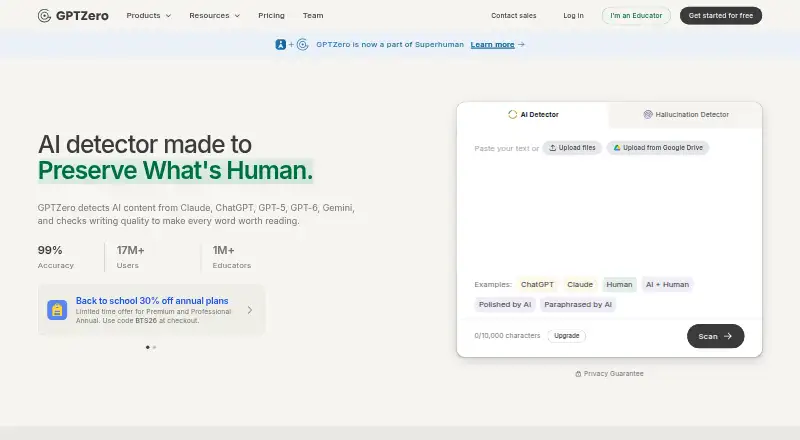
What GPTZero is
GPTZero identifies likely AI-generated writing and highlights potential AI use at document, sentence, and word level. Its detector can classify text as human, AI, or mixed, and provides confidence scores, explanations, AI vocabulary, and sentence-level highlights. Advanced Scan identifies sections contributing most to an AI classification. The service accepts pasted text and DOCX, PDF, and image files; its technology page says it can analyze up to 50 files at a time. GPTZero lists support for English, German, Portuguese, French, and Spanish, and says its detector covers text from ChatGPT, GPT-3 through GPT-6, Gemini, Claude, and Copilot, among other models. Other tools include Writing Replay, plagiarism checking, writing feedback, and grammar checking. A Chrome extension scans webpages and Google Docs, and listed integrations include Google Classroom, Canvas, an API, and Zapier. GPTZero says results can be wrong, work better on longer English prose, and should not be used alone to punish students.
Good
- Highlights potential AI writing sentence by sentence.
- Accepts pasted text and three listed file types.
- Lists five supported languages.
- Integrates with Google Classroom and Canvas.
- Free plan includes AI detection.
Watch out
- Results can be wrong.
- It performs better on longer English prose.
- Free plan has a 10,000-word monthly limit.
Who it suits
GPTZero suits educators, hiring teams, publishers, journalists, and others assessing writing authenticity. Its API, browser extension, and education integrations may also suit users who want detection in existing workflows.
Verdict
GPTZero combines AI-writing detection with review and feedback tools across web, document, and integration workflows. Its own guidance says detection results are not definitive and should not be the sole basis for consequential judgments.
Plans and prices
From GPTZero's own pricing page, checked 3 Oct 2026.
| Plan | Price | What it gives you |
|---|---|---|
| Free | Free | 10,000 words/month · 50,000 characters · free AI detection |
| Essential | $8.33 a month | 150,000 words/month · 50,000 characters per scan · when paying annual |
| Premium | $12.99 a month | 300,000 words/month · 50,000 characters per scan · when paying annual |
| Professional | $24.99 a month | 500,000 words/month · 150,000 characters per scan · when paying annual |
The facts
Each one read from GPTZero's own pages, with the date it was checked.
What it does
- Advanced analysis
- Advanced Scan identifies sections that contribute most to an AI classification, and GPTZero 4o adds explanations of recurring writing patterns.checked 3 Oct 2026
- API
- The API accepts files and text and returns AI-detection probabilities at document, paragraph, and sentence level, including batch inference.checked 3 Oct 2026
- API data handling
- GPTZero says it does not store or collect documents submitted through API calls, while dashboard inputs may be used in aggregate to improve the service.checked 3 Oct 2026
- Core features
- Its free detector provides confidence scores, AI vocabulary, detailed explanations, and sentence-by-sentence highlighting.checked 2 Oct 2026
- Detection features
- Its detector can classify writing as human, AI, or mixed and highlights sentences it identifies as AI-written.checked 3 Oct 2026
- Developer integrations
- Its AI detection API includes ready-to-use code in 17 programming languages, and the service also integrates with Zapier.checked 2 Oct 2026
- Education integrations
- GPTZero offers integrations for Google Classroom and Canvas, including assignment scan results and writing feedback features.checked 2 Oct 2026
- File scanning
- GPTZero accepts pasted text and DOCX, PDF, and image files, and its technology page says it can analyze up to 50 files at a time.checked 3 Oct 2026
- Integrations
- GPTZero lists Google Classroom and Canvas LMS integrations, an API for developers, and a Zapier integration.checked 3 Oct 2026
- Intended users
- GPTZero describes its audiences as educators and students, as well as publishers, recruiters, copywriters, marketers, and businesses.checked 3 Oct 2026
- Known limits
- GPTZero says results can be wrong, perform better on longer English prose, and should not be used alone to punish students.checked 2 Oct 2026
- Languages
- GPTZero says it fully supports English, German, Portuguese, French, and Spanish.checked 3 Oct 2026
- Model coverage
- The detector supports text from ChatGPT, GPT-3 through GPT-6, Gemini, Claude, and Copilot, among other models.checked 2 Oct 2026
- Privacy
- GPTZero says it does not store or collect documents submitted through API calls, while dashboard inputs may be used in aggregate to improve the service.checked 2 Oct 2026
- Purpose
- GPTZero identifies AI-generated text and highlights AI use at document, sentence, and word level.checked 2 Oct 2026
- Security
- GPTZero states it is SOC 2 Type II compliant and lists CCPA, GDPR, FERPA, HECVAT, and VPAT commitments or assessments.checked 3 Oct 2026
Where it runs
- Browser and Docs
- The Chrome extension scans webpages and Google Docs, provides writing feedback in Google Docs comments, and offers writing-process reports.checked 3 Oct 2026
- Browser extension
- The Chrome extension scans web pages and adds AI detection, citation checks, writing feedback, and writing replays to Google Docs and other workflows.checked 2 Oct 2026
The company
- Company
- The team page says GPTZero is based in New York and Toronto and was founded in January 2023.checked 2 Oct 2026
- Company location
- GPTZero says its team is based in New York and Toronto and works in a hybrid setup.checked 3 Oct 2026
- Founded
- 2023checked 23 Sep 2026
- Headquarters
- New York, United Stateschecked 23 Sep 2026
Money
- Free use limit
- A free account supports AI detection for texts up to 150,000 characters or batches of up to 250 files.checked 2 Oct 2026
- Plan overages
- GPTZero says plan overages cost $0.00046 per word and users can exceed their plan by up to 1 million words before being asked to upgrade.checked 3 Oct 2026
The full review of GPTZero
GPTZero suits educators, editors, and writing teams who need to review AI use across documents and established workflows. Its detection and feedback tools cover more ground than a simple text checker, but its results are a starting point for review, not a verdict.
Overview
GPTZero classifies writing as human, AI, or mixed, and flags suspected AI use at document, sentence, and word level. It accepts pasted text and DOCX, PDF, and image files, with batch scanning for up to 50 files at a time. Its stated language support includes English, German, Portuguese, French, and Spanish, and its detector covers text from ChatGPT, GPT-3 through GPT-6, Gemini, Claude, Copilot, and other models.
That breadth is useful when a reviewer handles varied writing and file types. The important limitation is that GPTZero says results can be wrong, perform better on longer English prose, and should not be used alone to punish students or make a final judgment. Its language range does not remove the need to consider the context and examine the writing itself.
Key features
The free detector returns confidence scores, AI vocabulary, explanations, and sentence-level highlights. Advanced Scan identifies the sections contributing most to an AI classification, while GPTZero 4o explains recurring writing patterns. These cues can focus a reviewer’s attention; they cannot establish authorship by themselves.
Writing Replay, plagiarism checking, writing feedback, and grammar checking extend the service into writing review. The Chrome extension scans web pages and Google Docs, where it can provide feedback in comments and writing-process reports. Google Classroom and Canvas integrations add assignment scan results and writing feedback, which makes GPTZero more relevant to educators already working in those systems than to someone seeking only a quick standalone check.
For developers, the API accepts text and files, supports batch inference, and returns detection probabilities at document, paragraph, and sentence level. It includes ready-to-use code in 17 programming languages and connects with Zapier. GPTZero says it does not store or collect documents submitted through API calls; dashboard inputs may be used in aggregate to improve the service. It also states that it is SOC 2 Type II compliant and describes encryption, vulnerability scans, penetration testing, and MFA access controls.
Pricing
GPTZero is freemium, with a free plan and a 14-day trial. The free plan is listed at free and includes 10,000 words per month, 50,000 characters, and free AI detection. A separate account allowance supports detection for texts up to 150,000 characters or batches of up to 250 files, while the technology page describes scanning up to 50 files at a time. For regular use, the stated 10,000-word monthly plan allowance is the more practical constraint to keep in view.
Essential costs $8.33 a month when billed annually and includes 150,000 words per month and 50,000 characters per scan. It suits individuals who need more monthly volume than the free plan allows, but not larger scans. Premium costs $12.99 a month when billed annually, raises the monthly allowance to 300,000 words, and keeps the 50,000-character scan cap; it is the stronger fit for frequent use of medium-length submissions.
Professional costs $24.99 a month when billed annually, with 500,000 words per month and a 150,000-character scan cap. That higher per-scan ceiling matters for users reviewing longer pieces as well as higher monthly volume. GPTZero says plan overages cost $0.00046 per word and permit use beyond the plan by up to 1 million words before an upgrade is required. The paid plans are presented with annual billing, so the monthly figures should not be read as month-to-month terms.
Platforms
GPTZero is available on the web, through a Chrome extension, and via API. The extension adds webpage and Google Docs scanning to browser workflows; the API fits teams building detection into their own tools. Google Classroom, Canvas, and Zapier integrations further suit education and automation use cases.
Who it's for
Educators can use the Classroom and Canvas integrations to review assignments alongside writing feedback, while editors, publishers, journalists, and hiring teams may find the layered highlights and explanations useful for directing closer review. Developers have an API with batch inference and multiple output levels. GPTZero is a poor fit for anyone who needs a detector to make a conclusive authorship or disciplinary decision: the service itself warns against that use.
Pros and cons
- Pros: Classification at document, sentence, and word level, plus explanations and focused analysis, gives reviewers more to investigate than a single score.
- Pros: Google Docs, Classroom, Canvas, API, and Zapier support make it adaptable to education and team workflows.
- Pros: The API has batch inference and stated document non-retention, a useful combination for integration work handling submitted files.
- Cons: Detection can be wrong and is stronger on longer English prose, limiting confidence across short or multilingual submissions.
- Cons: Free use is capped at 10,000 words monthly, and the paid per-scan character ceilings remain 50,000 on Essential and Premium.
- Cons: Annual billing applies to the published monthly paid-plan prices, and overage words incur a charge.
Alternatives
For a wider category comparison, browse AI Content Detectors, AI Content Detection Software, or Plagiarism Detection Software.
- Originality.ai is another freemium option with web, extension, and API access; its free Basic plan limits users to three scans a day and 2,000 words per scan.
- AI Detectors.io is a freemium option spanning web, macOS, Windows, extension, and API.
- Pangram offers a free tier with 2,000 words per day, image scans, OCR, and support for over 20 languages.
- Winston AI has a 14-day free trial with 2,000 credits and includes AI-content and image detection.
- Copyleaks AI Detector combines AI detection and plagiarism detection, with support for 30+ AI-detection languages in its Personal plan.
- It's AI has a free plan with 4,000 words, file upload, and three deep scans.
- TrustOriginality.ai offers a web-only free tier limited to one text analysis per month.
- Proofademic pairs multilingual AI detection with a plagiarism checker and report export on its free plan.
Verdict
GPTZero is a strong choice for educators and writing teams that want detection alongside document review, feedback, and integrations. Its layered explanations and workflow coverage are the main reasons to choose it; its imperfect detection, English-prose advantage, and warning against consequential decisions are the reasons to look elsewhere if you need a definitive authorship test.
Getting started
- Open https://gptzero.me/
- Create a free account or choose a listed paid plan
- Paste text or upload DOCX, PDF, or image files
- Install the Chrome extension for webpage and Google Docs scans
- Connect Google Classroom, Canvas, Zapier, or the API when needed
Limits worth knowing
The Free plan is free and includes 10,000 words per month and 50,000 characters. GPTZero also describes free-account detection for texts up to 150,000 characters or batches of up to 250 files; paid plans list larger monthly word quotas, while Professional lists a larger scan size. Plan overages cost 0.00046 USD per word, with up to 1 million words permitted before an upgrade request.
Questions
Does GPTZero have a free plan?
Yes. The Free plan is listed as free, and GPTZero also offers a 14-day trial.
What platforms does GPTZero support?
It is available through the web, an API, and a browser extension.
Which languages does GPTZero support?
GPTZero says it fully supports English, German, Portuguese, French, and Spanish.
What files can I scan?
You can paste text or submit DOCX, PDF, and image files. The technology information describes analyzing up to 50 files at a time.
Does GPTZero provide an API?
Yes. Its API accepts files and text, returns document-, paragraph-, and sentence-level probabilities, and supports batch inference.
How much do paid plans cost?
Essential is $8.33 a month, Premium is $12.99 a month, and Professional is $24.99 a month, each billed when paying annually.
Alternatives to GPTZero
- 1

AI Detector Pro
Free planAndroidWebAPImacOS8.1Free plan - 2
Grammarly
Free planAndroidiOS7.8From $12 a month - 3

Originality.ai
Free planWebAPIExtension7.6From $12.95 a month - 4
Trinka
Free planWebAPIExtensionmacOS7.5From $300 a year - 5

Winston AI
Free planWebAPIExtensionSelf-hosted7.5From $189 a month - 6

Sapling
Free planWebAPIExtensionSelf-hosted7.4From $144 a year