
Nextjournal
Nextjournal is a notebook for reproducible research and data-driven work, available as a hosted web service or for self-hosting.
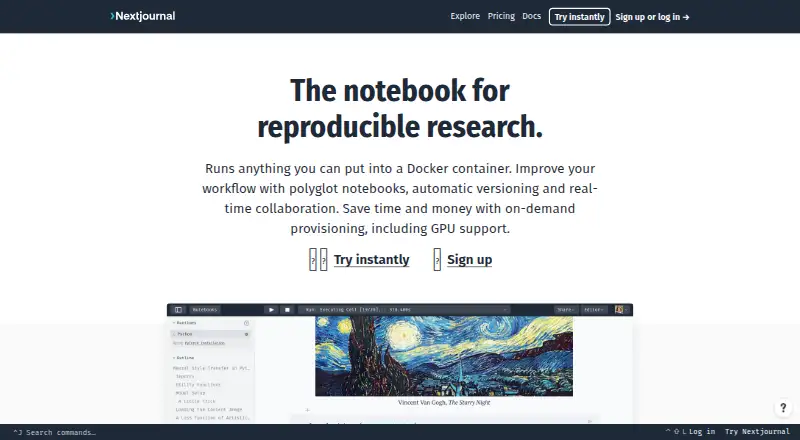
What Nextjournal is
Nextjournal is a notebook for reproducible research and data-driven work, available as a hosted web service or for self-hosting. A notebook can combine multiple language runtimes, including Python, R, Julia, Clojure, Bash, JavaScript, and ClojureScript, passing values between runtimes through files. Teams can edit notebooks together in real time, and automatic versioning preserves changes along with data and the runtime environment so earlier states can be restored. Each running notebook receives a compute instance that shuts down when computation ends; GPU support is also listed. Notebooks can connect to Amazon S3 and Google Cloud Storage, clone private GitHub repositories, and import Docker Hub images. Import formats include Jupyter, IPython, RMarkdown, and Markdown, with Markdown export available. The free plan costs nothing, with limited concurrent compute resources and entry-level compute under a fair-use policy. A 14-day trial is listed.
Good
- Multiple language runtimes can share values through files
- Real-time collaborative editing
- Automatic history preserves data and runtime environment
- Imports Jupyter, IPython, RMarkdown, and Markdown
Watch out
- Free plan limits concurrent compute resources
- Free computation is subject to fair use
Who it suits
Nextjournal is aimed at researchers, data scientists, library authors, professors, and scientists working with code and data. It also suits collaborators who need shared notebooks and saved runtime history.
Verdict
Nextjournal combines collaborative notebooks with preserved environments and several runtime options. The free plan has compute constraints, while Team and Enterprise have substantial listed starting prices.
Plans and prices
From Nextjournal's own pricing page, checked 30 Sep 2026.
| Plan | Price | What it gives you |
|---|---|---|
| Free | Free | Unlimited private notebooks · Data & Secrets Management · Limited concurrent compute resources · Entry level compute resources under Fair Use Policy |
| Team | $299 a month | Additional editors $99/month each · Unlimited concurrent compute · High-performance compute · Scheduled notebook runs · ~$240/month of computational credits · Additional compute billed per use · starts at $299/month, including 5 editors |
| Enterprise | $499 a month | Additional editors $125/month each · Hosted or on-prem (AWS, Google Cloud) · Single Sign-On · Priority Slack support · Dedicated compute · ~$400/month of computational credits · Internal publishing · starts at $499/month, including 5 editors |
The facts
Each one read from Nextjournal's own pages, with the date it was checked.
What it does
- Audience
- The homepage describes use cases for machine-learning researchers, data scientists, library authors, professors, and scientists.checked 30 Sep 2026
- Collaboration
- Users can edit notebooks together in real time and create public or private groups.checked 30 Sep 2026
- Compute
- The service provisions a compute instance for each running notebook and shuts it down automatically when computation is done.checked 30 Sep 2026
- Fair use limit
- The free plan has no hard compute-time or resource limits, but Nextjournal reserves the right to cancel computation it deems excessive case by case.checked 30 Sep 2026
- GPU support
- The homepage states support for up to 8 NVIDIA Tesla K80, P100, or P100 Workstation GPUs per runtime.checked 30 Sep 2026
- HIPAA
- The pricing FAQ says HIPAA guideline compliance may be possible with the on-prem solution and gives AWS reference architecture as an example.checked 30 Sep 2026
- Import and export
- Nextjournal supports importing Jupyter, IPython, RMarkdown, and Markdown notebooks and exporting notebooks to Markdown.checked 30 Sep 2026
- Integrations
- Notebooks can access Amazon S3 and Google Cloud Storage, clone private GitHub repositories, and import images from Docker Hub.checked 30 Sep 2026
- Paid from
- 299checked 20 Sep 2026
- Polyglot notebooks
- A notebook can use multiple programming-language runtimes, with values exchanged between runtimes using files.checked 30 Sep 2026
- Publishing
- Published notebooks have permanent URLs and can be public or limited to group members; published versions are read-only and can be remixed by viewers.checked 30 Sep 2026
- Purpose
- Nextjournal describes itself as a notebook for reproducible research and data-driven research.checked 30 Sep 2026
- Secrets
- Secrets are stored outside notebooks and computational environments in Vault and can only be read by the user's profile.checked 30 Sep 2026
- Support
- Enterprise priority support is provided through a team-to-team Slack channel, with responses within 24 hours during the week.checked 30 Sep 2026
- Versioning
- Changes are saved automatically, including data and the full runtime environment, and previous changes can be restored.checked 30 Sep 2026
The company
- Company history
- The About page says the team entered an exploration phase in 2015 and created Nextjournal after exploring reproducibility and scientific tooling.checked 30 Sep 2026
- Headquarters
- Berlin, Germanychecked 28 Sep 2026
Money
- Free plan
- Yeschecked 20 Sep 2026
Alternatives to Nextjournal
- 1

Replit
Free planAndroidiOSWebLinux9.2From $18 a month - 2

StackBlitz
Free planAndroidiOSWebAPI8.9Free plan - 3

Playcode
Free planAndroidiOSWebAPI8.9From $25 a month - 4
Paperspace Gradient
Free planOpen sourceWebAPIExtensionLinux8.7From $8 a month - 5
GitHub Codespaces
Free planAndroidiOSWebAPI8.6Free plan - 6

JDoodle
Free planAndroidiOSWebAPI8.6From $4 a month