mymesh
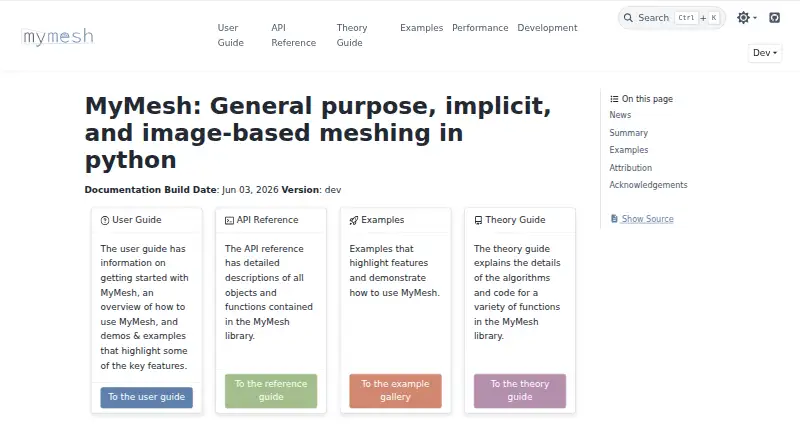
The facts below are what the maker publishes about mymesh, checked and dated. Our editors have not written about it yet.
The facts
Each one read from mymesh's own pages, with the date it was checked.
What it does
- Analysis
- It includes geometric and curvature analysis, intersection and inclusion tests, and mesh quality evaluation and improvement.checked 12 Oct 2026
- Animation tools
- Nochecked 24 Sep 2026
- Boolean operations
- It includes mesh intersection, union, and difference operations.checked 12 Oct 2026
- Citation
- The project asks users to cite its 2026 Journal of Open Source Software paper when they use MyMesh.checked 12 Oct 2026
- Construction
- It supports sweep construction methods including extrusions and revolutions.checked 12 Oct 2026
- Conversion
- It supports conversions such as volume to surface, hexahedral or mixed-element to tetrahedral, and first-order to second-order elements.checked 12 Oct 2026
- Dependencies
- The repository says to omit `[all]` when installing only the minimum required dependencies.checked 12 Oct 2026
- Geometry analysis
- The toolkit includes geometric and curvature analysis.checked 12 Oct 2026
- Installation
- The project documents installation from PyPI with `pip install mymesh[all]` or from a local source checkout.checked 12 Oct 2026
- Intended use
- The documentation says MyMesh is intended for research purposes and that its uses should be validated and verified appropriately.checked 12 Oct 2026
- Intersection tests
- It supports ray-surface intersection and point-in-surface tests.checked 12 Oct 2026
- License
- The repository identifies its license as MIT.checked 12 Oct 2026
- Mesh operations
- It supports mesh boolean operations, sweep construction such as extrusions and revolutions, and point set, mesh, and image registration.checked 12 Oct 2026
- Mesh quality
- It includes mesh quality evaluation and improvement.checked 12 Oct 2026
- Open source
- GitHub identifies the public repository as MIT licensed.checked 12 Oct 2026
- Origin
- MyMesh was originally developed to support research in Boston University's Skeletal Mechanobiology and Biomechanics Lab.checked 12 Oct 2026
- Purpose
- MyMesh is a general purpose Python toolkit for generating, manipulating, and analyzing meshes, with a focus on implicit function and image-based meshing.checked 12 Oct 2026
- Registration
- It includes point-set, mesh, and image registration.checked 12 Oct 2026
- Sculpting tools
- Nochecked 24 Sep 2026
- Source installation
- The project also documents installation from a cloned or downloaded source directory using pip.checked 12 Oct 2026
- Support and feedback
- The documentation acknowledges users who tested the code, reported bugs, requested features, and provided feedback.checked 12 Oct 2026
The company
- Founded
- 2021checked 19 Oct 2026
Money
- Free plan
- Yeschecked 24 Sep 2026
Where it runs
- Platform access
- desktopchecked 24 Sep 2026