Mininet-WiFi
Mininet-WiFi extends the Mininet software-defined networking emulator with virtualized Wi-Fi stations and access points.
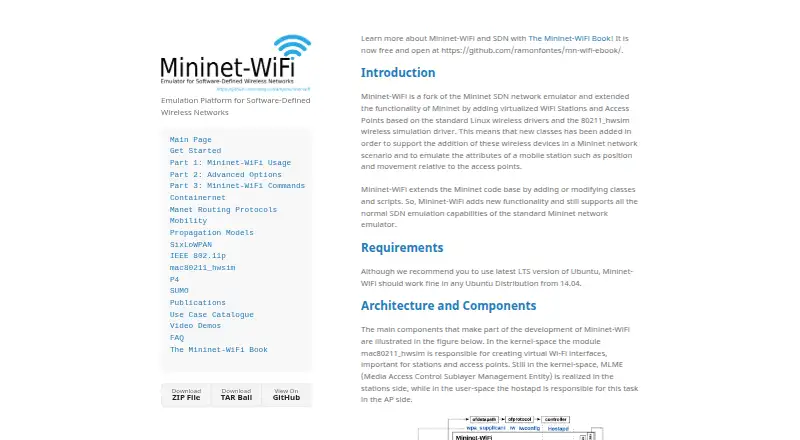
What Mininet-WiFi is
Mininet-WiFi extends the Mininet software-defined networking emulator with virtualized Wi-Fi stations and access points. It uses Linux wireless drivers and the 80211_hwsim simulation driver to represent wireless devices, including station movement. Wireless-medium behavior can be modeled with Traffic Control or wmediumd, and the project recommends wmediumd for ad hoc and wireless mesh networks. Documented mobility models include RandomWalk, TruncatedLevyWalk, RandomDirection, RandomWayPoint, GaussMarkov, ReferencePoint, and TimeVariantCommunity. Containernet integration allows Docker containers to act as Mininet hosts and Mininet-WiFi stations in networking and cloud testbeds. Documentation also describes running SUMO externally through a TraCI server port and configuration file. 6LoWPAN support uses fakelb and mac802154_hwsim, with the latter supported from Linux kernel 4.18. The project recommends the latest Ubuntu LTS, documents source installation on Ubuntu and Debian, and marks Fedora guidance experimental. A downloadable VM image and source installation are offered, with VirtualBox recommended as a free virtualization option for OS X, Windows, and Linux.
Good
- Virtualizes Wi-Fi stations and access points
- Offers multiple documented mobility models
- Supports Containernet Docker integration
- Integrates with SUMO through TraCI
- Supports 6LoWPAN simulation
Watch out
- Requires a Linux environment
- Fedora installation is experimental
- IEEE 802.11p procedure requires kernel 5.5
- No free trial
Who it suits
It suits Linux users building wireless, mobility, container, or cloud-network simulations. It is aimed at people who can provide a Linux environment and work with emulator integrations.
Verdict
Mininet-WiFi is a free emulator for experimenting with wireless network behavior and mobility. Its integrations broaden the testbed options, while Linux and kernel requirements shape deployment.
Plans and prices
From Mininet-WiFi's own pricing page, checked 7 Oct 2026.
| Plan | Price | What it gives you |
|---|---|---|
| Mininet-WiFi | Free | Open-source network emulator · requires a Linux environment |
The facts
Each one read from Mininet-WiFi's own pages, with the date it was checked.
What it does
- 6LoWPAN
- Mininet-WiFi supports 6LoWPAN through fakelb and mac802154_hwsim, with the latter supported from Linux kernel 4.18.checked 7 Oct 2026
- Container integration
- Containernet allows Docker containers to act as Mininet hosts and Mininet-WiFi stations for networking and cloud testbeds.checked 7 Oct 2026
- Distribution
- The project offers a downloadable VM image and source installation, and recommends VirtualBox as a free virtualization option available for OS X, Windows, and Linux.checked 7 Oct 2026
- Documented limitation
- The IEEE 802.11p instructions state that their procedure works only with Linux kernel 5.5.checked 7 Oct 2026
- Mobility
- Documented mobility models include RandomWalk, TruncatedLevyWalk, RandomDirection, RandomWayPoint, GaussMarkov, ReferencePoint, and TimeVariantCommunity.checked 7 Oct 2026
- Network behavior
- Traffic Control and wmediumd are its two approaches for simulating the wireless medium, and the site recommends wmediumd for ad hoc and wireless mesh networks.checked 7 Oct 2026
- Purpose
- Mininet-WiFi extends the Mininet SDN network emulator with virtualized Wi-Fi stations and access points.checked 7 Oct 2026
- Security-related capability
- The documentation says wpa_supplicant is used with Hostapd to support WPA, among other things.checked 7 Oct 2026
- SUMO integration
- The documentation shows how to run SUMO as an external program using a TraCI server port and configuration file.checked 7 Oct 2026
- Support
- The getting-started guide identifies the mininet-wifi-discuss mailing list as the source for support and community discussion.checked 7 Oct 2026
- Wireless emulation
- It uses Linux wireless drivers and the 80211_hwsim wireless simulation driver to emulate wireless devices and mobile station position and movement.checked 7 Oct 2026
Where it runs
- Platform requirements
- The project recommends the latest Ubuntu LTS; its getting-started guide also describes source installation on Ubuntu, Debian, and experimentally Fedora.checked 7 Oct 2026
Alternatives to Mininet-WiFi
- 1

Containerlab
Free planOpen sourceWebAPIExtensionLinux7.6Free plan - 2
Avidemux
Free planOpen sourceWebLinuxmacOSWindows7.3Free plan - 3
Marionnet
Free planOpen sourceLinuxmacOSSelf-hostedWindows7.2Free plan - 4

EVE-NG
Free planWebLinuxmacOSSelf-hosted7.0Free plan - 5
Mininet
Free planAPILinuxmacOSSelf-hosted6.6Free plan - 6
NetSim
Free planWeb6.6From $15 a month