Milvus
Milvus is a free, open-source vector database for GenAI applications, developed by Zilliz.
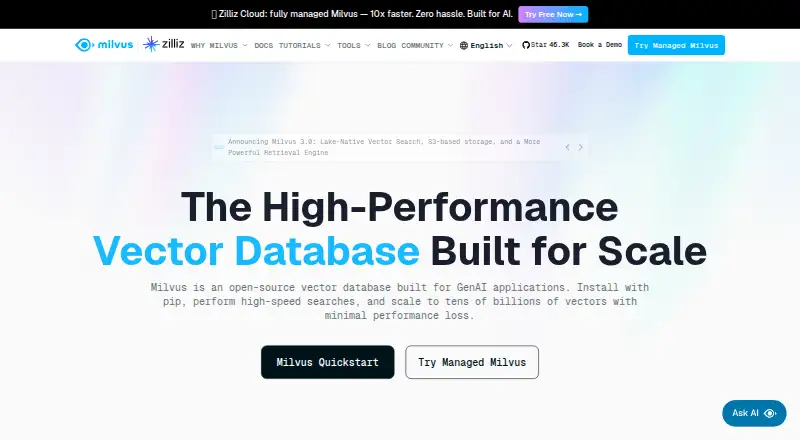
What Milvus is
Milvus is a free, open-source vector database for GenAI applications, developed by Zilliz. It supports approximate nearest neighbor, filtered, range, hybrid, and full-text search, as well as reranking, fetch, and query operations. Deployment choices are Lite, a Python library for local use; Standalone, a single-machine server; and Distributed, for Kubernetes clusters. The documentation recommends Lite for up to a few million vectors, Standalone for up to 100 million, and Distributed for 100 million to tens of billions. Lite can run without a cloud service, including for local searches of private or sensitive data. Official APIs and SDKs include REST, Python, Go, Java, Node.js, and C++; Microsoft contributes C#, while Rust is under development. Security features include user authentication, TLS for gRPC and REST traffic, and role-based access control at collection, database, and instance levels. Integrations listed include LangChain, LlamaIndex, Haystack, DSPy, Dify, Langflow, OpenAI, Cohere, and HuggingFace. A default Milvus 3.x deployment uses Woodpecker, etcd, and MinIO. An online upgrade from Standalone to a cluster is not currently supported.
Good
- Free and open-source under Apache 2.0.
- Supports hybrid, full-text, and filtered search.
- Offers local, single-machine, and Kubernetes deployment options.
- Lite can search data without a cloud service.
- Provides official APIs and SDKs in several languages.
Watch out
- Online upgrades from Standalone to a cluster are unsupported.
- Lite is recommended only up to a few million vectors.
- Default 3.x deployment uses three supporting components.
Who it suits
Milvus suits developers and teams building vector search into GenAI applications, from local experiments to large Kubernetes deployments. Its Lite option can also suit users who need local search over private or sensitive data.
Verdict
Milvus offers multiple deployment sizes and a broad set of vector search operations, with a local option that avoids a cloud service. Choose a deployment based on dataset scale, and account for the unsupported Standalone-to-cluster online upgrade.
Plans and prices
From Milvus's own pricing page, checked 4 Oct 2026.
| Plan | Price | What it gives you |
|---|---|---|
| Milvus (open-source software) | Free | Apache 2.0 licensed · Milvus Lite: recommended for datasets up to a few million vectors · Standalone: suitable for datasets up to 100 million vectors |
The facts
Each one read from Milvus's own pages, with the date it was checked.
What it does
- Access control
- RBAC can control operations at collection, database, and instance levels.checked 4 Oct 2026
- Dependencies
- A default Milvus 3.x deployment uses Woodpecker for messaging, etcd for metadata, and MinIO for object storage.checked 4 Oct 2026
- Deployment
- Milvus offers Lite as a Python library, Standalone as a single-machine server, and Distributed for Kubernetes clusters.checked 4 Oct 2026
- Deployment caveat
- The documentation says an online upgrade from a standalone Milvus instance to a cluster is not currently supported.checked 4 Oct 2026
- Deployment limits
- The docs recommend Lite for up to a few million vectors, Standalone up to 100 million, and Distributed for 100 million to tens of billions.checked 4 Oct 2026
- Deployment options
- Milvus offers Lite as a Python library, Standalone as a single-machine server, and Distributed for Kubernetes clusters.checked 4 Oct 2026
- Integrations
- The integrations documentation lists tools including LangChain, LlamaIndex, Haystack, DSPy, Dify, Langflow, OpenAI, Cohere, and HuggingFace.checked 4 Oct 2026
- Intended users
- The documentation describes Distributed as suited to enterprise users running large-scale vector search systems in production.checked 4 Oct 2026
- Local use
- Milvus Lite can run on a device without a cloud service for local search of private or sensitive data.checked 4 Oct 2026
- Managed option
- Milvus links to Zilliz Cloud as its fully managed offering and describes a free option on its documentation site.checked 4 Oct 2026
- Product
- Milvus is an open-source vector database built for GenAI applications.checked 4 Oct 2026
- Scale
- Milvus supports deployments from local notebook demos to Kubernetes clusters handling tens of billions of vectors.checked 4 Oct 2026
- Scale limits by deployment
- The documentation recommends Milvus Lite for up to a few million vectors, Standalone for up to 100 million, and Distributed for 100 million to tens of billions.checked 4 Oct 2026
- SDKs
- Milvus provides official REST, Python, Go, Java, Node.js, and C++ APIs or SDKs; C# is contributed by Microsoft and Rust is under development.checked 4 Oct 2026
- Search
- Milvus supports approximate nearest neighbor, filtering, range, hybrid, and full-text search, plus reranking, fetch, and query operations.checked 4 Oct 2026
- Search features
- Milvus supports approximate nearest neighbor, filtered, range, hybrid, and full-text search, as well as reranking and queries.checked 4 Oct 2026
- Security
- Milvus documents user authentication, TLS encryption for gRPC and REST traffic, and role-based access control.checked 4 Oct 2026
- Support
- The Milvus site lists community channels including Slack, Discord, GitHub, and Milvus Office Hours.checked 4 Oct 2026
- What it does
- Milvus is an open-source vector database developed by Zilliz for high-performance, scalable vector search.checked 4 Oct 2026
Money
- Free plan
- Yeschecked 22 Sep 2026
The company
- Maker
- The documentation says Milvus was developed by Zilliz and is associated with the LF AI & Data Foundation under the Linux Foundation.checked 4 Oct 2026
Alternatives to Milvus
- 1

Chroma
Free planOpen sourceAndroidiOSWebAPI8.6From $250 a month - 2

Vespa
Open sourceWebAPILinuxmacOS8.4 - 3

Pinecone
Free planWebAPILinuxmacOS7.8From $20 a month - 4
Weaviate
Free planWebAPILinuxSelf-hosted7.0$45 usage-based - 5

Qdrant
Free planWebAPILinuxmacOS6.9Free plan - 6

Elasticsearch
WebAPILinuxSelf-hosted6.7From $99 a month