Mill
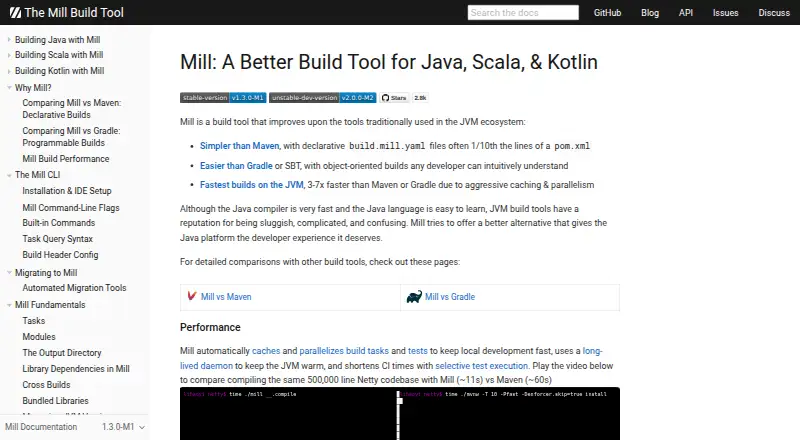
The facts below are what the maker publishes about Mill, checked and dated. Our editors have not written about it yet.
The facts
Each one read from Mill's own pages, with the date it was checked.
What it does
- Build configuration
- Mill supports declarative build.mill.yaml files and object-oriented build definitions.checked 7 Oct 2026
- Build speed
- The site says Mill caches and parallelizes build tasks and tests, and uses a long-lived daemon to keep the JVM warm.checked 7 Oct 2026
- Built-in workflows
- Mill documents built-in support for dependency management, testing, linting, packaging, publishing, and web frameworks.checked 7 Oct 2026
- Commercial support
- Commercial support and services for organizational training, adoption, or maintenance are available by arrangement through [email protected].checked 7 Oct 2026
- Community support
- The site points users to GitHub Discussions and the Scala Discord TOOLING#mill channel for community discussion.checked 7 Oct 2026
- Declarative configuration
- The site describes build.mill.yaml files as declarative project configuration that can be much shorter than Maven pom.xml files.checked 7 Oct 2026
- Dependency management
- Mill supports dependency declarations, version management and BOMs, unmanaged dependencies, and JVM version management.checked 7 Oct 2026
- IDE limitation
- The documentation says VSCode integration supports Java and Scala, while Kotlin users are advised to use IntelliJ IDEA Community Edition.checked 7 Oct 2026
- IDE support
- Mill supports IntelliJ and VSCode, and generally supports clients of the Build Server Protocol; it can also generate Eclipse project files for Java.checked 7 Oct 2026
- Installation
- The recommended installation method is a per-project bootstrap script that downloads the selected Mill version when needed.checked 7 Oct 2026
- Integrations
- The documentation lists integrations including JUnit, ScalaTest, MUnit, Spring Boot, Micronaut, Ktor, Maven Central, Artifactory, Docker, and Apache Spark.checked 7 Oct 2026
- JVM requirements
- The native launcher can run without Java installed, while the JVM launcher requires a globally installed Java version 17 or newer.checked 7 Oct 2026
- Languages
- The documented languages include Java, Kotlin, and Scala.checked 7 Oct 2026
- Operating systems
- The native launcher supports Windows, macOS, and Linux on Intel, and macOS and Linux on ARM; Windows ARM is unsupported by the native launcher.checked 7 Oct 2026
- Performance
- Mill says it caches and parallelizes build tasks and tests, uses a long-lived daemon, and supports selective test execution.checked 7 Oct 2026
- Purpose
- Mill is a build tool for Java, Scala, and Kotlin projects.checked 7 Oct 2026
- Security
- The documentation recommends providing publishing credentials through environment variables for security considerations.checked 7 Oct 2026
- Selective test execution
- Mill can limit tests and other tasks to those affected by code changes, which the documentation describes as useful for large codebases and CI.checked 7 Oct 2026
- Testing
- The site lists support for JUnit 4 and 5, TestNG, ScalaTest, Specs2, and MUnit, among other test frameworks.checked 7 Oct 2026
Alternatives to Mill
- 1

AWS CodeBuild
Free planWebAPILinuxmacOS7.9From $0.01 a month - 2

fastlane
Free planAndroidiOSLinuxmacOS7.4Free plan - 3

Nx
Free planWebLinuxmacOSSelf-hosted7.2From $29 a month - 4

Bazel
Free planLinuxmacOSWindows6.7Free plan - 5

FASTBuild
Free planLinuxmacOSWindows6.6Free plan - 6
Open Build Service
Free planWebAPILinuxSelf-hosted6.6Free plan