MetaVoice
MetaVoice is an open-source foundational text-to-speech model centered on MetaVoice-1B, a 1.2-billion-parameter model trained on 100,000 hours of speech and …
What MetaVoice is
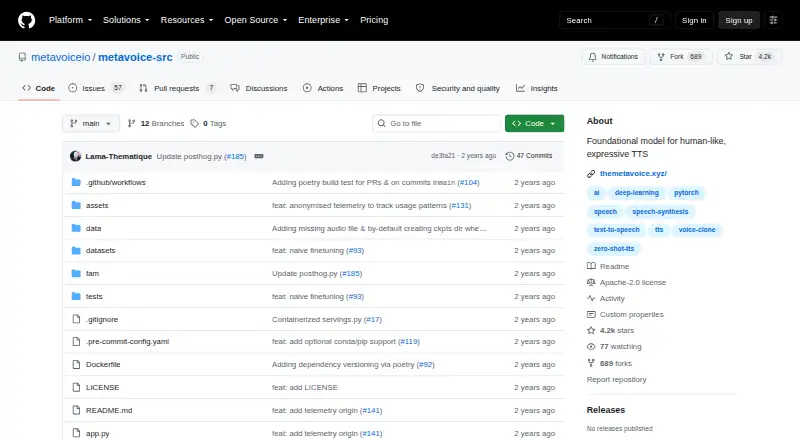
MetaVoice is an open-source foundational text-to-speech model centered on MetaVoice-1B, a 1.2-billion-parameter model trained on 100,000 hours of speech and released under the Apache 2.0 license. It is designed for emotional rhythm and tone in English, long-form synthesis, and zero-shot cloning of American or British voices from 30 seconds of reference audio. The repository includes a Gradio web interface with preset voices and voice-sample uploads, plus an inference server whose API documentation is available at its /docs route. You can run the reference implementation locally or deploy it on AWS, GCP, or Azure, with links to Hugging Face and Google Colab. The project supports fine-tuning its first-stage language model and reports success with as little as one minute of training audio for Indian speakers. Commercial use is allowed. The web UI truncates text beyond 220 characters, and voice uploads have recording and size limits.
Good
- Apache 2.0 open-source license
- Clones American and British voices
- Local, cloud, web, and API interfaces
- Supports long-form synthesis
- Commercial use allowed
Watch out
- Requires GPU with at least 12 GB VRAM
- Python must be below version 3.12
- Web UI truncates text over 220 characters
- Voice uploads capped at 50 MB
Who it suits
MetaVoice suits developers and creators needing open-source speech generation, voice cloning, or API deployment. It is also relevant to teams wanting local or cloud deployment and optional model fine-tuning.
Verdict
MetaVoice combines open licensing with web, API, local, and cloud deployment options. Its hardware, Python, text-length, and voice-upload requirements should be checked before adoption.
The facts
Each one read from MetaVoice's own pages, with the date it was checked.
What it does
- Access
- The README links to use through Hugging Face and a Google Colab demo.checked 9 Oct 2026
- API and deployment
- The project provides an inference server with API documentation at its /docs route and says it can be deployed on AWS, GCP, or Azure.checked 9 Oct 2026
- Deployment
- The README says it can be deployed on AWS, GCP, or Azure, or used locally with the reference implementation.checked 9 Oct 2026
- Fine-tuning
- The repository supports fine-tuning its first-stage language model and says it has succeeded with as little as one minute of training audio for Indian speakers.checked 9 Oct 2026
- Hardware requirement
- Installation requires a GPU with at least 12 GB of VRAM and Python version 3.10 or later but below 3.12.checked 9 Oct 2026
- Interfaces
- The repository provides a web UI and an inference server with API definitions available at the server's /docs URL.checked 9 Oct 2026
- License
- The model is released under the Apache 2.0 license.checked 9 Oct 2026
- Local use
- The model can be downloaded and run locally through the reference implementation.checked 9 Oct 2026
- Model scale
- The model has 1.2 billion parameters and was trained on 100,000 hours of speech.checked 9 Oct 2026
- Open-source model
- MetaVoice-1B is a 1.2-billion-parameter text-to-speech model trained on 100,000 hours of speech and released under the Apache 2.0 license.checked 9 Oct 2026
- Optional integration
- The fine-tuning workflow offers optional Weights & Biases logging.checked 9 Oct 2026
- Organization
- GitHub identifies the MetaVoice organization as based in the United States; the opened maker pages do not state its headquarters city or founding year.checked 9 Oct 2026
- Performance
- The README says that on Ampere, Ada-Lovelace, and Hopper GPUs, synthesis runs faster than real time after model compilation.checked 9 Oct 2026
- Product
- MetaVoice-1B is an open-source foundational text-to-speech model.checked 9 Oct 2026
- Product status
- The GitHub-linked metavoice.io site redirects to Familiar, which describes a duplex speech model for outbound sales calls and offers a 30-day pilot.checked 9 Oct 2026
- Security and privacy
- The repository describes the model and code as open source but does not state security certifications or data-handling commitments.checked 9 Oct 2026
- Speech style
- The project lists emotional speech rhythm and tone in English as a design priority.checked 9 Oct 2026
- Text length
- The README describes synthesis of arbitrary-length text.checked 9 Oct 2026
- UI input limit
- The included web UI accepts up to 220 characters of text and truncates longer input.checked 9 Oct 2026
- Voice cloning
- It supports zero-shot cloning of American and British voices from 30 seconds of reference audio.checked 9 Oct 2026
- Voice generation
- The model targets emotional speech rhythm and tone in English, zero-shot cloning of American and British voices using 30 seconds of reference audio, and long-form synthesis.checked 9 Oct 2026
- Voice upload limits
- The web UI asks for a clean, single-speaker sample of 30 to 90 seconds without background noise, and its code enforces a 50 MB upload-size ceiling.checked 9 Oct 2026
- Web interface
- The repository includes a Gradio web UI with preset voices and an option to upload a target voice sample for cloning.checked 9 Oct 2026
Alternatives to MetaVoice
- 1

Voicebox
Free planOpen sourceAndroidiOSWebAPI8.5From $12 a year - 2
Resemble AI
Free planAndroidiOSWebAPI8.3From $280 a month - 3

Speechify
Free planAndroidiOSWebAPI8.3From $10 a month - 4
Voice.ai
Free planAndroidiOSWebAPI8.3From $5 a month - 5
Wavel AI
Free planWebAPILinuxmacOS8.0From $16 a month - 6

Altered Studio
Free planWebAPImacOSSelf-hosted7.9From $30 a month