MBPLS
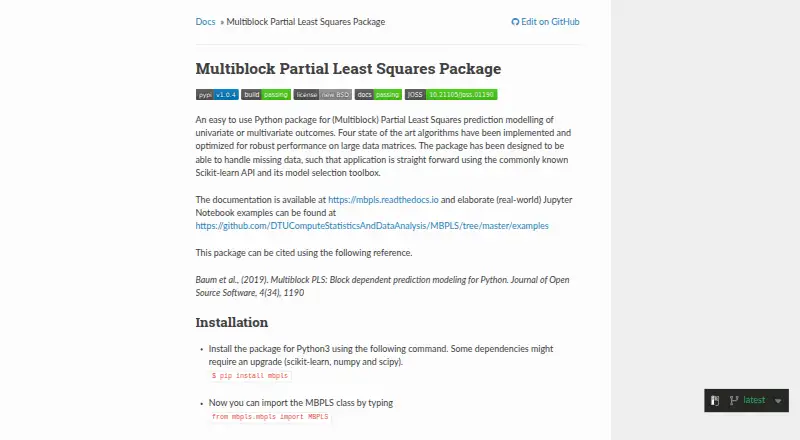
The facts below are what the maker publishes about MBPLS, checked and dated. Our editors have not written about it yet.
The facts
Each one read from MBPLS's own pages, with the date it was checked.
What it does
- Algorithms
- The package provides KERNEL, NIPALS, and UNIPALS for multiblock modeling, as well as SIMPLS for fast predictions.checked 12 Oct 2026
- Block contribution
- The introduction example says MB-PLS provides a measure of how much each X block contributes to predicting Y.checked 12 Oct 2026
- Dependencies
- The installation instructions say some dependencies may require upgrades, naming scikit-learn, numpy, and scipy.checked 12 Oct 2026
- Examples
- The documentation links to real-world Jupyter Notebook examples in the project's GitHub repository.checked 12 Oct 2026
- Installation
- The documentation gives `pip install mbpls` as the Python 3 installation command.checked 12 Oct 2026
- Intended fields
- The repository lists bioinformatics, chemometrics, data fusion, metabolomics, and machine learning among its topics.checked 12 Oct 2026
- Large matrices
- The documentation says its algorithms are optimized for robust performance on large data matrices.checked 12 Oct 2026
- License
- The project repository identifies its license as BSD-3-Clause.checked 12 Oct 2026
- Missing data
- The package documentation says it is designed to handle missing data.checked 12 Oct 2026
- Model methods
- The MBPLS class supports fitting, prediction, transforming data, and plotting model values.checked 12 Oct 2026
- Multiple data blocks
- MBPLS predicts a response vector or matrix from multiple data blocks.checked 12 Oct 2026
- Outcomes
- It supports prediction of univariate or multivariate outcomes.checked 12 Oct 2026
- Plotting
- The quick-start example uses a built-in plot method for exploratory analysis of multiblock PLS models.checked 12 Oct 2026
- Purpose
- MBPLS is a Python package for Partial Least Squares prediction modeling with univariate or multivariate outcomes.checked 12 Oct 2026
- Regression models
- Yeschecked 24 Sep 2026
- Scikit-learn API
- The package uses an interface described as compatible with the commonly known Scikit-learn API and its model selection toolbox.checked 12 Oct 2026
- Scikit-learn interface
- The package uses a commonly known Scikit-learn API and its model selection toolbox.checked 12 Oct 2026
- Scripting support
- Yeschecked 24 Sep 2026
- Sparse data limit
- NIPALS is the only documented algorithm that handles sparse data, and sparse_data must be set to True to allow it.checked 12 Oct 2026
Money
- Free plan
- Yeschecked 24 Sep 2026