
Mattrbld
Mattrbld is a Git-based headless CMS for creating, editing, and managing content independently of a particular frontend framework.
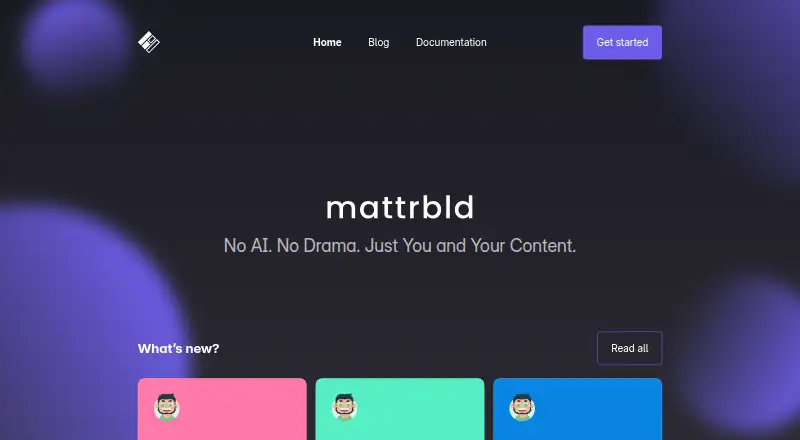
What Mattrbld is
Mattrbld is a Git-based headless CMS for creating, editing, and managing content independently of a particular frontend framework. Content remains in Git repositories rather than Mattrbld’s external servers. After importing a project, users can edit content offline, but they need to reconnect to publish changes. Schemas define content fields and validation rules, which Mattrbld uses to generate editing forms. It supports JSON and Markdown files with YAML frontmatter; plain YAML support is planned but not implemented. Developers can build a preview route using Mattrbld’s protocol so editors can see content updates in real time. Repository communication uses Git rather than proprietary provider APIs. The documentation identifies GitLab, GitHub, and Bitbucket as providers requiring a CORS proxy. Mattrbld does not require its own account, but collaborators need Git-provider accounts to access private repositories or sync changes. When a proxy is needed, credentials and repository requests pass through it; Mattrbld says it does not store passwords or access tokens. The product can be self-hosted as a single-page application. Its free hosted instance has no availability guarantee, and its supplied CORS proxy is intended for small-scale private projects.
Good
- Content stays in Git repositories
- Editing works offline after project import
- Schemas generate forms with validation rules
- Can be self-hosted
Watch out
- Publishing requires reconnecting to the internet
- Does not support Git LFS
- Not suited to media-heavy projects
- Cannot schedule publishing
Who it suits
Mattrbld suits developers and agencies helping small to medium-sized clients manage website content. It is not a drag-and-drop website builder.
Verdict
Mattrbld offers Git-based content editing for teams comfortable working with repositories and schemas. Its offline editing has limits, and projects with large binary assets or scheduled publishing need another approach.
Plans and prices
From Mattrbld's own pricing page, checked 5 Oct 2026.
| Plan | Price | What it gives you |
|---|---|---|
| Official hosted instance | Free | No guarantee for availability · Provided CORS proxy intended for small-scale private projects · Free to try |
| Self-hosted core | Free | Open source under GNU AGPL · Core features · Free to use for self-hosting |
The facts
Each one read from Mattrbld's own pages, with the date it was checked.
What it does
- Authentication
- Mattrbld does not require its own account, but collaborators need accounts with the Git provider and must authenticate to import private repositories or sync changes.checked 5 Oct 2026
- Automation
- Mattrbld cannot schedule publishing because it only runs while a user is actively using it.checked 5 Oct 2026
- Content storage
- Content lives in Git repositories and is not stored on Mattrbld’s external servers.checked 5 Oct 2026
- Credential handling
- Mattrbld says it does not store passwords or access tokens, but credentials and repository requests pass through the configured CORS proxy when one is required.checked 5 Oct 2026
- Data modelling
- Schemas define content fields and validation rules, and Mattrbld uses them to generate editing forms.checked 5 Oct 2026
- Git integrations
- Mattrbld communicates with repositories using Git rather than proprietary provider APIs, and its documentation names GitLab, GitHub, and Bitbucket as providers requiring a CORS proxy.checked 5 Oct 2026
- Intended users
- The maker describes it as suited to developers or agencies helping small to medium-sized clients manage website content, and says it is not a drag-and-drop website builder.checked 5 Oct 2026
- Live previews
- Developers can implement a preview route using Mattrbld’s protocol so editors can see content updates in real time.checked 5 Oct 2026
- Notable limitation
- Mattrbld does not support Git LFS and is not suited to media-heavy projects or content containing large amounts of binary data.checked 5 Oct 2026
- Offline editing
- After importing a project, users can create and edit content offline, but cannot publish changes until they reconnect.checked 5 Oct 2026
- Product
- Mattrbld is a Git-based headless CMS for creating, editing, and managing content independently of a particular frontend framework.checked 5 Oct 2026
- Self-hosting
- Mattrbld can be built from source and hosted as a single-page application on a hosting service of the user’s choice.checked 5 Oct 2026
- Supported content formats
- Mattrbld supports JSON and Markdown files with YAML frontmatter; plain YAML support is planned but not implemented.checked 5 Oct 2026
The full review of Mattrbld
Mattrbld is a Git-based headless CMS for editing structured content independently of a site’s frontend framework. It suits developers and agencies managing content for small to medium-sized clients. Its strongest case is keeping content in Git while giving editors generated forms; media-heavy work and scheduled publishing call for another tool.
Overview
Content lives in Git repositories, not Mattrbld’s external servers. That makes it a natural fit for teams already comfortable with repository-based workflows, but collaborators need Git-provider accounts and authentication to import private repositories or sync changes. Mattrbld is a content editor, not a drag-and-drop website builder.
It supports JSON and Markdown files with YAML frontmatter. Schemas define fields and validation rules, then generate editing forms, helping teams keep content consistent without asking editors to work directly in files. Plain YAML support is planned but not implemented.
Key features
Git editing and offline work
Mattrbld communicates with repositories through Git rather than proprietary provider APIs. Its documentation names GitLab, GitHub and Bitbucket as providers that require a CORS proxy. Mattrbld says it does not store passwords or access tokens, but credentials and repository requests pass through the configured proxy when one is required. Teams should factor that proxy into their security and infrastructure decisions.
Once a project has been imported, users can create and edit content offline, then publish changes after reconnecting. This is useful for drafting without a connection, but does not provide offline publishing.
Schemas and previews
Developers can implement a preview route using Mattrbld’s protocol, allowing editors to see content updates in real time. That flexibility puts setup in the hands of the project’s developers rather than providing a ready-made preview for every site.
Media and publishing limits
Mattrbld does not support Git LFS, making it a poor choice for media-heavy projects or repositories with large amounts of binary data. It also cannot schedule publishing: the application only runs while a user is actively using it, so teams that need unattended releases should look elsewhere.
Pricing
Both plans cost nothing. The Official hosted instance is free to try, but availability is not guaranteed; its provided CORS proxy is intended for small-scale private projects. It is the simplest way to start, provided that availability and proxy scope suit the project.
Self-hosted core is free to use for self-hosting and open source under GNU AGPL, with core features. It fits teams willing to build and host the single-page application themselves; unlike the hosted instance, it puts hosting in their hands. Mattrbld can be built from source and hosted on a service of the user’s choice.
Platforms
Mattrbld is available on Android, iOS and the web, and can be self-hosted. Its hosting model is both hosted and self-hosted, giving teams a choice between the official instance and running the application themselves.
Who it's for
Mattrbld is best for developers or agencies helping small to medium-sized clients manage website content in Git. It is a stronger fit when structured editing and repository-based storage matter more than scheduled publishing or handling large binary assets. Teams seeking a visual site builder, Git LFS support or unattended publishing should choose another approach.
Pros and cons
Pros
- Content stays in Git: repositories remain the content store rather than Mattrbld’s external servers.
- Structured editing: schemas generate forms from defined fields and validation rules.
- Offline drafting: users can edit after importing a project, even without a connection.
- Self-hosting option: teams can build the application from source and choose their hosting service.
Cons
- Publishing requires a connection: offline edits cannot be published until users reconnect.
- Proxy is part of some integrations: GitLab, GitHub and Bitbucket require a CORS proxy, through which credentials and repository requests pass.
- Weak fit for large media: no Git LFS support limits repositories with substantial binary content.
- No scheduled publishing: releases depend on a user actively running the application.
Alternatives
Git-Based CMS is a useful place to compare other tools in the category.
Consider Quiqr if you want a free, open-source option that runs on Linux, macOS, Windows and the web, with self-hosting available.
deco CMS is another option if you want an open-source, self-hostable CMS with a free core.
Choose Netlify if you need a platform with a free tier that includes 300 credits per month, one concurrent build and one team owner, or a paid Personal plan at $9 a month.
Decap CMS is an alternative with a free plan covering one site and one seat, and a free trial.
Kiln may suit teams looking for a free, self-hosted AGPL-3.0 option where they run the worker and GitHub App and provide the site host.
Siteleaf offers a free Developer plan with 100 MB, 100 pages, public GitHub repositories, API use within limits and community support; its Personal plan costs $7 a month, billed annually.
TinaCMS has a free plan for two users and two roles, with community support.
Dhub has a free Hobby plan for one user, limited to personal GitHub accounts and public repositories, with editing and pushing to the default branch.
Verdict
Choose Mattrbld if your team wants structured content editing while keeping content in Git, and has developers comfortable with schemas and repository setup. Its free hosted and self-hosted options make that workflow accessible, but the lack of scheduled publishing and Git LFS support is reason enough for media-heavy or automation-dependent projects to look elsewhere.
Getting started
- Open Mattrbld’s website
- Choose the official hosted instance or build the self-hosted core
- Import a Git project
- Authenticate with the Git provider for private repositories or synchronization
- Define schemas for content fields and validation
- Add a preview route if live previews are needed
Limits worth knowing
Mattrbld does not support Git LFS and is not suited to media-heavy or binary-heavy content. It cannot schedule publishing, and the hosted instance has no availability guarantee; its supplied CORS proxy is intended for small-scale private projects.
Questions
Does Mattrbld cost anything?
The official hosted instance is free, and the self-hosted core is free to use under the GNU AGPL license.
Does Mattrbld require its own account?
No. Collaborators still need accounts with the relevant Git provider to access private repositories or synchronize changes.
Which content formats are supported?
Mattrbld supports JSON and Markdown files with YAML frontmatter. Plain YAML support is planned but not implemented.
Can Mattrbld work offline?
After importing a project, users can create and edit content offline. Publishing changes requires reconnecting.
Can it be self-hosted?
Yes. Mattrbld can be built from source and hosted as a single-page application on a hosting service of your choice.
Which Git providers work with Mattrbld?
It communicates through Git, and its documentation names GitLab, GitHub, and Bitbucket as providers requiring a CORS proxy.
Alternatives to Mattrbld
- 1

CrafterCMS
Free planOpen sourceWebAPILinuxmacOS8.3Free plan - 2

deco CMS
Free planOpen sourceWebAPImacOSSelf-hosted7.9Free plan - 3

Kiln
Free planOpen sourceWebAPISelf-hosted7.9From $4.99 a month - 4

Keystatic
Free planOpen sourceWebAPISelf-hosted7.6From $10 a month - 5
Quiqr
Free planOpen sourceWebLinuxmacOSSelf-hosted7.5Free plan - 6
Siteleaf
Free planWebAPI7.4From $7 a month