Quiqr
Quiqr is a free offline desktop CMS focused on Hugo and the creation of static HTML websites.
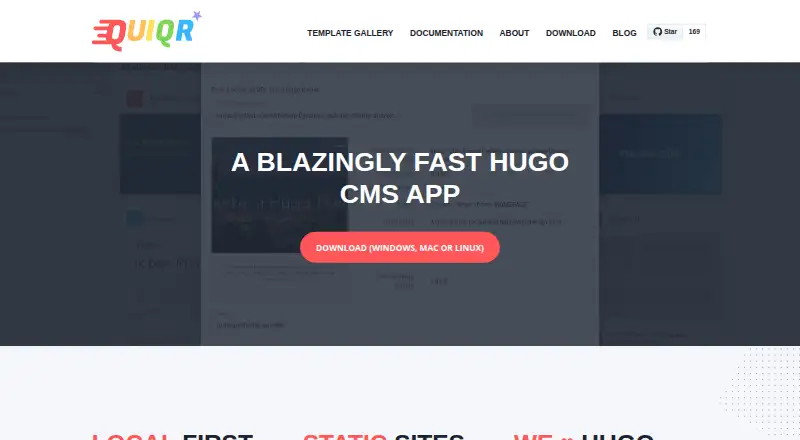
What Quiqr is
Quiqr is a free offline desktop CMS focused on Hugo and the creation of static HTML websites. It runs on the user’s computer, keeps content local, and lets users publish when ready. The app includes an embedded Hugo server and supports importing Hugo themes. Its desktop template gallery offers community-built starting points, and a site library helps users switch between and maintain multiple sites. Quiqr’s built-in Git client can push sites to GitHub, BitBucket, or GitLab; users can also prepare sites for other static hosting services. Developers can create CMS forms using YAML, JSON, or TOML files. Quiqr describes its intended audience as website owners and developers. The software is available for Windows, macOS, and Linux; its Linux download page describes an AppImage intended to run on any Linux distribution. The project invites contributions through GitHub, including bug reports, pull requests, templates, documentation, translations, and interface work.
Good
- Keeps site content local until users choose to publish.
- Includes an embedded Hugo server.
- Publishes through GitHub, BitBucket, or GitLab.
- Supports CMS forms in YAML, JSON, or TOML.
- Free forever.
Watch out
- Specialized for Hugo.
- CMS runs as a desktop app rather than a hosted service.
Who it suits
Quiqr may suit website owners who want an offline, local-first CMS for Hugo-based static sites. Developers can use its support for themes, Git publishing, and forms defined in YAML, JSON, or TOML.
Verdict
Quiqr centers its workflow on local editing and publishing static websites built with Hugo. Its template gallery, site library, and Git publishing options support both site owners and developers.
Plans and prices
From Quiqr's own pricing page, checked 4 Oct 2026.
| Plan | Price | What it gives you |
|---|---|---|
| Quiqr | Free | Open source · Free forever |
| Quiqr Free | Free | Open-source desktop CMS · Windows, macOS and Linux · Hugo-focused · local-first editing |
The facts
Each one read from Quiqr's own pages, with the date it was checked.
What it does
- API status
- The repository changelog records an incremental API migration with stubs, so the public API work is documented as ongoing rather than presented as a finished SDK.checked 14 Oct 2026
- Audience
- Quiqr says it is for website owners and website developers.checked 4 Oct 2026
- CMS forms
- Developers can create CMS forms using YAML, JSON, or TOML files.checked 4 Oct 2026
- Documentation depth
- The Quiqr Book contains installation guidance, user roles, content-model reference, field-type reference, preferences, examples and developer how-to material.checked 14 Oct 2026
- Documentation version
- The documentation landing page says its reference is up to date for Quiqr version 0.13.x.checked 14 Oct 2026
- Downloads
- Quiqr lists installers for Mac, Windows, and Linux; its Linux download page describes an AppImage intended to run on any Linux distribution.checked 4 Oct 2026
- Editor workflow
- The product is marketed as a simple CMS that does not require a terminal or text editor for routine editing.checked 14 Oct 2026
- Embedded Hugo server
- Quiqr downloads and runs the appropriate Hugo binary so sites can be previewed locally.checked 14 Oct 2026
- Field library
- The documentation lists numerous field types, including Markdown, date, color, image selection, sliders, accordions and bundle management.checked 14 Oct 2026
- Folder publishing
- Quiqr can synchronize a site to a folder that must then be copied manually to a public server.checked 14 Oct 2026
- Form model structure
- Models support build, serve, Hugo-version, collections, singles, menus and dynamic-form definitions, with reusable includes and partials.checked 14 Oct 2026
- Generic builder support
- The project says systems that work with static serialized data can be integrated through its generic builder approach.checked 14 Oct 2026
- Git publishing
- The built-in Git client can publish to GitHub, GitLab and Bitbucket.checked 14 Oct 2026
- Hugo specialization
- Quiqr is designed specifically for Hugo and includes Hugo-oriented features.checked 14 Oct 2026
- Hugo support
- Quiqr includes an embedded Hugo server, optimized Hugo features, and the ability to import Hugo themes.checked 4 Oct 2026
- Independent concern: maintenance
- A Reddit user questioned whether Quiqr was still maintained because they perceived little recent activity and wanted confirmation of compatibility with current macOS and Hugo.checked 14 Oct 2026
- Independent workflow note
- A Reddit reply explained that Hugo handles multilingual sitemaps and hreflang in templates while Quiqr mainly edits front-matter fields rather than implementing SEO itself.checked 14 Oct 2026
- Integrated Git component
- Quiqr identifies Embgit, a Git client written in Go, as one of its main projects.checked 14 Oct 2026
- Licence
- The public desktop repository is distributed under the MIT licence.checked 14 Oct 2026
- Limit: import problem
- In that Hacker News discussion, a user reported importing a Hugo blog but seeing no content in Quiqr, possibly because the blog was old.checked 14 Oct 2026
- Limit: issue backlog
- A Reddit commenter reported that the repository had 114 open issues at the time of their comment and described that as a concern despite a recent update.checked 14 Oct 2026
- Limit: migration uncertainty
- The same Reddit discussion raised questions about how easily a site, configuration and other files could be moved away if the application stopped working.checked 14 Oct 2026
- Limit: older hardware
- A Reddit user said an older computer could only run an old Quiqr version, limiting their ability to evaluate current Hugo support.checked 14 Oct 2026
- Limit: rough edges
- A Hacker News commenter recommending Quiqr warned that the product was rough around the edges.checked 14 Oct 2026
The full review of Quiqr
Overview
Quiqr is a free CMS for making static websites, with a particular emphasis on Hugo. It is best suited to site owners and developers who prefer local work and Git-based publishing over a hosted content platform.
Its focused Hugo workflow and no-cost plan are compelling for suitable projects, but basic media management and the need to handle publishing through Git or a static host make it a narrower choice than an all-in-one website service.
Key features
Quiqr runs on the user’s computer and keeps content local until it is ready to publish. That suits people who want to work offline and control when changes go live. An embedded Hugo server, Hugo-oriented features and theme importing reinforce that focus; projects built on other systems should look elsewhere.
A gallery of community templates provides ready-made starting points with a CMS, while a site library helps users switch between and maintain multiple sites. The visual editor and live preview support editing without relying solely on raw files. Developers can define CMS forms with YAML, JSON or TOML, offering flexibility for Hugo projects, though that configuration work is better suited to technically comfortable users.
The built-in Git client can push sites to GitHub, BitBucket or GitLab, and users can pre-publish for static hosting. That offers several publishing routes, but Quiqr does not replace the hosting step. Its media management is basic, a practical drawback for sites that need more involved media organization.
Quiqr’s security argument is tied to static HTML: the project describes such sites as secure by design and not requiring updates. That positioning may appeal to publishers seeking a simpler site output, but it does not remove the need to manage the publishing workflow.
Pricing
Quiqr costs nothing and is described as open source and free forever. There is no free trial because the plan is free, and no paid tier is needed to access the stated product. That makes it a straightforward fit for individuals and developers who can work within its Hugo and Git-centered approach; its free price does not change the tradeoff of basic media management or self-directed hosting.
Platforms
Quiqr supports Linux, macOS and Windows, and is also categorized for web and self-hosted use. Installers are offered for Mac, Windows and Linux; the Linux download is an AppImage intended to run across Linux distributions. The desktop emphasis will suit people who want local editing, while the web and self-hosted categories provide additional platform options.
Who it's for
Quiqr is a strong match for Hugo site owners and developers who want a local editing environment, a reusable template starting point and direct Git publishing. Developers who need custom forms can work with YAML, JSON or TOML. It is less suitable for people seeking extensive media management or a managed hosting service bundled into the CMS.
Pros and cons
- Pro: The free-forever, open-source plan removes subscription cost for users comfortable with its workflow.
- Pro: An embedded Hugo server, theme importing and community templates make it specifically useful for Hugo site creation.
- Pro: Local content and Git pushes to GitHub, BitBucket or GitLab give users control over when and where they publish.
- Con: Basic media management may constrain sites with substantial media needs.
- Con: Users must arrange static hosting or use a Git-based publishing route; Quiqr is not presented as managed hosting.
- Con: Its Hugo specialization makes it a poor fit for teams seeking a general-purpose CMS.
Alternatives
For a broader starting point, browse Git-Based CMS.
deco CMS is worth considering if an open-source, self-hostable CMS with a free core is more important than Quiqr’s specific Hugo workflow.
Netlify may suit readers who want a platform with a free tier and a paid Personal plan at $9 a month, rather than relying on Quiqr’s local CMS and Git publishing approach.
Decap CMS offers a free plan with a stated limit of one site and one seat, and may be preferable when those terms fit a web-based CMS workflow.
Kiln is another free, open-source option for self-hosting; its self-hosted plan requires users to run the worker and GitHub App and provide site hosting.
TinaCMS may fit small teams looking for a free tier that covers two users and two roles, with community support.
HugoCMS is another Hugo-focused option, with a free open-source plan described as multilingual and allowing unlimited updates.
Keystatic may be preferable for teams that need a free plan for up to three users per team.
Sveltia CMS offers free personal and commercial use without an account or subscription, and no hard limits on content or users.
Verdict
Choose Quiqr if you build with Hugo and want a free, local-first CMS that can publish through familiar Git providers. Its strongest reason to choose it is the concentration of Hugo tools, templates and publishing options in one workflow. Look elsewhere if you need richer media management, a general-purpose CMS or hosting managed for you.
Getting started
- Download the installer for Windows, macOS, or Linux from quiqr.org.
- On Linux, use the AppImage described as intended to run on any Linux distribution.
- Create or import a Hugo site, or start from a community template.
- Edit the site and preview it in Quiqr.
- Publish through Git to GitHub, BitBucket, or GitLab, or prepare the site for another static hoster.
Questions
Is Quiqr free?
Yes. The Quiqr plan is listed at 0.00 USD and described as open source and free forever.
Which platforms does Quiqr support?
It lists Windows, macOS, Linux, self-hosted, and web. Installers are listed for Windows, macOS, and Linux.
Does Quiqr work with Hugo?
Yes. It is specialized for Hugo and includes an embedded Hugo server, Hugo-focused features, and Hugo theme imports.
Where can I publish a site from Quiqr?
Its built-in Git client can push to GitHub, BitBucket, or GitLab. Users can also prepare sites for other static hosting services.
Is Quiqr open source?
Yes. Its plan is labeled open source.
Who makes Quiqr?
The listed facts do not identify a maker.
Alternatives to Quiqr
- 1

CrafterCMS
Free planOpen sourceWebAPILinuxmacOS8.3Free plan - 2

deco CMS
Free planOpen sourceWebAPImacOSSelf-hosted7.9Free plan - 3

Kiln
Free planOpen sourceWebAPISelf-hosted7.9From $4.99 a month - 4

Keystatic
Free planOpen sourceWebAPISelf-hosted7.6From $10 a month - 5
Siteleaf
Free planWebAPI7.4From $7 a month - 6

Netlify
Free planWebAPI7.1From $9 a month