Matchering
Matchering is free, open-source software that automatically matches and masters audio.
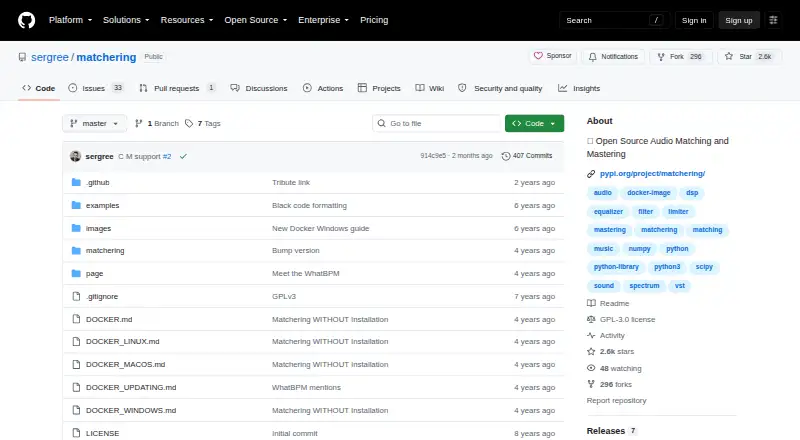
What Matchering is
Matchering is free, open-source software that automatically matches and masters audio. It takes a target track and a reference track, then produces a mastered target matching the reference’s RMS, frequency response, peak amplitude, and stereo width. Matchering 2.0 is available as a containerized web application, a Python library, and a ComfyUI node; it is also integrated into the UVR5 Desktop App. The Python library has a command-line application and requires Python 3.8.0 or higher and a machine with 4 GB of RAM. WAV and MP3 are listed as input formats, but MP3 loading requires a separate FFmpeg installation. The project says it works well with almost all genres, especially EDM, except experimental music with a very specific musical form. It uses digital signal processing rather than a neural network. The software is distributed under the GNU General Public License v3, with no published paid plans. Its web application is intended for home or in-house use, not public Internet hosting without security and scalability changes.
Good
- Matches RMS, frequency response, peak amplitude, and stereo width.
- Available as a web app, Python library, and ComfyUI node.
- Includes a command-line application.
- Free under the GNU General Public License v3.
Watch out
- MP3 loading requires a separate FFmpeg installation.
- Python library requires Python 3.8.0 or higher and 4 GB RAM.
- Web app is not suitable for public hosting without changes.
- Experimental music with a very specific form is an exception.
Who it suits
Matchering suits people who want to match a track’s sound to a reference using an open-source tool. It may fit users of the Python ecosystem or supported desktop and hosted integrations.
Verdict
Matchering offers several ways to run reference-based audio matching at no software cost. Note the Python requirements, separate FFmpeg need for MP3, and warning against exposing the web app publicly without changes.
Plans and prices
From Matchering's own pricing page, checked 1 Oct 2026.
| Plan | Price | What it gives you |
|---|---|---|
| Open-source software | Free | GPLv3 license · no published paid plans |
The facts
Each one read from Matchering's own pages, with the date it was checked.
What it does
- Album consistency
- The documentation presents using one reference across multiple tracks as a way to make an album sound more cohesive.checked 21 Oct 2026
- Audio-format limit
- MP3 loading requires installing FFmpeg separately.checked 1 Oct 2026
- Audio formats
- An independent software directory describes WAV and FLAC input/output support and professional WAV output.checked 21 Oct 2026
- ComfyUI integration
- A ComfyUI-Matchering node is offered as an integration route.checked 21 Oct 2026
- Command line
- The repository points developers to a separate Matchering CLI and an enhanced fork of that CLI.checked 21 Oct 2026
- Desktop integration
- Matchering is integrated into the UVR5 Desktop App.checked 1 Oct 2026
- Developer integration
- The Python library can be connected to everything in the Python ecosystem and has a command-line application.checked 1 Oct 2026
- Docker deployment
- The repository provides separate Docker instructions for Windows, macOS and Linux, plus an update guide.checked 21 Oct 2026
- Documentation
- The repository includes a README, FAQ wiki, Docker guides, examples, log-code documentation and limiter testing material.checked 21 Oct 2026
- Genre guidance
- The algorithm is described as working well with almost all genres, especially EDM, except experimental music with a very specific musical form.checked 1 Oct 2026
- Hosted access
- The project README identifies Songmastr, MVSEP and Moises as services that host Matchering for browser-based trials.checked 21 Oct 2026
- Hosted integrations
- The project says users can try it without installation through Songmastr, MVSEP and Moises hosting.checked 1 Oct 2026
- Independent assessment
- Hysen Labs describes the project as matching four measurements with a project-specific limiter and notes that the newest tagged release is from 2022.checked 21 Oct 2026
- License
- Matchering is distributed under the GNU GPL version 3.0 license.checked 21 Oct 2026
- Limiter
- Version 2 introduced the project’s own open-source Hyrax brickwall limiter.checked 21 Oct 2026
- Limit: interface and controls
- Beathoven characterizes Matchering as having a less polished interface and fewer adjustable parameters than commercial services such as LANDR or eMastered.checked 21 Oct 2026
- Limit: reference dependence
- Beathoven warns that good results depend on choosing a suitable reference track.checked 21 Oct 2026
- Limit: service outage
- A Songmastr user reported that the hosted site had gone down, while another later comment said it was back online.checked 21 Oct 2026
- Limit: setup knowledge
- ToolStock says self-hosting requires basic technical knowledge for installation.checked 21 Oct 2026
- Limit: upload errors
- Reddit commenters reported browser bad-request errors and later said they could not upload songs to the hosted service.checked 21 Oct 2026
- Matching method
- It takes a TARGET track and a REFERENCE track and produces a mastered TARGET matching the reference’s RMS, frequency response, peak amplitude and stereo width.checked 1 Oct 2026
Where it runs
- Linux dependency
- Linux installations require the system libsndfile library to be installed separately.checked 21 Oct 2026
The company
- Maker identity
- The package credits Sergree as author and lists one maintainer on PyPI.checked 21 Oct 2026
- Maker location
- The maintainer’s GitHub profile identifies Sergey Grishakov and lists Moscow, Russian Federation.checked 21 Oct 2026
The full review of Matchering
Matchering is open-source software that masters a target track toward a reference recording, best suited to musicians who have a sound in mind and developers who want to work in Python. Its no-cost, multi-format approach is compelling for reference-led work, but it is not a general-purpose mastering environment.
Overview
Provide a TARGET and a REFERENCE, and Matchering produces a mastered target intended to match the reference’s RMS, frequency response, peak amplitude and stereo width. That makes it a practical option for pursuing a consistent sound against a chosen benchmark; without a suitable reference, its focused approach offers less direction than a mastering workflow built around broader creative control.
Matchering 2.0 is available as a containerized web application, a Python library and a ComfyUI node, and it is integrated into the UVR5 Desktop App. Songmastr, MVSEP and Moises host it for people who want to try it without installation. The project says the algorithm uses digital signal processing rather than a neural network, and that users may use their mastered tracks wherever they want.
Key features
Reference matching is the defining capability. Matching a reference’s loudness, tonal response, peak level and stereo width can help align a target with an established sound, but the result depends on selecting a suitable reference. The algorithm is described as working well across almost all genres, especially EDM; experimental music with a very specific musical form is a less dependable fit.
Developers can use the Python library with the wider Python ecosystem or its command-line application. The library requires Python 3.8.0 or higher and a machine with 4 GB of RAM, which is a manageable baseline for many development setups but still makes this less immediate than using a hosted service. Loading MP3 files also requires installing FFmpeg separately; WAV is supported without that stated extra requirement.
The Python package is distributed under the GNU General Public License v3 (GPLv3), so its open-source availability comes with a license to consider for software integration. For users who prefer not to install Matchering, the hosted integrations provide a route to try it through Songmastr, MVSEP or Moises.
Pricing
Matchering is free. The Open-source software plan costs nothing and is distributed under GPLv3; no paid plans are published. This is a straightforward fit for hobbyists, musicians and developers who can use the available forms and accept the license terms, rather than buyers seeking a paid tier with a different service commitment.
Platforms
Matchering supports Linux, macOS and Windows, as well as web and self-hosted use. The containerized web application, Python library and ComfyUI node give it several routes into an existing setup, while UVR5 integration and the three hosted services offer additional ways to access it. The self-hosting option needs particular care: the maker says the web app is intended for home and in-house use, not public Internet hosting without security and scalability changes.
The maker points to Django, SQLite, Redis and the Matchering worker running in one container, non-scalable SQLite, DEBUG enabled and the absence of a production web server as reasons not to expose the application publicly as-is. That warning matters more than the convenience of a browser-based interface for anyone considering an Internet-facing deployment.
Who it's for
Matchering makes the most sense for musicians who want a reference-guided master, developers comfortable with Python or command-line integration, and users who already work with ComfyUI or UVR5. It is less suitable for experimental material whose form is unusually specific, or anyone who wants a conventional mastering environment without choosing a reference track.
Pros and cons
- Pros: Free access across multiple forms, including a Python library, containerized web app and ComfyUI node, makes it adaptable to both creative and developer workflows.
- Pros: Matching RMS, frequency response, peak amplitude and stereo width gives users concrete reference targets rather than an unspecified mastering result.
- Cons: The Python route requires Python 3.8.0 or higher and 4 GB of RAM, and MP3 loading needs separate FFmpeg installation.
- Cons: The web application is not suitable for public hosting without changes, so self-hosters must not treat its containerized form as production-ready for the open Internet.
- Cons: A reference-dependent method is a narrower choice for users seeking open-ended mastering control, and the project cautions that experimental music with a very specific form may not suit it.
Alternatives
For another free route to mastering software, compare Audio Mastering Software. Readers specifically comparing AI-based offerings can browse AI Music Mastering Software, though Matchering itself uses digital signal processing rather than a neural network.
IK Multimedia ReSing is a freemium macOS and Windows option with a free tier limited to two voices, two instruments, one RVC import and no model generation; choose it for those voice and instrument tools rather than Matchering’s reference-led mastering. Tunr is another free macOS and Windows alternative; its free key is counted per machine and starts with three masters before a licence key, so it may suit someone seeking that desktop workflow.
Voxengo SPAN is a free real-time FFT spectrum analyzer plugin for macOS and Windows, a better fit when the need is spectrum analysis rather than automatic matching. StudioZIO Mastering Suite is free macOS software supporting AU, VST3, AAX and standalone use without a licence key or account, making it an option for users who want that plugin and standalone format range.
TDR Limiter 6 GE offers a personal/small business license for €60, paid once, with free updates for one user on up to five computers; consider it instead if that paid license arrangement and platform support suit your setup. DSP-Quattro is a macOS alternative with a free trial. Acustica Audio Erin Studio and FUSER are other options; FUSER costs £59, paid once and supports macOS and Windows.
Verdict
Choose Matchering if you want free, reference-based mastering and can supply a suitable benchmark, especially if Python, ComfyUI or UVR5 fits your workflow. Its strongest reason to choose it is that focused matching is available in several forms at no software cost; its strongest reason to look elsewhere is the narrow reference-led approach, compounded for self-hosters by the warning against public deployment without substantial changes.
Getting started
- Open the Matchering GitHub project.
- Choose the containerized web application, Python library, or ComfyUI node.
- For Python use, provide Python 3.8.0 or higher and a machine with 4 GB of RAM.
- Install FFmpeg separately if you need to load MP3 files.
- Alternatively, try the hosted versions through Songmastr, MVSEP, or Moises without installation.
Limits worth knowing
The Python library requires Python 3.8.0 or higher and 4 GB of RAM; MP3 loading requires a separate FFmpeg installation. The web application is intended for home or in-house use, not public Internet hosting without security and scalability changes.
Questions
Does Matchering cost anything?
The open-source software is listed as free under the GPLv3 license. No paid plans are published.
What does Matchering do with two tracks?
It uses a TARGET and REFERENCE track to produce a mastered TARGET that matches the reference’s RMS, frequency response, peak amplitude, and stereo width.
What formats does it accept?
WAV and MP3 are listed as input formats. MP3 loading requires installing FFmpeg separately.
What forms of the software are available?
Matchering 2.0 is provided as a containerized web application, Python library, and ComfyUI node, and is integrated into the UVR5 Desktop App.
What does the Python library require?
It requires Python 3.8.0 or higher and a machine with 4 GB of RAM. It includes a command-line application.
Can I host the web application publicly?
The maker says it is designed for home and in-house use and is not suitable for public Internet hosting without security and scalability changes.
Alternatives to Matchering
- 1

WaveLab
Free planmacOSWindows7.4$99.99 one-time - 2
Sonoris DDP Creator
iOSmacOSWindows6.6€249 one-time - 3

DSP-Quattro
macOS6.5$99 one-time - 4

Acustica Audio Erin Studio
macOSWindows6.4€45 one-time - 5
LANDR Mastering Plugin
macOSWindows6.4From $15.99 a month - 6
Brainworx bx_masterdesk
macOSWindows6.2From $149.99 a year