MailHog
MailHog is a free, MIT-licensed email testing tool for developers.
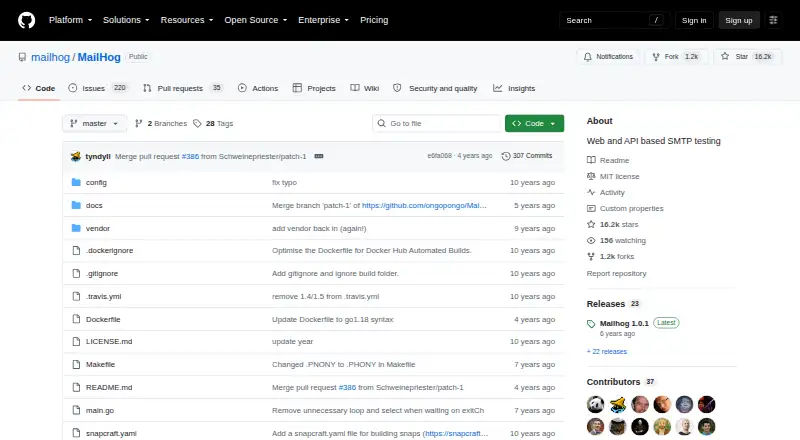
What MailHog is
MailHog is a free, MIT-licensed email testing tool for developers. An application sends mail to it over SMTP, after which developers can inspect messages in a web interface or use a JSON API. The interface displays plain text, HTML, or message source, supports encoded headers, and updates in real time. The API can list, retrieve, and delete messages, and download full messages or individual MIME parts. Messages can optionally be released to real SMTP servers. MailHog implements ESMTP RFC5321 and supports SMTP AUTH and PIPELINING; it also includes a Chaos Monkey feature for failure testing. Storage defaults to memory, with MongoDB and Maildir available as alternatives. It can run from the command line, as a daemon, in Docker, or on AWS Elastic Beanstalk. With in-memory storage, an Elastic Beanstalk deployment is limited to one instance; load-balanced deployments require MongoDB-backed storage. HTTP basic authentication can protect requests using a password file with bcrypt-hashed passwords. By default, the SMTP server listens on port 1025 and the HTTP server on port 8025.
Good
- Free and released under the MIT license
- Web interface displays text, HTML, and source
- API can retrieve and delete messages
- Offers memory, MongoDB, and Maildir storage
Watch out
- Memory storage limits Elastic Beanstalk to one instance
- Load-balanced deployments require MongoDB-backed storage
Who it suits
MailHog suits developers who need to capture application email for inspection or failure testing. It is also useful when a project needs message access through a web interface or JSON API.
Verdict
MailHog provides developers with a way to inspect application mail and test failure scenarios without sending every message onward. Its storage choice matters for Elastic Beanstalk deployments that need load balancing.
Plans and prices
From MailHog's own pricing page, checked 4 Oct 2026.
| Plan | Price | What it gives you |
|---|---|---|
| MailHog | Free | Open-source email testing tool · MIT license |
The facts
Each one read from MailHog's own pages, with the date it was checked.
What it does
- Authentication
- HTTP basic authentication can protect all HTTP requests, including static content and API endpoints, using a password file with bcrypt-hashed passwords.checked 4 Oct 2026
- Default ports
- By default, the SMTP server listens on port 1025 and the HTTP server listens on port 8025.checked 4 Oct 2026
- Deployment
- MailHog can be run from the command line, as a daemon, in Docker, or on AWS Elastic Beanstalk; the deployment guide also documents a SaltStack formula.checked 4 Oct 2026
- Failure testing
- MailHog includes a Chaos Monkey feature for failure testing.checked 4 Oct 2026
- HTTP API
- The HTTP API can list, retrieve, and delete messages, and supports downloading complete messages and individual MIME parts.checked 4 Oct 2026
- Integrations
- The project lists Node.js API v2 and PHP API v1/v2 client libraries and provides mhsendmail as a sendmail replacement.checked 4 Oct 2026
- License
- MailHog is released under the MIT license.checked 4 Oct 2026
- Message release
- Messages can optionally be released to real SMTP servers for delivery.checked 4 Oct 2026
- Notable limit
- With in-memory storage, an Elastic Beanstalk deployment can use only a single MailHog instance; load-balanced deployments require MongoDB-backed storage.checked 4 Oct 2026
- Purpose
- MailHog is an email testing tool for developers that accepts application mail over SMTP and lets users view messages in a web UI or retrieve them through a JSON API.checked 4 Oct 2026
- SMTP
- MailHog implements ESMTP RFC5321 and supports SMTP AUTH RFC4954 and PIPELINING RFC2920.checked 4 Oct 2026
- Storage
- Message storage can use memory, MongoDB, or Maildir; the default is in-memory storage.checked 4 Oct 2026
- Web interface
- The web interface displays messages as plain text, HTML, or source and supports RFC2047 encoded headers and real-time updates using EventSource.checked 4 Oct 2026
Where it runs
- Platform support
- The README provides installation instructions for macOS, Debian/Ubuntu, FreeBSD, and Docker, and says MailHog runs without installation on multiple platforms.checked 4 Oct 2026
The full review of MailHog
MailHog is a self-hosted email testing tool for developers who need to inspect application messages before they reach real recipients. Its strongest fit is a development setup that values direct SMTP capture and API access; teams needing a load-balanced deployment must choose their storage carefully.
Overview
MailHog accepts application mail over SMTP and makes it available in a browser or through a JSON API. Messages can optionally be released to real SMTP servers, giving developers a way to inspect routine test mail while retaining a path to deliver selected messages. It is free, open-source software under the MIT license, but its self-hosted nature means deployment and storage are part of the decision.
Key features
Message inspection and automation
The web interface shows messages as plain text, HTML, or source, supports RFC2047-encoded headers, and updates in real time through EventSource. That range is useful when a developer needs to check both readable rendering and the message contents that produced it. The HTTP API can list, retrieve, and delete messages, download complete messages, and access individual MIME parts, making it suitable for scripted inspection as well as manual review.
SMTP and failure testing
MailHog implements ESMTP RFC5321 and supports SMTP AUTH RFC4954 and PIPELINING RFC2920. Its Chaos Monkey feature enables failure testing, extending its role beyond simply catching outbound development mail. The default SMTP port is 1025 and the HTTP server uses port 8025, so applications and tooling need to be configured for those endpoints when using the defaults.
Storage, access, and deployment
Messages are stored in memory by default, with MongoDB and Maildir as alternatives. In-memory storage is convenient for a straightforward single-instance setup, but it constrains AWS Elastic Beanstalk deployments: they can use only one MailHog instance. Load-balanced Elastic Beanstalk requires MongoDB-backed storage, so teams that need that deployment pattern should account for the database choice from the outset.
HTTP basic authentication can protect all HTTP requests, including static content and API endpoints, using a password file with bcrypt-hashed passwords. MailHog can run from the command line, as a daemon, in Docker, or on AWS Elastic Beanstalk; its deployment guide also documents a SaltStack formula. Node.js API v2 and PHP API v1/v2 client libraries are listed, and mhsendmail provides a sendmail replacement. These options suit developers integrating a capture server into existing application workflows, though the product remains a tool to deploy and operate rather than a hosted inbox.
Pricing
MailHog is free: its open-source plan costs nothing and is released under the MIT license. There is no free trial because there is no paid tier to trial. The free plan is a natural fit for individual developers and teams able to host the service themselves; it does not remove the operational trade-off around storage, especially for load-balanced Elastic Beanstalk deployments.
Platforms
MailHog supports API, Linux, macOS, self-hosted, and web use. Installation instructions cover macOS, Debian/Ubuntu, FreeBSD, and Docker, and the project says it can run without installation on multiple platforms. The platform mix favors development teams that can run a local or managed instance; it is not presented as a mobile app.
Who it's for
MailHog is a good fit for developers who need to capture application SMTP traffic, inspect message bodies and MIME parts, automate checks through an API, or exercise failure scenarios without routing every message onward. It is particularly compelling when a team can self-host and wants control over storage and deployment. It is a weaker fit for teams that want a hosted service without deployment responsibilities, or for Elastic Beanstalk users who need load balancing but do not want MongoDB-backed storage.
Pros and cons
- Pros: Free MIT-licensed software makes it usable without a subscription or a trial deadline.
- Pros: Browser inspection, real-time updates, and a capable HTTP API cover both manual review and automated message workflows.
- Pros: Optional SMTP release and Chaos Monkey support delivery checks and failure testing within the same tool.
- Cons: Self-hosting puts deployment and operation on the user rather than providing a hosted testing service.
- Cons: Default in-memory storage limits Elastic Beanstalk to a single instance; load balancing requires MongoDB-backed storage.
Alternatives
Compare email testing software if you want to survey the category before choosing a tool. Mailpit is a close free alternative for Linux, macOS, Windows, self-hosted, web, and API use, with a single static binary or multi-architecture Docker images and a default retention of the most recent 500 emails.
Twilio Segment is a broader web and mobile option with a free tier that includes 1,000 visitors per month, 500,000 Reverse ETL records per month, 2 sources, and 700+ integrations. MailSlurp may suit readers who prefer a freemium API and web service with a free allowance covering 500 received emails per month, 1,000 sandbox sends per month, and other capped testing actions.
Emailens is another freemium API, extension, and web alternative, with a free plan that includes 30 simulated previews per day. EmailQA is worth considering for team-based rendering review: its free tier includes 3 projects per month, 2 team members, 25 real-device renders per month, and a 7-day render history, while Pro costs $20 a month.
GlockApps is a freemium API and web alternative whose free tier focuses on deliverability-related checks, including 2 spam test credits and 10,000 DMARC messages. Mailinator offers a free Verified Pro tier with private inboxes and a private domain, while Mailtrap Email Sandbox has a free plan capped at 50 test emails per month, 1 user, and 1 sandbox. These alternatives are more relevant when their listed service or allowance matches the workflow better than a self-hosted capture server.
Verdict
Choose MailHog if you are a developer who wants a free, self-hosted SMTP capture tool with browser and API inspection, optional delivery, and failure testing. Its strongest reason to choose it is the breadth of message access and deployment control at no subscription cost. Look elsewhere if you want a hosted service, or if your Elastic Beanstalk deployment needs load balancing and you do not want to use MongoDB-backed storage.
Getting started
- Open the MailHog GitHub project
- Run MailHog from the command line, as a daemon, in Docker, or on AWS Elastic Beanstalk
- Configure your application to send SMTP mail to port 1025
- Open the web interface on port 8025
- Choose memory, MongoDB, or Maildir storage
- Add HTTP basic authentication with a bcrypt password file if required
Limits worth knowing
With in-memory storage, an Elastic Beanstalk deployment can use only one MailHog instance. Load-balanced deployments require MongoDB-backed storage.
Questions
Is MailHog free?
Yes. MailHog is free and released under the MIT license.
Which platforms are supported?
It supports API, Linux, macOS, self-hosted, and web environments, with installation guidance for macOS, Debian/Ubuntu, FreeBSD, and Docker.
Can messages reach real recipients?
Messages can optionally be released to real SMTP servers for delivery.
What storage options are available?
Storage can use memory, MongoDB, or Maildir; memory is the default.
Does it provide an API?
Yes. The JSON API can list, retrieve, and delete messages, and download complete messages or individual MIME parts.
What are the default ports?
The SMTP server listens on port 1025 by default, while the HTTP server uses port 8025.
Alternatives to MailHog
- 1

MailSlurp
Free planAndroidiOSWebAPI7.9From $19.99 a month - 2

Mailinator
Free planAndroidWebAPIExtension7.8From $79 a month - 3

Emailens
Free planOpen sourceWebAPIExtensionSelf-hosted7.7From $9 a month - 4

GlockApps
Free planWebAPI7.4From $59 a month - 5

Unspam.email
Free planWebAPI7.4From $5 a month - 6
testmail.app
Free planWebAPI7.3From $9 a month