
Linkagent
Linkagent crawls a website to locate missing internal links and add only links users approve.
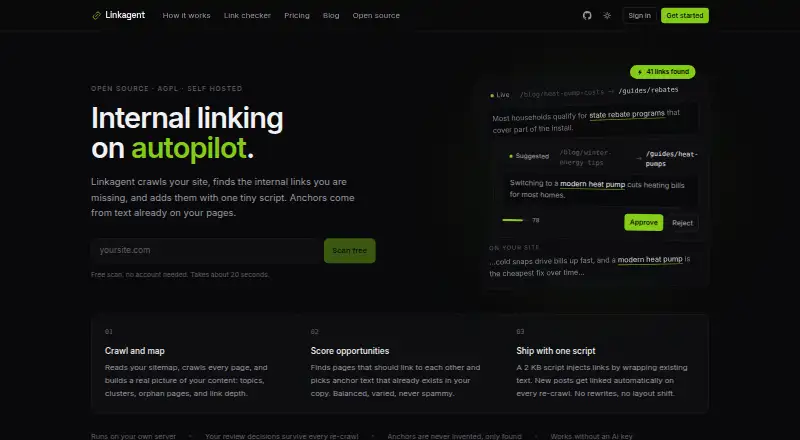
What Linkagent is
Linkagent crawls a website to locate missing internal links and add only links users approve. It can deliver approved links through a script, a WordPress plugin, or a JSON API. Its analysis reads a sitemap and maps topics, clusters, orphan pages, click depth, and links within page text. Suggested anchor phrases come from existing page copy, and optional AI review checks them against their original sentence. Crawling, clustering, scoring, and anchor selection do not require an AI key; a Claude API key enables additional review. Users can accept or reject suggestions, with those decisions carried into later crawls. Linkagent balances suggestions at roughly one new link per 250 words and limits new inbound links and repeated anchor use. Its asynchronous embed script is about 2 KB and wraps existing text without adding or moving content. The script or API supports WordPress, Next.js, Shopify, Webflow, and other CMSs. Self-hosting keeps content, link graphs, and review decisions in the user's own Postgres database. A no-account scan is available, but the hosted product has no free plan.
Good
- Finds orphan pages and maps click depth
- Anchor suggestions draw from existing page copy
- User decisions persist across re-crawls
- Works with several CMSs through script or API
- Free self-hosted plan requires your infrastructure
Watch out
- Hosted product has no free plan
- Self-hosting requires your infrastructure
Who it suits
It suits site owners and teams looking to identify internal-link gaps and review suggestions before adding them. Self-hosting may suit users who want content and review data kept in their own Postgres database.
Verdict
Linkagent offers reviewable internal-link suggestions with delivery options for scripts, WordPress, and APIs. Consider whether a hosted plan’s limits or self-hosting requirements better suit your site.
Plans and prices
From Linkagent's own pricing page, checked 4 Oct 2026.
| Plan | Price | What it gives you |
|---|---|---|
| Self-hosted | Free | Every feature, ungated · requires your infrastructure · $0 forever · AGPL-3.0 |
| Starter | $29 a month | 1 site · biweekly re-crawls · up to 200 pages · $29/month |
| Pro | $99 a month | 5 sites · weekly re-crawls · up to 1,000 pages per site · $99/month |
| Agency | $249 a month | 25 sites · weekly re-crawls · up to 5,000 pages per site · $249/month |
The facts
Each one read from Linkagent's own pages, with the date it was checked.
What it does
- AI requirement
- Crawling, clustering, scoring, and anchor selection work without an AI key; a Claude API key enables additional review.checked 4 Oct 2026
- Anchor text
- Suggested anchors come from phrases already present in page copy, and AI-reviewed anchors are validated against the original sentence.checked 4 Oct 2026
- Content analysis
- It reads a sitemap and maps page topics, clusters, orphan pages, click depth, and the in-text link graph.checked 4 Oct 2026
- Hosted limits
- Hosted plans differ by site count, crawl size, and re-crawl frequency; all include AI review and content edit suggestions.checked 4 Oct 2026
- Integrations
- Linkagent supports WordPress, Google Search Console tracking, and a JSON API for server-side rendering.checked 4 Oct 2026
- Licensing
- The platform is AGPL-3.0 licensed and the embed script is MIT licensed.checked 4 Oct 2026
- Link limits
- Suggestions are balanced at roughly one new link per 250 words, with caps on new inbound links and repeated anchor use.checked 4 Oct 2026
- Purpose
- Linkagent crawls a website, finds missing internal links, and adds approved links using a script, WordPress plugin, or JSON API.checked 4 Oct 2026
- Review workflow
- Users approve or reject link suggestions, and those decisions persist across re-crawls.checked 4 Oct 2026
- Script
- The embed script is about 2 KB, loads asynchronously, and wraps existing text without adding or moving page content.checked 4 Oct 2026
- Self-hosting and data
- Self-hosters keep content, link graphs, and review decisions in their own Postgres database; the site says nothing phones home.checked 4 Oct 2026
- Support
- The self-hosted plan includes community support on GitHub.checked 4 Oct 2026
Money
- Free scan
- A no-account site scan is available without a card, and the pricing page says the hosted product has no free plan.checked 4 Oct 2026
Where it runs
- Platform compatibility
- The site says it works across WordPress, Next.js, Shopify, Webflow, and other CMSs through a script or API.checked 4 Oct 2026
The full review of Linkagent
Linkagent is a review-driven internal-linking system for websites that need to find gaps and add links through a script, WordPress, or an API. It suits publishers, ecommerce teams, and agencies that want approval control or self-hosting rather than unexplained automatic edits. The main trade-off is clear: its workflow is flexible and cautious, while hosted tiers impose hard limits on sites, pages, and crawl frequency.
Overview
Linkagent crawls a site from its sitemap, identifies missing internal links, and proposes additions for approval. It maps page topics, clusters, orphan pages, click depth, and the in-text link graph, so recommendations can be judged in the context of the site's wider structure. That makes it a stronger fit for teams doing systematic information-architecture work than for owners seeking a one-click plugin.
Approved links can be delivered through an embed script, a WordPress plugin, or a JSON API. The platform also supports Google Search Console tracking. Compatibility is broad: the site says the script or API works with WordPress, Next.js, Shopify, Webflow, and other CMSs.
Key features
Suggested anchor text is taken from phrases already present in page copy. Optional AI review validates an anchor against its original sentence, reducing the risk of wording that feels detached from the surrounding content. Crawling, clustering, scoring, and anchor selection work without an AI key; adding a Claude API key enables the extra review layer.
Approval is persistent. Accepting or rejecting a suggestion carries forward across re-crawls, which prevents the same decisions from returning as recurring noise. Link volume is deliberately restrained at roughly one new link per 250 words, with caps on new inbound links and repeated anchor use. Those limits favor editorial control and natural density, but they make Linkagent less suitable for teams wanting unrestricted bulk insertion.
The approximately 2 KB embed script loads asynchronously and wraps existing text without adding or moving page content. Self-hosters keep content, link graphs, and review decisions in their own Postgres database; the site says nothing phones home. The platform is AGPL-3.0 licensed, while the embed script is MIT licensed.
Pricing
Linkagent uses a freemium model in practice, but its hosted product has no free plan or free trial. A no-account site scan is available without a card, while ongoing hosted use starts at $29/month.
| Plan | Price | What you get |
|---|---|---|
| Self-hosted | free | Billed $0 forever under AGPL-3.0, with every feature ungated; you provide the infrastructure. Community support is through GitHub. |
| Starter | $29 a month | 1 site, biweekly re-crawls, and up to 200 pages. |
| Pro | $99 a month | 5 sites, weekly re-crawls, and up to 1,000 pages per site. |
| Agency | $249 a month | 25 sites, weekly re-crawls, and up to 5,000 pages per site. |
Hosted plans include AI review and content edit suggestions, but the site-count, crawl-size, and re-crawl limits determine who each tier fits. Starter is aimed at one smaller site; Pro suits a team managing several substantial properties; Agency is the practical tier for a portfolio of client sites. Self-hosted costs no license fee and removes feature gating, but shifts infrastructure and operational responsibility to you.
Platforms
Linkagent is available as a web service, API, or self-hosted deployment. WordPress users can use the plugin, while server-rendered applications can consume the JSON API. The asynchronous script is the simplest route for supported CMSs and avoids relocating existing page content.
Who it's for
Choose Linkagent if your site has orphan pages or inconsistent internal structure and you want every proposed change reviewed. It is particularly well matched to agencies, editorial teams, and technically capable operators who need persistent decisions, CMS flexibility, or a private Postgres-backed installation. It is a weaker fit for a very small site that expects a permanent hosted free tier, or for teams that want links published without an approval workflow.
Pros and cons
Pros
- Context-rich recommendations: topic clusters, click depth, orphan-page detection, and the in-text graph support prioritization beyond a simple URL list.
- Editorial safeguards: persistent approvals, anchor reuse caps, inbound-link caps, and roughly one link per 250 words keep automation controlled.
- Deployment choice: script, WordPress, API, and self-hosted options cover varied stacks.
- Private self-hosting: content and decisions remain in your Postgres database, with no phone-home behavior stated by the site.
Cons
- No hosted free tier or trial: ongoing hosted use begins at $29/month after the scan.
- Hosted ceilings: Starter is limited to one site and 200 pages, while larger portfolios require materially more expensive tiers.
- Infrastructure burden: self-hosting is free but requires you to operate the necessary infrastructure and relies on GitHub community support.
- Review is part of the process: teams seeking fully hands-off publishing may find approvals and conservative link caps restrictive.
Alternatives
For a broader comparison, see Internal Linking Tools.
LinkBoss is the better starting point if you need a hosted web tool with a free plan, free trial, and a $11 monthly Launch tier.
Choose Interlink when a free WordPress plugin with no signup is more important than cross-CMS delivery.
InterLinks fits readers wanting a free demo and a $19 monthly Professional plan for web-based linking.
Internal Link Juicer is an alternative for self-hosted users who want a free version or a $69.99-per-year one-site license.
Pick Link Whisper for a WordPress-oriented self-hosted workflow with a free install option.
Linkbot suits sites prioritizing a free starter property and diagnostics before paying for automation.
Magic Rinku is worth considering when credit-based pricing and a free credit allowance match your usage.
redCacti is another web-based freemium option for readers comparing free site and page allowances.
Verdict
Linkagent is a strong choice for teams that need explainable, reviewable internal-link suggestions across multiple CMSs, with self-hosting available for tighter data control. Its persistent approvals, structural analysis, and delivery options are the main reasons to choose it. Look elsewhere if you require a hosted free plan, a trial, or fully automatic linking without site and crawl quotas.
Alternatives to Linkagent
- 1
Internal Link Juicer
Free planOpen sourceWebSelf-hosted7.7From $69.99 a year - 2

Link Whisper
Free planOpen sourceWebAPISelf-hosted7.7From $1 a month - 3
Magic Rinku
Free planOpen sourceWebAPI7.7From $9 a month - 4
Link&Cluster
Free planOpen sourceSelf-hosted7.4$34 one-time - 5
InterLinks
Free planWeb7.3From $9 a month - 6
Core+ Links
Free planOpen sourceWebSelf-hosted7.2Free plan