LiAg
LiAg is free, open-source software for creating and rendering 3D avatars in a web-based workspace.
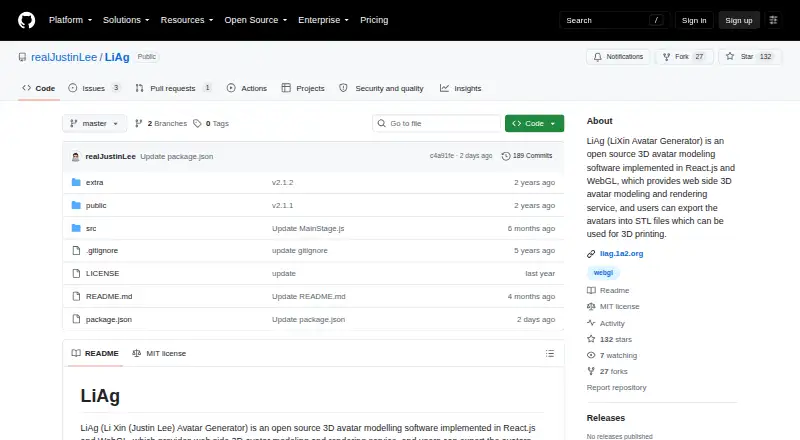
What LiAg is
LiAg is free, open-source software for creating and rendering 3D avatars in a web-based workspace. Its editor includes a component selector for assembling an avatar and a pose editor for positioning it. Finished models can be exported as STL files for 3D printing. The project uses React.js and WebGL and is distributed under an MIT license, with commercial use allowed. Listed platforms include Android, Linux, macOS, Windows, and the web; the README specifically names Android tablets and Windows 11 among compatible systems. There is no planned iOS support. Running LiAg requires Node.js v26.2.0, React.js 19.2.6, and three.js 0.184.0. Installation involves cloning the repository, running npm build commands, and serving the resulting build. Version 2.3.1 is listed. An Electron desktop release appears as a TODO, so the available workflow is presented as web based rather than as a released Electron application.
Good
- Free plan with commercial use allowed
- Component selector and pose editor
- STL export for 3D printing
- MIT-licensed open-source project
- Supports web, desktop, and Android platforms
Watch out
- No planned iOS support
- Requires specified Node, React, and three.js versions
- Electron desktop app remains a TODO
- Installation requires cloning and building the repository
Who it suits
LiAg suits users who want open-source avatar modeling with browser-based rendering and STL export. It is relevant to people using compatible desktop systems or Android tablets, including commercial projects.
Verdict
LiAg provides a focused web workflow for assembling, posing, rendering, and exporting 3D avatars. Its free MIT license and STL output suit users comfortable with repository-based installation, while iOS users and those seeking a released Electron app are not covered.
The facts
Each one read from LiAg's own pages, with the date it was checked.
What it does
- Compatibility
- The README lists macOS, Linux, Windows 11, and Android tablets as compatible platforms.checked 8 Oct 2026
- Editor
- The README identifies a component selector and a pose editor.checked 8 Oct 2026
- Editor views
- The README shows a component selector, a pose editor, and an exported STL model.checked 8 Oct 2026
- Export
- Users can export avatars as STL files for 3D printing.checked 8 Oct 2026
- Implementation
- The software is implemented with React.js and WebGL.checked 8 Oct 2026
- Installation
- The installation instructions clone the repository, run npm commands to build it, and serve the build.checked 8 Oct 2026
- License
- The repository lists an MIT license.checked 8 Oct 2026
- Purpose
- LiAg is open source 3D avatar modeling software that provides web based modeling and rendering.checked 8 Oct 2026
- Requirements
- The listed requirements are Node.js v26.2.0, React.js 19.2.6, and three.js 0.184.0.checked 8 Oct 2026
- Technology
- The project is implemented with React.js and WebGL.checked 8 Oct 2026
- Version
- The README lists version 2.3.1.checked 8 Oct 2026
Where it runs
- Desktop app
- The README lists releasing the project as an Electron desktop app as a TODO.checked 8 Oct 2026
- iOS support
- The README says there is no plan to support iOS.checked 8 Oct 2026
Alternatives to LiAg
- 1

Meshy
Free planAndroidiOSWebAPI8.3From $20 a month - 2

MetaPerson Creator
Free planAndroidiOSWebAPI8.1From $800 a month - 3

ZBrush
Free planiOSAPImacOSWindows7.9Free plan - 4

in3D
Free planAndroidiOSWebAPI7.6$100 one-time - 5

Blender
Free planOpen sourceLinuxmacOSWindows7.5Free plan - 6
IMVU
Free planAndroidiOSWebmacOS7.5From $4.99 a month