
in3D
in3D is a mobile app for creating virtual human avatars through 3D body scanning.
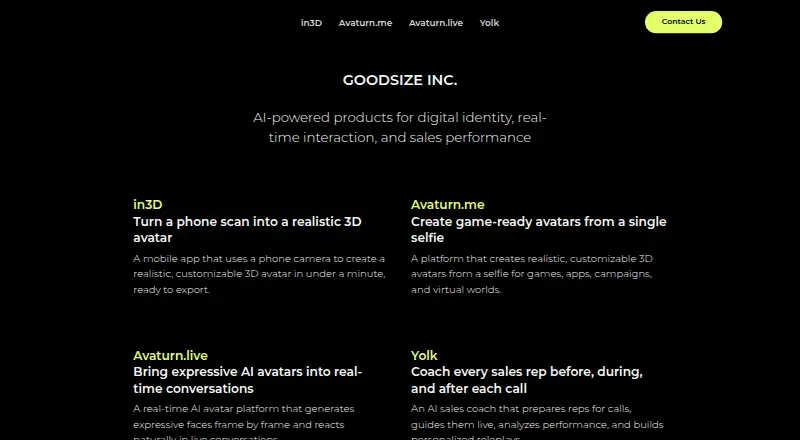
What in3D is
in3D is a mobile app for creating virtual human avatars through 3D body scanning. It records video and photos through the phone camera, using video and TrueDepth data during scanning; the site says an avatar can be created within a minute. Models can be exported in FBX, GLB, or USDZ formats, and the maker lists SDKs for Unreal Engine and Unity. Its Web SDK and API can integrate avatars into apps on any platform. The maker describes avatars as having a Mixamo-compatible rig and a 2048×2048 texture, and says API-created avatars can be used in commercial or non-commercial games, experiences, videos, and metaverses. API-created avatars may not be used to build competing 3D scanning technology or sold as NFTs or paid model distributions. The app uploads only video and photos recorded in the app for processing through Google Cloud Platform and Amazon Web Services. The privacy policy says those files are encrypted with a key stored locally on the mobile device. The free API testing plan is rate limited to two scans per day; a 100-scan plan costs $100, paid once.
Good
- Creates avatars using a phone camera scan.
- Exports models in FBX, GLB, or USDZ formats.
- SDKs are listed for Unreal Engine and Unity.
- Free API testing includes two scans per day.
Watch out
- Free API testing is limited to two scans daily.
- The 100-scan plan costs $100, paid once.
- Children under 13 are not allowed to use the app.
Who it suits
It suits people who want to create and export phone-scanned avatars, as well as developers integrating avatars into apps or games. API users should note the stated limits on competing scanning products and paid model distribution.
Verdict
in3D offers phone-based avatar scanning alongside export formats and developer integration options. Its free API testing is rate limited, and API-created avatars have stated use restrictions.
Plans and prices
From in3D's own pricing page, checked 5 Oct 2026.
| Plan | Price | What it gives you |
|---|---|---|
| FREE | Free | API testing · rate limited at 2 scans per day |
| 100 scans for a larger test | $100, paid once | 100 scans |
| Production / platform plan | Priced on request | Contact [email protected] |
The facts
Each one read from in3D's own pages, with the date it was checked.
What it does
- Age limit
- The privacy policy says the app is not directed at children under 13 and its terms do not allow their use.checked 4 Oct 2026
- Avatar specifications
- The maker says in3D avatars have a Mixamo-compatible rig and 2048×2048 texture.checked 5 Oct 2026
- Avatar specs
- The same post says in3D avatars have a Mixamo-compatible rig and 2048×2048 texture.checked 4 Oct 2026
- Cloud processing
- The app uses Google Cloud Platform and Amazon Web Services to process and edit photographs and videos.checked 4 Oct 2026
- Commercial use
- The developer portal says avatars created using the in3D API can be used in commercial or non-commercial games, experiences, videos, and metaverses.checked 5 Oct 2026
- Data use
- The policy says user videos are used to provide 3D body scanning or as anonymized data for internal technology improvement.checked 4 Oct 2026
- Encryption
- The policy says videos and photos are encrypted using a key stored locally on the mobile device.checked 4 Oct 2026
- Export formats
- The app lets users export 3D models in FBX, GLB, or USDZ formats.checked 5 Oct 2026
- Integration
- An in3D blog post says the app can directly export a 3D model to Sketchfab using a Sketchfab API token.checked 4 Oct 2026
- Mobile availability
- The developer portal directs non-developers to use the iOS or Android app.checked 5 Oct 2026
- Privacy and processing
- The privacy policy says the app uploads only video and photos recorded in the app, and uses Google Cloud Platform and Amazon Web Services to process them.checked 5 Oct 2026
- Product
- in3D is an app and SDK for 3D body scanning and creating realistic avatars.checked 5 Oct 2026
- Scan input
- The app uses video and TrueDepth data recorded through the user’s camera during scanning.checked 4 Oct 2026
- Scan speed
- The site says avatars can be created from a phone camera within a minute.checked 5 Oct 2026
- SDK integrations
- The site names SDKs for Unreal Engine and Unity.checked 5 Oct 2026
- Security
- The privacy policy says videos and photos are encrypted using a key stored locally on the mobile device, while also stating that Goodsize cannot guarantee information security.checked 5 Oct 2026
- Support
- The developer portal lists [email protected] for support and [email protected] for production inquiries.checked 5 Oct 2026
- Upload scope
- The policy says the app uploads only the video and photos specifically recorded using the app.checked 4 Oct 2026
- Use restrictions
- The developer portal says API-created avatars cannot be used to create competing 3D scanning technology or sold as NFTs or paid 3D model distributions.checked 5 Oct 2026
- Web SDK and API
- The maker says its Web SDK and API can integrate avatars into an app on any platform.checked 5 Oct 2026
The full review of in3D
in3D turns a phone-camera capture into a human 3D avatar, making it a focused option for creators and developers who need a scanned person in a game or digital experience. Its strongest case is the path from mobile scan to rigged exports and engine integrations; API users should consider the daily cap and limits on commercial use before committing.
Overview
The app records video and TrueDepth data through the camera while scanning, and the site says the process can produce an avatar within a minute. That speed suits projects that need a person-shaped model without starting from a blank modeling canvas, but in3D is a capture tool rather than a general 3D creation suite. Its avatars have a Mixamo-compatible rig and a 2048×2048 texture, a practical foundation for animation workflows.
Key features
FBX, GLB, and USDZ exports give creators options for moving an avatar into other software. The app can also export directly to Sketchfab with a Sketchfab API token. Unreal Engine and Unity SDKs serve game development, while the Web SDK and API are intended to integrate avatars into apps on any platform. These routes make in3D more compelling for teams with an existing engine or app pipeline than for someone seeking an all-in-one modeling environment.
API-created avatars are permitted in commercial and non-commercial games, experiences, videos, and metaverses. They cannot be used to build competing 3D scanning technology, sold as NFTs, or distributed as paid 3D models. Those restrictions rule it out for businesses whose product depends on reselling avatar files or offering a competing scan service.
For privacy, the policy says only video and photos recorded through the app are uploaded, and that Google Cloud Platform and Amazon Web Services process them. It says those files are encrypted with a key stored on the mobile device and may be used for scanning or, in anonymized form, internal technology improvement. The policy describes commercially reasonable safeguards but does not guarantee against access, disclosure, alteration, or destruction. The app is not for children under 13; questions about privacy practices can be sent to [email protected].
Pricing
- FREE: free. This API-testing option is rate limited to 2 scans per day, so it suits small evaluations rather than sustained production use.
- 100 scans for a larger test: $100, paid once for 100 scans. This gives teams a defined larger test allowance, but it is still a test-sized option rather than an ongoing production plan.
- Production / platform plan: custom pricing; contact [email protected]. This is the route for production or platform use, with pricing arranged directly.
Platforms
in3D is available on Android, iOS, web, and through its API. The developer portal directs non-developers to the iOS or Android app, while the Web SDK and API support integrations into apps across platforms.
Who it's for
in3D fits creators who want a scanned human avatar with a rig and common export formats, and developers who need an SDK or API route into a game or app. It is less suitable for people seeking broad modeling tools, or for commercial projects centered on selling avatar models or competing scanning technology.
Pros and cons
- Pro: A phone-camera scan can produce an avatar within a minute, reducing the capture step for projects that need a human figure.
- Pro: FBX, GLB, and USDZ exports, Sketchfab export, and Unity and Unreal SDKs offer several ways to move models into creator and developer workflows.
- Con: Free API testing is capped at 2 scans per day, limiting the usefulness of the free tier for larger evaluations.
- Con: API-created avatars cannot be sold as NFTs or paid 3D models, or used to create competing scanning technology, restricting some business models.
- Con: Scanning media is processed by Google Cloud Platform and Amazon Web Services; the policy acknowledges that security safeguards cannot guarantee against every form of compromise.
Alternatives
For broader 3D creation rather than phone-based avatar capture, Blender is a free, open-source suite that runs on Linux, macOS, and Windows, downloads without registration, and works without an internet connection. Blockbench is a free option for any type of project across mobile, desktop, and web platforms. MakeHuman is another free choice, with no license fees, paywall, or email requirement for downloads.
If a different avatar creation route is the priority, MetaPerson Creator offers the first avatar and export free, with additional avatars using in-app credits and a Pro plan at $800 a month. Meshy has a free plan with 100 credits and 10 free monthly downloads for Meshy 6 Lite models, plus a Pro plan at $20 a month. Genies Avatar SDK is free for developers and end users, and commercial projects may use it for free. VRoid Studio is free to use and supports VRM export on Windows, macOS, and iPad. ZBrush offers a free iPad plan with 28 brushes; its iPad subscription has custom pricing.
Browse more options in Game Character Creation Software and 3D Avatar Software.
Verdict
Choose in3D if you need a phone-scanned human avatar and want to carry it into a game or app through exports, SDKs, or the API. The combination of quick capture and a Mixamo-compatible rig is its clearest advantage. Look elsewhere if two free API scans per day are too restrictive for evaluation, or if your business depends on selling avatar files or building competing scanning technology.
Alternatives to in3D
- 1

Meshy
Free planAndroidiOSWebAPI8.3From $20 a month - 2

MetaPerson Creator
Free planAndroidiOSWebAPI8.1From $800 a month - 3

ZBrush
Free planiOSAPImacOSWindows7.9Free plan - 4

Blender
Free planOpen sourceLinuxmacOSWindows7.5Free plan - 5
IMVU
Free planAndroidiOSWebmacOS7.5From $4.99 a month - 6

Avaturn
Free planAndroidiOSWebmacOS7.4From $800 a month