Lethe
Lethe is a free, open-source command-line utility for wiping drives on Linux, macOS, and Windows.
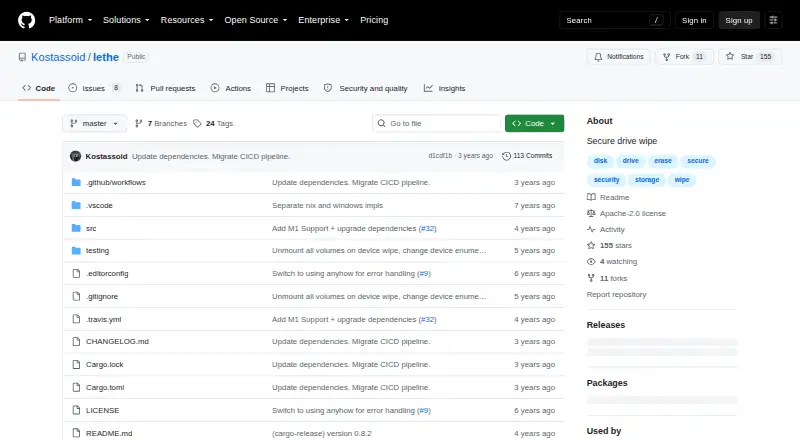
What Lethe is
Lethe is a free, open-source command-line utility for wiping drives on Linux, macOS, and Windows. It overwrites existing data with randomly generated data or a static pattern, and can read back data to check whether write commands succeeded. The project says it should work with HDDs, SSDs subject to limitations, and flash drives. Lethe requires root or administrator access to operate on real drives. It uses a fast cryptographic random generator and allows users to override the operating system’s recommended block size. It can track and automatically skip bad blocks and other localized errors, though this capability is marked experimental. The repository provides binaries for Windows x86-64, Intel macOS, experimental Apple macOS, and Linux x86-64, and documents installation from Rust sources. The project warns that SSD wear leveling and compression make it impossible for its current approach to reliably wipe all data. Other stated limits are a maximum of 4,294,967,296 blocks per device and no testing on RAID storage. Initial active development is complete, though occasional changes may still occur.
Good
- Can verify writes by reading data back.
- Works with HDDs and flash drives, according to the project.
- Offers random-data and static-pattern overwriting.
- Binaries are listed for Windows, macOS, and Linux.
Watch out
- Requires root or administrator access on real drives.
- Current approach cannot reliably wipe all SSD data.
- Bad-block handling is experimental.
- Not tested on RAID storage.
Who it suits
Lethe suits users who can operate a command-line drive-wiping tool with root or administrator access. Its SSD and RAID limitations matter when choosing it for those storage types.
Verdict
Lethe offers drive overwriting with read-back verification and support for several drive types. Its SSD warning and untested RAID status are important limits to consider before use.
Plans and prices
From Lethe's own pricing page, checked 14 Oct 2026.
| Plan | Price | What it gives you |
|---|---|---|
| Free | Free | CLI utility · requires administrator/root access for real drives · Free and open source |
The facts
Each one read from Lethe's own pages, with the date it was checked.
What it does
- Bad-block handling
- An experimental mode tracks and skips bad blocks and other localized errors automatically.checked 14 Oct 2026
- Benchmark result
- On a 2015 MacBook Pro with macOS 10.14.4 and a 64 GB USB flash drive, the README records Lethe random fill at 2,758.11 seconds versus dd at 4,546.48 seconds in the shown test.checked 14 Oct 2026
- Block-size control
- Users can override the operating system's recommended block size to potentially improve speed.checked 14 Oct 2026
- Capacity limit
- A device is limited to 4,294,967,296 blocks; with 1 MB blocks the stated maximum is 4096 TB.checked 14 Oct 2026
- Current release
- The repository identifies v0.8.2 as the current release.checked 14 Oct 2026
- Development status
- The maker describes initial active development as complete, with occasional changes and no exact roadmap.checked 14 Oct 2026
- Download options
- The repository provides binaries for Windows x86-64, Intel macOS, Apple macOS marked experimental, and Linux x86-64, and also documents installation from Rust sources.checked 8 Oct 2026
- Downloads
- Release archives are offered for Windows x86-64, macOS Intel, experimental Apple Silicon, and Linux x86-64.checked 14 Oct 2026
- Error handling
- It can track and automatically skip bad blocks and other localized errors, a feature marked experimental.checked 8 Oct 2026
- Historical missing feature
- The Docs.rs documentation states that Secure Erase was not supported in Lethe 0.2.2 and recommends additional native Secure Erase where possible.checked 14 Oct 2026
- Historical package documentation
- Docs.rs describes Lethe 0.2.2 as a free, cross-platform, open-source drive-wiping utility and exposes its Rust source documentation.checked 14 Oct 2026
- Independent package version
- MyNixOS lists Lethe version 0.8.2, Apache-2.0 licensing, one executable, and marks it neither broken, insecure, unfree, nor unsupported.checked 14 Oct 2026
- Interface
- Lethe is a command-line interface with general and command-specific help commands.checked 14 Oct 2026
- Interface and access
- Lethe is a command-line tool that requires root or administrator access to operate on real drives.checked 8 Oct 2026
- Licence
- The repository states that Lethe is licensed under Apache License 2.0.checked 14 Oct 2026
- License
- Lethe is licensed under the Apache License, Version 2.0.checked 8 Oct 2026
- Limit: drive wear
- The guide warns that multi-pass VSITR and badblocks operations perform intense passes that increase drive wear.checked 14 Oct 2026
- Limit: long operations
- The independent guide says wiping can take several hours depending on drive size and selected method.checked 14 Oct 2026
- Limit: privilege UX
- An open issue says the application only notifies users when it lacks elevation instead of requesting elevation automatically through a manifest.checked 14 Oct 2026
- Limit: verification failure
- A Windows 10 user reported that two random-fill passes on a 1.8 TB Seagate HDD completed writing but repeatedly failed verification.checked 14 Oct 2026
- Maintenance and support
- The maker says initial active development is complete, changes may still be made occasionally, there is no exact roadmap, and users can report issues.checked 8 Oct 2026
Where it runs
- Independent package platforms
- MyNixOS lists package targets across Darwin, Linux, BSD variants, Solaris, WASI, Redox, and Windows architectures.checked 14 Oct 2026
- Linux support
- Linux x86-64 binaries are provided.checked 14 Oct 2026
- macOS support
- macOS is supported, with Intel and experimental Apple Silicon binaries published.checked 14 Oct 2026
The full review of Lethe
Lethe is a free, open-source command-line utility for overwriting disks and removable media on Linux, macOS, and Windows. It suits technically confident users who can work with administrative privileges and want a straightforward wiping tool without a purchase. The decisive buying question is whether its verification and cross-platform access outweigh the limits of its SSD approach and untested RAID status.
Overview
Lethe replaces existing data with either randomly generated data or a static pattern, then can read data back to check whether write commands succeeded. That combination is useful when you need a direct, auditable check of write operations rather than a simple progress indicator. Verification is basic, however, so it should not be treated as proof that every underlying storage cell has been erased.
The utility is open source under the Apache License, Version 2.0. Its maker describes initial active development as complete; occasional changes may still arrive, there is no exact roadmap, and users can report issues. That maintenance posture is reasonable for a focused utility, but organizations needing a defined support cycle or predictable feature schedule should look elsewhere.
Key features
Patterns and verification
You can choose random data or a static pattern for the overwrite pass. A fast cryptographic random generator is intended to keep random-pattern jobs moving, while read-back verification checks that the device accepted the writes. This is a sensible setup for HDDs and flash drives where overwrite behavior is more predictable than on modern SSDs.
Block control and error handling
Lethe allows you to override the operating system's recommended block size. Experienced operators can use that control when balancing throughput against device behavior, though it also creates another setting that must be chosen carefully. The program can track bad blocks and automatically skip localized errors, but this handling is experimental; it should not be the deciding safety mechanism for high-consequence erasure work.
Access model
There is no graphical workflow. Lethe runs in a command-line environment and requires root or administrator access to operate on real drives.
Pricing
Lethe has one Free plan at no cost. It includes the drive-wiping utility and carries no paid upgrade, seat charge, or trial decision. The trade-off is the command-line interface and the need to manage administrative access yourself; there is no paid edition offering a different operating model or broader assurance.
Platforms
Lethe runs on Linux, macOS, and Windows. The project provides binaries for Windows x86-64, Intel macOS, and Linux x86-64. An Apple macOS build is marked experimental, so Apple-silicon users should regard that route as less established. Installation from Rust sources is also documented for users who prefer to build it themselves.
Disk wiping and removable media are supported. The project says HDDs should work, SSDs are subject to limitations, and flash drives are supported. SSD wear leveling and compression mean the current method cannot reliably wipe all data on an SSD, making Lethe unsuitable when complete SSD sanitization is the requirement. The maximum device size is 4,294,967,296 blocks, and RAID storage has not been tested.
Who it's for
Choose Lethe if you are comfortable identifying the correct device at a shell, can obtain root or administrator privileges, and need a free cross-platform utility for overwriting HDDs or removable media with read-back checks. Its pattern choice, block-size override, and script-friendly command-line design favor administrators and technically experienced individuals.
Do not make it your first choice for SSD disposal, untested RAID arrays, or jobs where experimental bad-block handling and basic verification are insufficient. A graphical workflow or formal commercial support also points toward another product.
Pros and cons
Pros
- Free and open source: the complete utility costs 0.00 USD, with Apache License 2.0 terms.
- Cross-platform reach: Linux, macOS, and Windows builds cover common desktop environments.
- Read-back checking: verification confirms whether write commands succeeded instead of relying only on completion status.
- Operator control: random or static patterns and an overridable block size suit experienced workflows.
- Removable-media support: useful for wiping flash drives as well as disks.
Cons
- Not reliable for complete SSD erasure: wear leveling and compression can leave data beyond the overwrite path.
- Command line with elevated access: mistakes in device selection are a user-managed risk, and there is no graphical guidance.
- Experimental error skipping: bad-block handling is not a firm assurance for critical jobs.
- RAID is untested: arrays fall outside a validated use case.
- Uneven macOS availability: the Apple macOS binary is experimental, and the maximum block count constrains very large devices.
Alternatives
For a broader directory of disk-erasure tools, see Disk Wiping Software.
Active@ KillDisk is the better direction when you want a freemium product with paid Personal Professional and Personal Suite licenses rather than a wholly free utility.
Pick DriveWipe when a free Windows, macOS, and Linux option for personal, hobby, and commercial use is preferable.
HDShredder suits users who want a freemium Windows/Linux tool with a private-use Free Edition and paid editions for additional capabilities.
Choose nwipe when Linux-only deployment and a command-line plus ncurses interface fit your workflow.
Overwrite is the macOS-only alternative, with a free Preview plan and a paid Annual Pro tier.
WipeOS is an alternative spanning Android, iOS, desktop, web, API, extension, and self-hosted platforms.
Strix Disk Cleaner is a free, MIT-licensed option for Windows and Linux.
Choose BitRaser Drive Eraser when a paid, freemium service with per-drive licensing and a trial is more appropriate.
Verdict
Lethe is a strong fit for technically capable users who need free, open-source overwriting of HDDs or removable media across major desktop platforms, especially when read-back verification matters. Its command-line workflow and adjustable write behavior are practical strengths. Look elsewhere for dependable complete SSD sanitization, validated RAID support, experimental-macOS confidence, or a guided graphical and commercially supported process.
Alternatives to Lethe
- 1
Active@ KillDisk
Free planLinuxmacOSWindows7.6$64.95 one-time - 2
DriveWipe
Free planOpen sourceLinuxmacOSSelf-hostedWindows7.3Free plan - 3

BitRaser Drive Eraser
WebLinuxmacOSWindows7.2$99 one-time - 4
Strix Disk Cleaner
Free planOpen sourceLinuxWindows7.1Free plan - 5
ShredIt
AndroidiOSmacOSWindows6.9$24.95 one-time - 6
HDShredder
Free planLinuxSelf-hostedWindows6.8€19.90 one-time