LabXchange
LabXchange is a digital science education platform created at Harvard University with support from the Amgen Foundation.
What LabXchange is
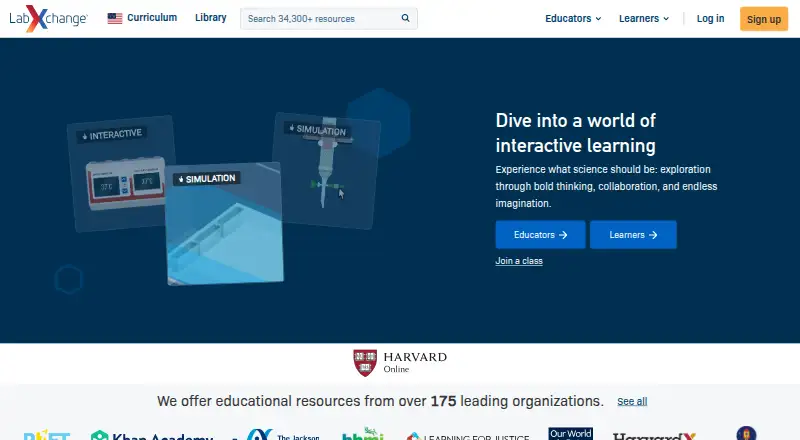
LabXchange is a digital science education platform created at Harvard University with support from the Amgen Foundation. Learners and educators can assemble videos, assessments, and simulations into customized learning journeys. Its free resource library includes virtual experiments, interactive materials, worksheets, lesson plans, and educator resources; some simulations offer a virtual notebook with background information. Educators can create private classes, share material, and track learner progress. Public content can be shared through Google Classroom, Facebook, Twitter, Pinterest, or a direct link. LabXchange says it is ad-free, does not sell student data or use it commercially, and stores student data on U.S. servers. It also says its security practices follow the NIST Cybersecurity Framework. Users can register directly or through third-party sign-on services such as Google or Facebook, and support requests can be sent through a form. The service is intended for organizations and people aged 13 or older. Use of LabXchange does not provide academic credit from Harvard University.
Good
- Free science resources include simulations and worksheets
- Educators can create classes and track learner progress
- Public content can be shared through several channels
- Platform is ad-free
- Student data is not sold or used commercially
Watch out
- Intended for people aged 13 or older
- Use does not provide Harvard University academic credit
- Student data is stored on U.S. servers
Who it suits
LabXchange suits learners and educators looking for free science resources, simulations, and guided learning materials. Educators who want to create private classes and follow learner progress may also find its tools relevant.
Verdict
LabXchange brings science resources, simulations, and class tools together in a free education platform. Its age eligibility, U.S. data storage, and lack of academic credit are worth noting.
Plans and prices
From LabXchange's own pricing page, checked 2 Oct 2026.
| Plan | Price | What it gives you |
|---|---|---|
| Free | Free | High-quality educational resources for learners and educators worldwide; platform supported by grant funding |
The facts
Each one read from LabXchange's own pages, with the date it was checked.
What it does
- Academic credit
- Using LabXchange does not provide academic credit from Harvard University.checked 2 Oct 2026
- Content library
- The platform provides free science learning resources, including simulations, interactives, worksheets, lesson plans, and educator resources.checked 2 Oct 2026
- Educator tools
- Educators can create private classes, share content, and track learner progress.checked 2 Oct 2026
- Eligibility
- The Terms of Service state that the services are intended for organizations and people aged 13 or older.checked 2 Oct 2026
- Integrations
- Public content can be shared through Google Classroom, Facebook, Twitter, Pinterest, or a direct link.checked 2 Oct 2026
- Learning paths
- Learners and educators can combine videos, assessments, and simulations into customized learning journeys.checked 2 Oct 2026
- Privacy
- The privacy notice says users may register directly or through third-party sign-on services such as Google or Facebook.checked 2 Oct 2026
- Purpose
- LabXchange is a digital science education platform created at Harvard University with support from the Amgen Foundation.checked 2 Oct 2026
- Security
- LabXchange says its security practices follow the NIST Cybersecurity Framework and that student data is stored on U.S. servers.checked 2 Oct 2026
- Student data
- LabXchange says it does not sell student data or use it for commercial purposes, and that the platform is ad-free.checked 2 Oct 2026
- Support
- Users can contact support through a form, and the site says a support staff member will respond as soon as possible.checked 2 Oct 2026
- Virtual labs
- Its simulations provide virtual environments for working through experiments, and some include a virtual notebook with background information.checked 2 Oct 2026
The full review of LabXchange
LabXchange is a free science-learning platform developed at Harvard University with support from the Amgen Foundation. It suits learners and educators who want to build lessons from science resources and simulations, with class tools for tracking progress. It is a strong no-cost option for guided science learning, but it is not a source of Harvard academic credit.
Overview
LabXchange brings together a library of science materials and tools for shaping them into learning journeys. Learners and educators can combine videos, assessments, and simulations, while educators can create private classes, share content, and follow learner progress. That combination makes the platform more useful for structured teaching than a resource library alone.
The resources span multiple science subjects and include simulations, interactives, worksheets, lesson plans, and educator materials. Public content can be shared through Google Classroom, Facebook, Twitter, Pinterest, or a direct link. Users may register directly or through third-party sign-on services such as Google or Facebook.
Key features
Learning paths and virtual labs
Customizable paths let learners and educators assemble videos, assessments, and simulations around a learning goal. Virtual labs offer a place to work through experiments; some add a notebook with background information. The variety supports both guided study and classroom use, though the notebook is not part of every simulation.
Educator tools
Private classes, content sharing, and learner-progress tracking give educators a way to organize study and monitor participation. These tools are a practical advantage for teaching groups, while individual learners may have less reason to use the classroom features.
Privacy and eligibility
LabXchange says it follows the NIST Cybersecurity Framework, stores student data on U.S. servers, does not sell student data or use it commercially, and keeps the platform ad-free. Its Terms of Service set eligibility at age 13 or older, so it is not intended for younger children. Support is available through a contact form, with staff responding as soon as possible.
Pricing
Free — free. The free plan offers educational resources for learners and educators worldwide and is supported by grant funding. With no paid tier to weigh against it, LabXchange is a straightforward option for schools and learners seeking science materials and class tools without a subscription cost. Use of the platform does not provide academic credit from Harvard University.
Platforms
LabXchange supports Windows 10+, macOS 12+, ChromeOS, and the Chrome, Edge, and Safari browsers, as well as mobile browsers. The platform is listed for Windows, macOS, and web; mobile access is through browsers.
Who it's for
LabXchange is best suited to learners and educators who want free, multi-subject science resources, interactive simulations, guided lessons, and assessment tools in one platform. Educators who need private classes and progress tracking have a particular reason to choose it. It is a poor fit for anyone under 13 or seeking academic credit from Harvard.
Pros and cons
- Pros: Free access combines simulations, worksheets, interactives, lesson plans, and educator resources, giving learners and teachers material for varied science study without a subscription.
- Pros: Private classes and progress tracking make the platform more useful for organized teaching than a library of standalone resources.
- Pros: The platform says it is ad-free and does not sell student data or use it commercially, which may matter to educators choosing digital learning tools.
- Cons: Eligibility starts at age 13, ruling it out for younger students.
- Cons: LabXchange does not confer Harvard academic credit, so it cannot substitute for credit-bearing study.
- Cons: Only some virtual labs include a notebook with background information, so that extra guidance is not consistent across simulations.
Alternatives
For educators focused on life-science classroom resources and professional learning, HHMI BioInteractive is also free and works on the web and Windows.
BioDigital Human is worth considering for anatomy and physiology in 3D: its free Personal plan includes 10 in-app model views per month, five saved models, and access to more than 500 models.
3D Organon is an alternative for anatomy learning, with a free Guest option and a paid Student subscription.
PraxiLabs offers a one-month free plan with access to three simulations, making it an option for readers who want a time-limited trial of virtual labs.
Biology Labs Online is a free web option centered on 12 interactive biology simulations and exercises.
Case It! is free for educational use and is another option for readers evaluating science-learning software.
BioMan Biology offers interactive games, virtual labs, and learning activities in an ad-supported free version, while its paid teacher plan is ad-free.
StarGenetics is another free option, accessible on the web or through downloads for Linux, Windows, and Mac.
Browse more options in Biology Learning Software, Virtual Lab Software, and Science Learning Software.
Verdict
Choose LabXchange if you want a free, flexible collection of science learning materials with simulations and practical tools for educators to organize classes and track progress. Its strongest case is breadth without a subscription; look elsewhere if you need a platform for under-13 learners or expect Harvard academic credit.
Alternatives to LabXchange
- 1

3D Organon
Free planAndroidiOSWebmacOS8.2From $74.50 a year - 2
PraxiLabs
Free planAndroidiOSWeb8.1From $29.99 a year - 3

BioMan Biology
Free planiOSWeb7.6From $49 a year - 4
StarGenetics
Free planWebLinuxmacOSWindows7.1Free plan - 5

Anatomyka
AndroidiOSmacOSWindows6.9From €47.80 a year - 6

BioDigital Human
Free planAndroidiOSWeb6.9Free plan