StarGenetics
StarGenetics is a simulator for Mendelian genetics crosses, designed to teach genetics concepts and experimental design.
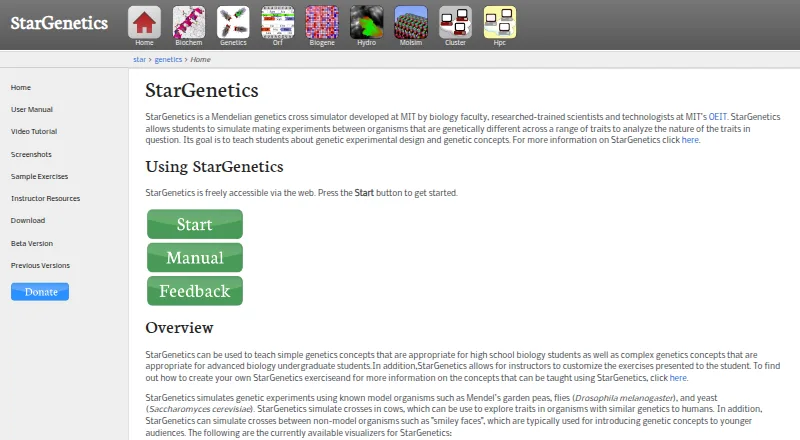
What StarGenetics is
StarGenetics is a simulator for Mendelian genetics crosses, designed to teach genetics concepts and experimental design. Its stated audience ranges from high school biology to advanced undergraduate biology. Students can use visualizers for cows, fish, flies, peas, a smiley face, and yeast. Instructor materials cover genetic crosses, Punnett squares, complementation, epistasis, gene linkage and mapping, and tetrad analysis.
Instructors can customize exercises with Excel workbooks in XLS format. The Punnett Square tool summarizes expected genotypic distributions for monohybrid and dihybrid crosses. Fly mating results can be examined one by one, sorted by sex and phenotype, or summarized by phenotype. DNA markers for genetic mapping are available in the Fly and Fish visualizers. Experiments can be saved to a file and reopened later, while Excel export is limited to Fly exercises. MIT recommends Java Web Start and provides operating-system downloads for people with limited internet connectivity. StarGenetics is free to access through the web and is also downloadable for Linux, Windows, and Mac.
Good
- Covers several genetics concepts, including epistasis and mapping
- Offers visualizers for six organisms or models
- Instructors can customize exercises with XLS workbooks
- Experiments can be saved and reopened
Watch out
- Excel export is available for Fly exercises only
- DNA marker mapping is limited to Fly and Fish visualizers
- Custom exercises use Excel workbooks in XLS format
Who it suits
StarGenetics suits biology students from high school through advanced undergraduate courses, as well as instructors creating genetics exercises. Its visualizers and teaching topics support work on genetic crosses and mapping.
Verdict
StarGenetics offers a free way to explore genetics crosses with several visualizers and instructor-customized exercises. Note that Excel export is restricted to Fly exercises, and marker-based mapping is limited to two visualizers.
Plans and prices
From StarGenetics's own pricing page, checked 15 Oct 2026.
| Plan | Price | What it gives you |
|---|---|---|
| Free | Free | Web access · downloadable Linux, Windows and macOS versions · no paid tiers listed |
| StarGenetics | Free | Freely accessible via the web; downloadable Linux, Windows, and Mac versions |
The facts
Each one read from StarGenetics's own pages, with the date it was checked.
What it does
- Audience
- The site describes use for high school biology through advanced undergraduate biology.checked 29 Sep 2026
- Connectivity
- MIT recommends Java Web Start and offers operating-system downloads for users with limited internet connectivity.checked 29 Sep 2026
- Custom exercises
- Instructors can create exercises by editing Excel 97-2004 workbooks that define organisms, genotypes, phenotypes and gene interactions.checked 15 Oct 2026
- Data export
- Excel export is available only for fly exercises.checked 15 Oct 2026
- DNA markers
- DNA-marker functionality is provided for the fly and fish visualizers.checked 15 Oct 2026
- Documentation depth
- The official manual documents setup, crosses, Punnett squares, yeast workflows, saving, exporting and feedback procedures.checked 15 Oct 2026
- Experiment analysis
- Fly mating results can be viewed individually, sorted by sex and phenotype, or summarized by phenotype.checked 29 Sep 2026
- Feedback support
- The application includes a form for bug reports, feature requests, comments and questions.checked 15 Oct 2026
- Genetics coverage
- Instructor materials list dominance, codominance, incomplete dominance, sex linkage, epistasis, linked genes, mapping, regulatory pathways, chi-square and tetrad analysis.checked 15 Oct 2026
- Genetics topics
- Instructor resources list concepts including genetic crosses, Punnett squares, complementation, epistasis, gene linkage and mapping, and tetrad analysis.checked 29 Sep 2026
- Independent classroom use
- A Maryknoll School lab handout says instructors selected StarGenetics for a multi-week fruit-fly exercise sequence.checked 15 Oct 2026
- Independent curriculum use
- A Universitat de València assignment uses StarGenetics to analyze autosomal, sex-linked, dominant, recessive, multi-locus and epistatic inheritance and recombination frequencies.checked 15 Oct 2026
- Independent learning outcomes
- The same handout uses StarGenetics to teach phenotype identification, dominance, genotype assignment, zygosity, Punnett-square ratios and sample-size effects.checked 15 Oct 2026
- Independent research use
- A Portuguese master's dissertation describes StarGenetics as a virtual laboratory for teaching heredity with Drosophila.checked 15 Oct 2026
- Independent software description
- MERLOT categorizes StarGenetics as a Java simulation for high-school and college genetics instruction and lists no mobile compatibility.checked 15 Oct 2026
- Integrations
- The documented extension point is Excel workbook authoring; no web-service integrations are described.checked 15 Oct 2026
- Licence status
- MERLOT lists the source code as unavailable and Creative Commons licensing as unavailable, so the application is not presented there as open source.checked 15 Oct 2026
- Limit: Chromebook support
- The Maryknoll handout warns that Java programs do not run on Chromebooks.checked 15 Oct 2026
- Limit: expired certificate
- The University of Toronto 2025 course guide reports that newer Windows 11 and Mac computers can fail because the StarGenetics security certificate has expired.checked 15 Oct 2026
- Limit: inconsistent desktop operation
- The handout says the software usually works on Windows and Mac but occasionally does not.checked 15 Oct 2026
- Limit: manual counting in early version
- MERLOT's 2008 entry says its then-beta version produced 50 offspring and required users to count offspring themselves.checked 15 Oct 2026
- Mating experiments
- Users select two organisms or strains, mate them, and inspect individual, sorted or summarized progeny results.checked 15 Oct 2026
- Notable news
- MIT's OEIT page records first implementation in MIT Genetics 7.03 in spring 2009 and nearly 6,000 visits across 215 cities and 41 countries by fall 2009.checked 15 Oct 2026
- Offline installation
- MIT provides Web Start plus Linux, Windows, bundled-JRE Windows, offline high-school Windows and macOS downloads.checked 15 Oct 2026
The full review of StarGenetics
StarGenetics is a free Mendelian genetics simulator for planning and interpreting classroom crosses. It fits learners from high-school biology through advanced undergraduate work, plus instructors building their own activities. Its broad topic coverage and organism visualizers make it a capable teaching platform, while organism-specific analysis limits matter for spreadsheet-heavy or marker-mapping courses.
Overview
The software frames genetics as an experimental process rather than a set of static diagrams. Students can set up crosses, inspect outcomes, and connect observed phenotypes with expected inheritance patterns. Instructors can adapt exercises to a course through XLS workbooks, making the platform more useful for structured teaching than for casual exploration alone.
It is freely accessible through the web and as downloadable Linux, Windows, and Mac versions. MIT also recommends Java Web Start and operating-system downloads for users with limited internet connectivity, so it can remain practical in classrooms where a continuous connection is unreliable.
Key features
Six visualizers—cow, fish, fly, peas, smiley face, and yeast—give lessons different biological contexts without changing the basic simulation approach. Instructor resources span ordinary genetic crosses and Punnett squares, then extend to complementation, epistasis, gene linkage and mapping, and tetrad analysis. That progression supports both introductory inheritance units and more advanced genetics instruction.
The Punnett Square tool reports expected genotypic distributions for monohybrid and dihybrid crosses. It is useful for checking predictions against experimental results, though it is a summary tool rather than a replacement for a full investigation. Fly exercises provide the richest result inspection: mating outcomes can be viewed one by one, sorted by sex and phenotype, or summarized by phenotype. Those views help students move from individual observations to population-level patterns.
DNA-marker mapping is available in the Fly and Fish visualizers only. Classes using cows, peas, yeast, or the smiley face cannot apply that marker workflow within those visualizers. Likewise, Excel export works only with Fly exercises, so spreadsheet-based analysis across every organism is not possible.
Experiments can be saved to a file and reopened later, supporting multi-session assignments and instructor demonstrations. Custom exercises are built with XLS workbooks: that enables tailored problems, but instructors must be comfortable preparing material in that format. An in-app suggestions form accepts bug reports, feature requests, comments, and questions. The manual instructs users to click Trust when an application-certificate prompt appears; product pages make no security or compliance certification claims.
Pricing
| Plan | Price | What it includes |
|---|---|---|
| StarGenetics | free | Freely accessible via the web; downloadable Linux, Windows, and Mac versions |
There are no paid tiers, seat charges, quotas, trial periods, or renewal terms. That makes it suitable for students, teachers, and institutions that need a no-cost genetics simulator. The trade-off is not a reduced paid-plan feature set but the fixed scope of each visualizer: marker mapping and Excel export remain limited to Fly and Fish, and Fly alone supports Excel export.
Platforms
StarGenetics runs on Linux, macOS, the web, and Windows. The combination of browser access, downloadable desktop editions, and connectivity-conscious distribution suits mixed-device classrooms. It also offers virtual labs, biology simulations, assessment tools, and teacher tools, with a mixed primary learner level.
Who it's for
Choose it for high-school through advanced undergraduate biology courses covering inheritance, experimental design, or more specialized genetics topics. It is particularly appropriate when instructors want customizable exercises and when students benefit from comparing predicted distributions with simulated mating outcomes.
Look elsewhere if your curriculum requires marker-based mapping in many organisms, routine Excel export from every exercise, or a broader anatomy and life-science platform beyond genetics crosses.
Pros and cons
Pros
- Free on web and desktop: Linux, macOS, Windows, and browser access remove licensing barriers and support varied classroom hardware.
- Wide genetics scope: Topics run from Punnett squares to epistasis, linkage, mapping, and tetrad analysis.
- Six organism visualizers: Instructors can present inheritance concepts through several biological examples.
- Custom and reusable work: XLS-based exercises and save-and-reopen experiment files support tailored, multi-session teaching.
- Useful Fly analysis: Individual, sorted, and summarized mating results give students several ways to interpret data.
Cons
- Restricted export: Excel output is available only for Fly exercises.
- Restricted marker mapping: DNA markers are confined to Fly and Fish visualizers.
- XLS preparation required: Custom exercise authoring depends on that workbook format.
- Certificate prompt: The manual directs users to trust the application certificate, without stated security or compliance certification.
Alternatives
Virtual Genetics Lab II is the closest free alternative when you want genetics problems covering one to three genes on Linux, macOS, the web, and Windows.
Pick 3D Organon instead for interactive anatomy across Android, iOS, macOS, web, and Windows, with a free Guest plan and a Student plan at $74.50 a year.
Case It! suits educational users seeking a free simulation available on mobile, desktop, and web platforms.
Choose BioDigital Human for 3D anatomy models; its free Personal plan allows 10 model views per month and five saved models.
PraxiLabs is the better fit for browser-based virtual laboratory simulations, with a free one-month plan that includes three simulations.
BioMan Biology offers ad-supported interactive games, virtual labs, and learning activities, with a 49.00 USD-per-year ad-free Individual Teacher plan.
For broader free life-science classroom materials, consider HHMI BioInteractive or LabXchange.
Verdict
StarGenetics is a strong choice for biology educators and students who need a free, genetics-focused environment for crosses, predictions, and experimental design. Its organism range, advanced topic coverage, custom XLS exercises, and reusable experiment files give it unusual classroom flexibility at no cost. Look elsewhere when your workflow depends on Excel export beyond Fly or DNA-marker mapping beyond Fly and Fish, or when you need a wider virtual-lab or anatomy offering.
Alternatives to StarGenetics
- 1

3D Organon
Free planAndroidiOSWebmacOS8.2From $74.50 a year - 2
PraxiLabs
Free planAndroidiOSWeb8.1From $29.99 a year - 3

BioMan Biology
Free planiOSWeb7.6From $49 a year - 4

Anatomyka
AndroidiOSmacOSWindows6.9From €47.80 a year - 5

BioDigital Human
Free planAndroidiOSWeb6.9Free plan - 6
SimBio
WebmacOSWindows6.7$7.50 one-time